





Part of the Real Food Traveler philosophy is the willingness to at least consider, if not actually eat, a local food that may be outside your comfort zone when traveling. Being open to what’s commonplace to one culture and very unusual in another celebrates the differences between various cuisines – and the people who enjoy it. A polite “no thank you,” can get you out of certain situations. But giving something a try could just lead to a new favorite. We welcome writer and photographer Donnie Sexton to RealFoodTraveler.com with an article about discovering new delicacies in China.
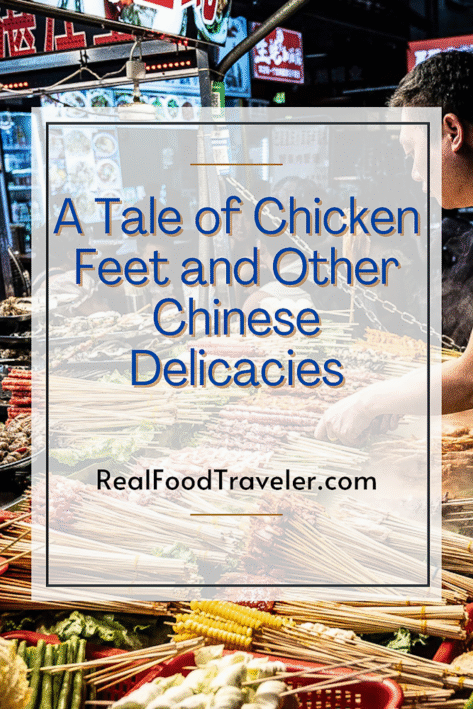
Save this article to Pinterest to learn about chicken feet and other Chinese delicacies. Photo: Night Market in Guilin by Donnie Sexton Graphic by RealFoodTraveler.com.
A Tale of Chicken Feet and Other Chinese Delicacies
I love chicken. Fried chicken, chicken salad, chicken and dumplings, chicken stew, honey garlic chicken bites, and chicken marsala are some of my favorite dishes.
However, I stop short of chicken feet. You read this right – chicken feet. We’re talking skin, cartilage, tendons, toenails, and bones. I’m told they are crunchy, gelatinous, rubbery, and bony. These unsightly little digits, a delicacy in China, seemed to be a staple while exploring southwest China. I was reminded that cultural differences extend to food.

The spectacular Longgji Rice Terraces in China have a history of more than 2300 years.
Ancient Rice Terraces
I had longed to photograph the ancient rice terraces of Yunnan and Guangxi, so when my dear friend David started kicking around the idea of a trip to explore the terraces, I was thrilled. I set to work helping to research potential stops, which included the Guilin Longji Rice Terraces and the Hani Rice Terraces, as well as the cities of Guilin, Yangshuo, and Kunming, all part of China’s southwest corner. We timed the trip for mid-September to see the terraces in golden hues, ready for harvest.
Bamboo Rice
The first stop on this memorable journey was the Longji terraces, situated high in the remote mountain area of Guilin Prefecture. We arrived close to sunset, but alas, there was no chance of glorious light, as low-hanging gray clouds signaled rain. Heading back to our lodging as the rain started, we found the lodge owner busy cooking bamboo rice over coals on an outdoor barbecue. Bamboo rice is a unique preparation of the grain found in this region. The locals take a mix of rice, water, and sometimes meat and fill a bamboo joint. They cover the mixture with banana leaves and then bake it over a charcoal fire until the bamboo turns black. It looked delicious, but when the bamboo joints were placed in the center of the table, my stomach did a flip-flop.
Giving Chicken Feet a Try
Chicken Feet
There, front and center, nestled into the rice, was a bulbous chicken foot, with its toenails removed, along with a few other digits. In a word, it was disgusting to see. We had four people from China on our trip, so they got right to work on the feet. Keep in mind that whoever chews on chicken feet must then spit them out, leaving yet another unpleasant item on the table. I’m sure you will get the picture.
This was just the start of a chicken feet trail, greeting us at almost every stop on the journey. The feet were prepared in every imaginable way, including fried, stewed, barbecued, braised, marinated, pickled, and even floating in soup. They appeared on hotel buffets, street food vendors, and of course, in local markets, where heaps of raw feet, toenails still attached, were available for purchase.

A bowl of steamed chicken feet, toenails removed, marinated in a sauce of spicy peppers and chilies.
Guilin’s Night Market
At our hotel in Guilin, a night market was located outside the back door. Local markets are a magnet for photographers, so we wasted no time in getting to the action. It was a family affair, with locals busy chatting, strolling, and enjoying their meals. Endless stalls were serving an array of skewers full of fried cicadas, crickets, and grasshoppers. Customers could also select skewers of raw meat, seafood, and, of course, chicken feet, to be grilled or steamed on site. Grilled tofu, tables of sweets, and fruity drinks were plentiful. I wasn’t brave enough to try anything, but I was thankful that I had filled up at the hotel’s buffet before heading out.
Hungry for more? Read about Taiwan’s Night Markets – Exciting, Daunting Culinary Immersions
Other Foods to Explore
Unusual Chinese Delicacies
The Chinese culture is one where no food is wasted. It was common to see fried fish or duck heads on the buffets, along with other strange dishes such as glue pudding, pig brain, salted duck eggs, and cubes of duck blood swimming in a blood broth. A whole chicken is prepared by a clever method that chops it into pieces, so you can expect to find bones and tendons in each serving. Fish are typically served whole, fried, or steamed with the heads on.
Mushroom Hot Pot
On a tastier note, one day we found ourselves at a Mushroom Hot Pot restaurant for lunch. Over 20 varieties of mushrooms were displayed in a glass case, allowing customers to pick and choose what they liked. The tables were circular, with a burner in the center where a large pot with seasoned broth was heated to a boil. Then the mushrooms of choice were added, simmered for 20 minutes, and then ladled into our bowls.
Beyond Chicken Feet
Lest you think I almost starved to death on this trip, there was a savory side to my exploration of China. Always present were bowls of noodles, sometimes made from wheat, rice, or mung beans, filled to the brim with vegetables or small pieces of pork, chicken, or beef. I was treated to Peking duck, featuring its crispy skin and breast meat, free of bones. Tofu was always an option, and in fact, we peeked in on a tofu factory, watching locals skillfully fashion little squares of bean curd with lightning speed. Steamed vegetables were abundant, as was fresh fruit. Pork-filled wontons, wonton soup, and steamed pork buns were some of my favorites. As expected, rice was plentiful and a staple of every meal, including fried rice with bits of egg, vegetables, and sometimes small pieces of pork, steamed rice, rice pudding, and congee (rice porridge, usually served at breakfast).
Hungry for more? Learn About Eating Bugs in Cambodia.
History of Rice Terraces
Our exploration of the rice terraces brought about a new appreciation for this grain. The Longji terraces date back approximately 2,300 years, having been cultivated by the Zhuang and Yao people. Over time, the rice fields were meticulously woven into the mountainous landscape, creating undulating fields of green that were peppered with villages and forests. The timing proved to be too early to see the Longji fields turning yellow and ready for harvest.
Hani Rice Fields
A second exploration of the Hani rice terraced fields led us to observe landscapes dating back 1,300 years. To water their fields, the Hani people created a system of channels that bring water down from the forested mountains, not only for the fields but also for the use of their villages. The locals pride themselves on utilizing four interconnected components – the forest, village, terraces, and water- to sustain their way of life. In 2013, the Hani Terraced Fields were inscribed on UNESCO’s World Heritage List.
My culinary tale of China can be summed up in this amusing Chinese proverb: “The Chinese eat everything with four legs, except tables, and everything that flies, except airplanes.”
-Story and photos by Donnie Sexton
Use our link from Expedia.com to select a hotel in Guilin.
This site uses an affiliate tool provided by the third-party provider Stay22. If you use certain affiliate links to make a booking or take advantage of an offer, I may receive an affiliate commission from this third-party provider. To determine whether you have used any of the affiliate solutions, the third-party provider will use cookies to attribute commission. These cookies will be removed as soon as they have served this purpose.






0 Comments