





The pub culture in England includes a special kind of beer, “Real Ale.” Writer Rich Grant provides RealFoodTraveler.com readers with this handy guide in how to thoroughly enjoy the experience of Real Ale pubs just like the locals do.

Save this article to Pinterest and let it be your guide to experiencing Real Ales. Photos by Rich Grant. Graphic by RealFoodTraveler.com.
England in a Glass: Real Ale Pubs
I was leafing through a magazine when I came upon an article with an ominous title: “Ten Ways to Tell if You’re an Alcoholic.”
Number one was: “You can remember with pleasure the first time you had a beer.”
Ouch. That was close enough to make me follow Henny Youngman’s advice. He said, “When I read about the dangers of drinking, I gave up reading.”

The author, Rich Grant.
I put the magazine down and remembered the strange feelings I had the first time I tasted a real beer. Of course, I’d drunk hundreds of American beers in high school and thousands in college, but it was in a long-forgotten pub three decades ago, somewhere in Chelsea, London, that I had my first taste of real beer.
It was a brutally hot day for London, and I’d walked ten miles, finally entering into the cool darkness of a pub with half-timbered walls and a long row of attractive wood beer handles behind the bar, each wrapped with a metal shield stating the beer name. A bright red, white and blue nameplate with the title “Bombardier Best Bitter” caught my eye, and being a novice, I ordered a pint.
The beer I was served came as a shock. The barman pulled the handle numerous times to draw out a copper-colored liquid with little carbonation, the beer climbing flat to the rim of the glass with just a smear of head. It was warm to the touch, and when I tasted it – I being hot, tired, and thirsty – it was awful beyond description. It was as if someone had taken a tea bag, filled it with barley, and dunk it for an hour or so in warm water. I looked around. Was someone pulling my leg? Was this a joke on the Yank? No. Everyone in the room was drinking the stuff.
How could I know that I was soon to fall in love with this strange English beverage and desire it above any other drink I have known?
It’s called real ale or cask conditioned beer. Unlike most every other beer, it is made without adding carbonation. No CO2 gas, like most beers, has been added, nor nitrous gas like Guinness. Instead, the yeast in the cask allows the beer to continue fermenting, creating natural carbonation that is much less “fizzy” than regular beers when it is “pulled” from the cask by suction. It is a 200-year-old craft product that is slowly being replaced, even in English pubs, by more familiar English, American and European carbonated beers. But thanks to the Campaign for Real Ale founded in 1971, there is a strong movement to keep it alive.
Now real English beer is not actually served warm, but rather at “cellar temperature.” So, in July, on a sweltering day, the cellars where the beer is stored will be warm. And so will be the beer.
But for the most part, England is a cold place with an often-disagreeable climate, so most pubs are designed to be cozy with stout walls and roaring fires to keep out the damp and chill. And the cellars? Well, on a cold day, they are just fine at 45 degrees, keeping a perfect temperature around their casks of real ale in the basement, just waiting to be drawn by hand pump (since there is no added gas to force the liquid from the keg, you must “pull” the beer up from the cask by suction – hence the term, draught beer).

Cask conditioned ales are pumped.
Hungry for more? Read Rich’s article about where and what George Washington drank.
A Hundred Mistresses
I can’t say I liked my first real ale, or even the first few. But on a later visit to England, on a bitter, gray, mid-December day, my brother and I were walking around the old town of Bath in the late afternoon. Which is to say, twilight. Winter darkness comes early in England, and this being the holidays and a Saturday, the town was filled with shoppers, scurrying past back-lit shops in Victorian buildings, the windows stuffed with decorations and wonderful things to buy. Just when it couldn’t get any better, the church bells started ringing. Not one, but a half dozen steeples, each ringing out a different holiday melody, the bells pulled by ropes in a cadence to tunes hundreds of years old.
There was nothing to be done but to pop into a pub with a fire, filled with patrons and good cheer, and order…what? Yes! There was the same Bombardier Best Bitter. Why not? It looked flat, exactly like the first one I’d had in London years before, but I’d being lying if I didn’t say in this setting and temperature and sounds, it was suddenly the best thing I have ever tasted in my life – articles about alcoholics be damned! I will always remember that beer with fondness. It was England in a glass.
That was 30 years ago. I’ve had a hundred different English bitter mistresses since then. Some great, some fantastic, and some just okay. Fresh beer needs to be fresh. Imagine walking into a Paris bakery and there are hot croissants coming out of the oven with espresso steaming in the corner, compared to a supermarket bakery with packaged bread wrapped in plastic sitting on a shelf. So it is with real beer. When you happen on a fresh barrel being served in the right pub at the right cellar temperature – it can be life changing.
But to genuinely enjoy a real beer in Britain requires all the senses. So here are some rules that I set forth:
Rules for Enjoying Real Beer in Great Britain
Obviously, go to a pub. There are dozens and dozens of exciting-looking cans and bottles of British beers in bottle shops, but remember, you don’t go to France to buy bread and pastries in a supermarket. Only drink beer in pubs. They are the “bakeries of beer.” The Campaign for Real Ale site will help you understand cask conditioned ales and find the best pubs to enjoy them.
Know your limits and plan accordingly. Despite looking “heavy,” real British beer is remarkably low in alcohol – about 4%, roughly, the same as American beers like Coors. The adjective “Best” is added to beer (mostly called “bitter”) that has more alcohol, but even “best bitters” have about the same alcohol as normal American beers. My brother and I figure, starting at noon, with walks between villages and pubs, we can average about six to eight pints a day before traditional closing at 11pm. That’s nothing exceptional. Ask any barman. They’ll tell you, “Oh, most of the lads in a day will have six to ten pints. Some will have 14. You notice a difference at 14.” We were always on the lookout for “Fourteeners.” They’re gentle souls, often in a corner sitting by themselves. Still, it’s best not to anger them or make any loud noises nearby.

Nags Head McMullen serves real ale in England.
Accepting the fact that you have only six pints a day (maybe much less depending on your stamina), don’t waste them! There are thousands of pubs, but as a tourist, you have only limited access to six pubs a day, so each stop must be “pub worthy.” Never waste a pint in a pub that does not meet your standards. Now, in London, there are mostly tourist pubs in tourist areas. We’ll deal with them shortly. But in the countryside, set some lofty standards:
- The pub must allow dogs.
- There can be no gambling machines, juke boxes, or canned music, things that can ruin many an otherwise fine-looking pub.
- The pub must have genuine cask conditioned, hand-pumped ales, of course.
- There must be a fireplace burning wood, peat, or, in an extreme case, at least gas.
- The word “gastropub” must never have been associated with the place.
- There is a possibility of live music.
- The pub is within walking, bus, or rail distance of your hotel or B&B.
- They have fried scampi on the menu, or at the very least, scampi chips. That’s a personal choice. Some may say fish and chips, or bangers and mash, or Shepard’s pie, or a Ploughman’s lunch. But some hideous traditional British dish must be on the menu.

A Ploughman’s Lunch is often served in English pubs.
- It must look like a pub. People have been buying alcoholic drinks in England for more than a thousand years at a variety of taverns, ale houses, coaching inns, and grog shops, but what we think of today as a typical English pub didn’t happen until 1830. In the 1700s, to counter distilled spirits imported from Ireland and Scotland, England encouraged distilling corn into gin with the result that Shakespeare’s “green and pleasant land” endured a century of drunkenness. In 1740, there were 9,000 gin shops in London alone. In 1830, to encourage more sensible drinking of beer instead of gin, the Duke of Wellington (of Waterloo fame) proposed that all taxes on beer be removed and for the price of two guineas anyone could brew and sell beer. Predictably, this had the opposite effect of what was intended and in one year, 30,000 beer shops opened.

The Shakespeare Greene King.


Because many of these first public houses were in the brewer’s home, many of these early “pubs” resembled living rooms, only they were much nicer than the places people lived with better lighting, more comfortable chairs, games like darts and, of course, beer, conversations, neighbors, music, gossip, and laughter. At a time when there was nothing much to do in the evening, the local pub became a great source of joy.
Today there are 26,442 pubs or bars in the U.K. In 2019, there were 47,200! With so much home entertainment possible, the idea of a public house is dwindling, so visit them while you can.
Hungry for more? Read Rich’s article about where to experience the Great Allied Invasion in Normandy.
The thing about drinking in England
An English pint is 20 ounces vs the American 12 ounce serving, so if you are mentally keeping track ordering “pints” versus beers by the number of glasses consumed, remember you will drink far more liquid in England. This can become exceedingly important when traveling between pubs. While there are more public restrooms in London than in the average American city, it can still be a long journey home after so much liquid, so plan accordingly.
Remember, of course, that you must go to the bar to order a beer in a pub. It may look chaotic at the bar, but just be patient and wait your turn – the barman or barmaid sees you. There is no table service in a real pub.
England has zero tolerance for drinking and driving, so don’t do it. You can travel from village to village on public walking paths, by local buses and by rail. My friend Mike Gerrard has written a book on how to visit the best London pubs by tube. There are numerous books on hiking or riding trains between pubs. For instance, it’s easy to take a train from Paddington Station in London for 90 minutes to Moreton-in-Marsh in the Cotswolds, where you can have a pint at the famous Bell Inn, catch a bus to lovely Stow-on-the-Wold for another beer, walk from here on a public foot path to Upper and Lower Slaughter for a streamside third pint, hike to Bourton-on-the-Water for a fourth, and on and on.
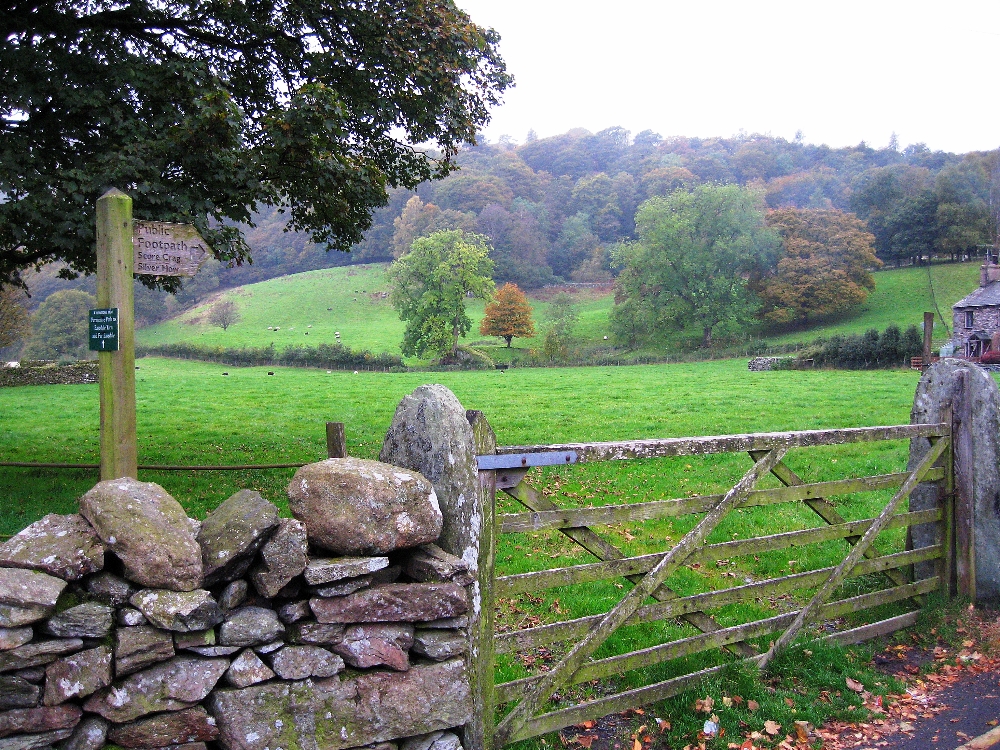
Take footpaths, sometimes in the countryside, to get between pubs.
Of course, everyone has opinions of which are the “best” pubs – but the truth is: if you follow the rules, the “best” pub will always be the one you are in and discovered for yourself.
-Story and photos by Rich Grant
Hungry for more? Nibble on recipes from Downton Abbey.
Please note: This article contains a link to Amazon.com. RealFoodTraveler.com is a participant in the Amazon Services LLC Associates Program, an affiliate advertising program designed to provide a means for sites to earn a small amount of advertising fees by linking to Amazon.com while providing convenience for the reader. This in no way affects the prices of any products you may purchase in conjunction with this link







0 Comments