





Whether in restaurants, homes, or from street vendors, visitors can experience a wealth of Cambodian cuisine in all of its varieties. Here, writer Yvette Cardozo recounts a trip she took several years ago.
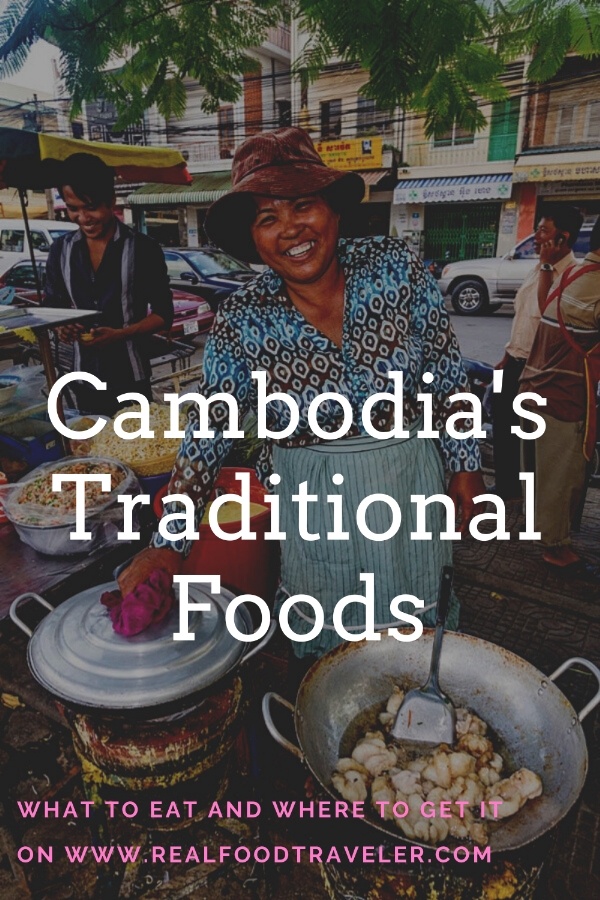
Woman on street cooks pork and shrimp for sale in Phnom Penh, and example of Cambodian cuisine.
Yes, Cambodians eat a lot of rice. In fact, there’s a Cambodian phrase which asks if you’ve eaten, but actually translates to “Have you yet eaten rice?” So expect a LOT of rice on a tour through Cambodia. Beyond that, Cambodian food is much like Thai, but nowhere near as hot. And a bit like Vietnamese, but heavier. The bottom line? If you aren’t sampling the local cuisine in Cambodia, you are missing one of the best parts of the trip.
The national dish is something called amok, which is a thick stew where curry paste is the binding ingredient. In addition, amok has either meat, fish or chicken, lime leaves, cabbage and coconut, usually served in a bowl lined with a banana leaf.
Each region, heck, each town, and, actually, each restaurant seems to have its own version. In Phnom Penh, we did what everyone does, went to the waterfront along the Mekong River, found a menu we liked, climbed to the restaurant’s second floor balcony and ordered, of course, amok.
The restaurant, Khmer Saravan, was latter-day hippie, with enthusiastic (very enthusiastic) comments scribbled in magic marker on construction paper lining the walls. We sat there in the city’s heated steaminess, fanning ourselves and sipping coffee smoothies between bites of the amok. A perfect city dinner. And a total bill, including three coffee drinks and the two bowls of amok, of about $10.
Cambodia is one of the last places on earth where the US dollar goes the distance. We ate in fancy hotels. We ate at street stalls. We ate at a private home. We ate sitting on a straw mat in a night market and best of all, we nibbled our way through sidewalk cafes in the country’s tourist mecca, Siem Reap.
Yes, we were careful about water. And thanks to the heat, we consumed an ocean of iced coffee, which in this part of the world is thick, chocolatey and comes with an inch of sweetened condensed milk on the bottom.
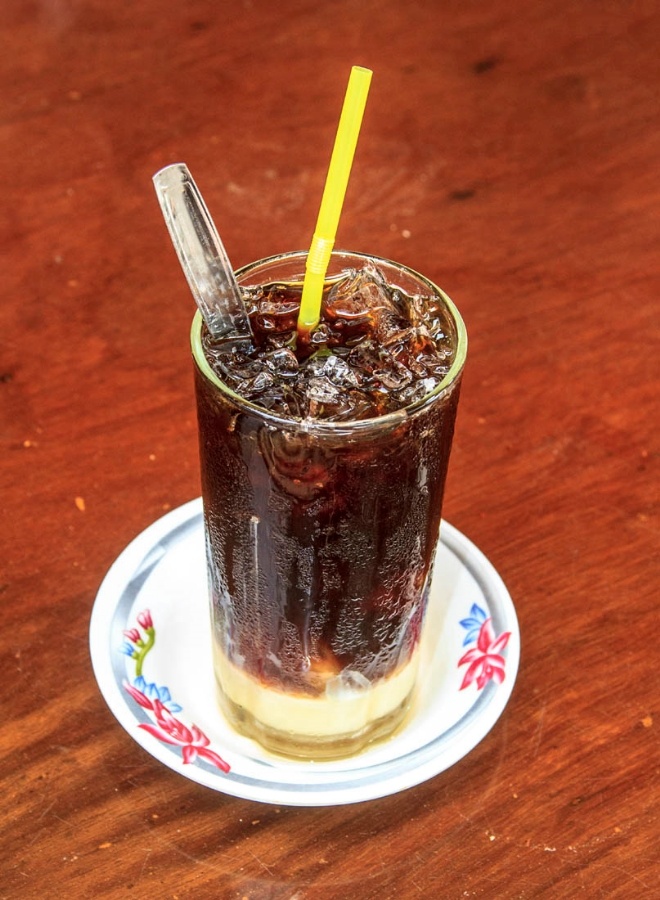
Iced coffee with sweetened condensed milk in the bottom is refreshing in Cambodia.
The trick to the ice is to ask if it’s clean. One way to tell is if the ice cubes are uniform. It usually means boiled or bottled water was used to make ice in trays. The other stuff is usually local water frozen into a block and chipped with a pick. So the ice comes in little shards. Sadly, we learned this the hard way. But back to the food…
At Phnom Penh’s night market, there was a welter of meats on a stick. We kicked off our shoes, settled onto one of the straw mats and chowed down on grilled pork and something (I still don’t know what) fried in a thin pastry.
The private home was on an island off Kratie called Koh Trong. This island is a slice of Cambodia’s rural past. There are no cars. People get around either by ox or horse cart, bicycle or, in a few cases, motorbikes. It was a great way to see how the majority of Cambodia lives outside cities.
And while our home stay wasn’t the private experience we expected (we wound up sharing it with a dozen French tourists, sleeping on thin mattresses all together in one huge room), dinner that night was divine – morning glory greens stir fried with chunks of pork, soup with chunks of fish and the local favorite fruit, pomelo, which looks like green grapefruit. They’re not as sweet nor as juicy, but in that climate, they are perfect.
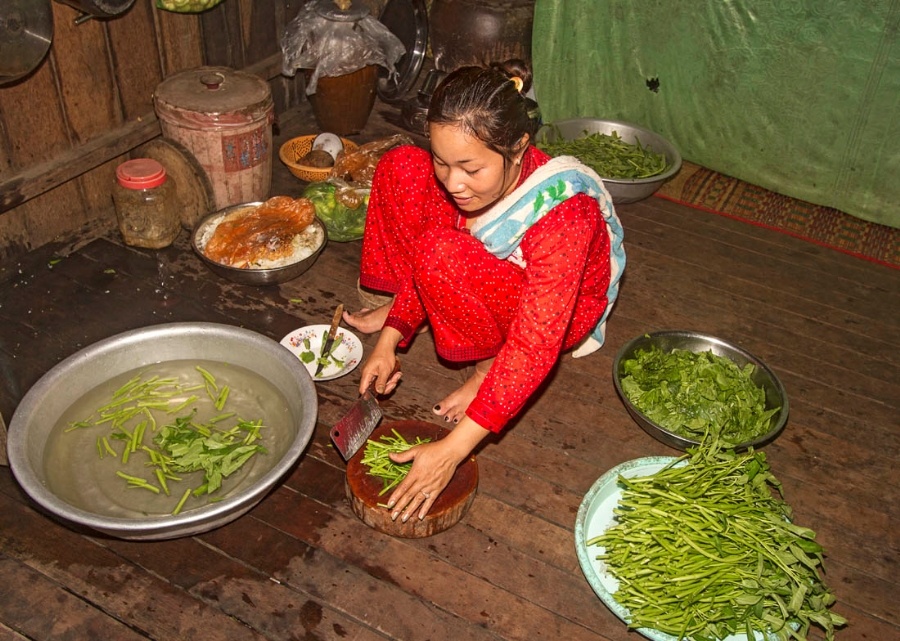
Young woman prepares morning glory stems and spinach for dinner on Koh Trong Island across the Mekong River from Kratie, Cambodia.
As we went on from place to place, we realized clear soups with a hint of lime and lots of vegetables seemed to work best in that heat. Light clear soup goes down easy and is tasty when it comes to Cambodian cuisine.
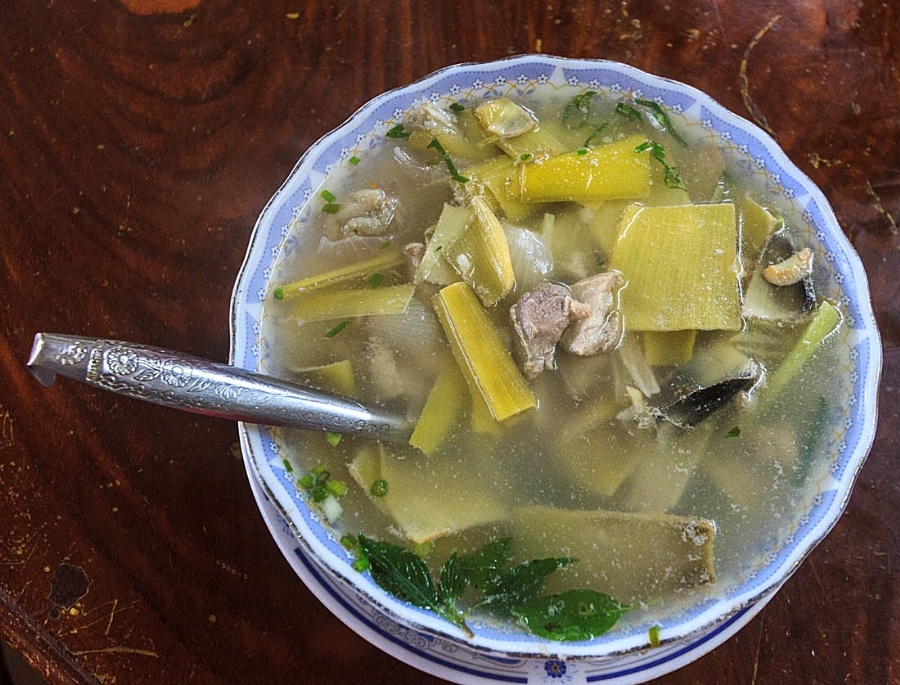
Clear soups made with vegetables are popular in Cambodia.
Um, yes, the heat. We carefully planned our trip for the alleged cool, dry season. But it turns out we were a month early, despite what Google and all the guide books said.
“You’ve heard of this global warming?” our guide asked. “Our weather hasn’t been right for five years.”
I didn’t think it was possible to sweat that much, but the country runs on bottled water. And so do all the visitors. I lost count after half a dozen by the middle of each day.
From the island, we made our way to Siem Reap, ground zero for Cambodia’s 2.8 million yearly tourists. The draw is Angkor Wat and its surrounding temples. Honestly, while everyone flocks to the main temple, the best of all is Ta Prohm, also called the jungle temple because ficus trees have swallowed the ruins.
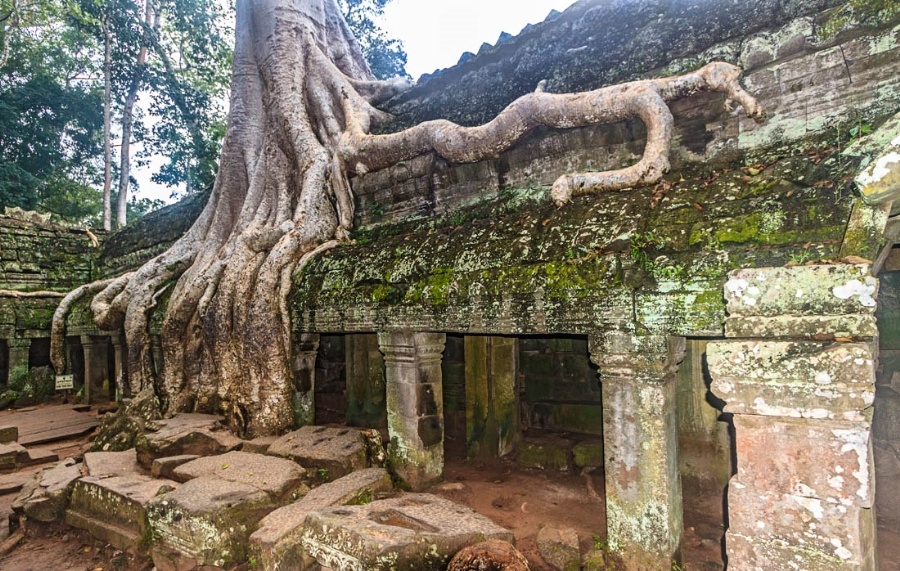
Temples are overgrown with ficus trees.
The highlight is one massive series of roots across a particularly picturesque building which has been nicknamed the Tomb Raider ruin. Unfortunately, its claim to fame comes from the based-on-a-video-game movie starring Angelina Jolie. But the ruin and its tangle of roots is beyond neat.
That evening, we did what everyone in Siem Reap does – caught a tuk tuk (think rickshaw pulled by motorcycle) and went to the night market.
The night market here is the center, the mecca, of Siem Reap’s evening tourist scene. In other Cambodian cities, the markets are really for locals – hot, sweaty, claustrophobic places jammed with pots and pans, cheap clothing and other goods of daily life. After the markets of Phnom Penh and Kratie, I was beginning to think there really was nothing for a tourist to buy in this country. But in case anyone misses the point in Siem Reap, there are huge, glowing, three-foot-high neon signs hanging across the street. Like, every 50 feet or so.

Market in Kratie, Cambodia.
I was looking for a pair of lightweight pants. Something that might fit me (I’m not small) in a country where size zero is considered large. But, I did find them and they look great. Also a t-shirt, scarves, earrings and assorted other whatnots. You could, if you tried very hard, spend serious dough here. There’s silver trinkets and wall hangings and paintings and furniture to die for and this quilt shop where they make bedding to order.
Mostly, the fun is to just wander and window shop. Maybe try a “doctor fish” tank where tiny carp nibble dead skin off your feet (much less icky than it sounds but VERY ticklish).

Tiny carp eating the dead skin off ones feet is very ticklish.
And then we ate. Though eating on the street might seem adventurous, the food is all either grilled over coals or cooked to a crisp in a wok. I figured the heat was enough to kill just about anything potentially harmful.
One night, we had stir fry. Another it was ribs. Just about everything is priced in US dollars. The exception was the whole, stuffed red snapper which fed us both and ran less than $10. We topped that off with a young coconut. They cut a hole, add a straw and you quench your thirst.
Finally, shopped out and fed, we hailed another tuk tuk and headed back to our hotel, where the swimming pool awaited.
Bonus tips for visiting Cambodia:
Cambodia has two seasons – wet and dry. Avoid the wet season (June – November) at all costs. Many roads, even main ones, are dirt and under construction. The mud can be axle deep.
Cambodia is not far from the Equator. It is HOT and steamy and temperatures can reach 100 degrees, especially during wet season. If you can, stay in hotels with swimming pools.
Don’t expect slick organization. This country was taken back to the stone age by the Khmer Rouge in the late 1970s. Most people over 40 don’t even know what year they were born. It’s been a slow recovery. But, cell phone signals are everywhere.
The US dollar is the main currency. There really is no need to change large amounts of money. But make sure to bring a LOT of small bills ($1s and $5s) and they must be in perfect shape. No one will take any bill if it has the smallest rip. Ask for new, crisp bills at your bank.
To learn more and plan a trip, visit Cambodia tourism: www.tourismcambodia.com/
Plan where to stay with this affiliate link from TripAdvisor.
— Story and photos by Yvette Cardozo
Please note: RealFoodTraveler.com is a member of Amazon Services LLC Associates program and AWIN, an affiliate marketing organization that pairs publishers with advertisers whose content matches the needs of the readers. Affiliate marketing programs are designed to provide a means for sites to earn a small amount of advertising fees by linking to to their advertisers while providing convenience for the reader.
Hungry for more? Read these other articles about Cambodian cuisine: How to cook Amok, and which bugs to eat when you go. Yes, bugs!
Pin this story to Pinterest to keep it handy.






0 Comments