









It’s one of those things people will tell you, “You just have to see it for yourself.” The fact that it’s a natural and recurring event that we get to be privy to, makes it even more amazing. Writer Carole Jacobs takes us on her first-person account of Nebraska’s Great Crane Migration. You’ll also learn a lot from our entertaining podcast interview with the Director of Conservation Research at the Crane Trust in Nebraska. After you read Carole’s article, be sure to listen to our podcast interview which will give you unique, behind the scenes insight into the world of the cranes.
Save this article and podcast about the great Crane Migration to Pinterest to help you plan your trip.
Hungry for more? Listen to our podcast conversation about the Great Crane Migration.
In the hush of the pre-dawn chill, our guide leads us in a monk-like procession down a series of footpaths worn into the corn-stubble field. “Shhhhh!” she whispers to our group. ”No talking—even a whisper could scare off the cranes!”
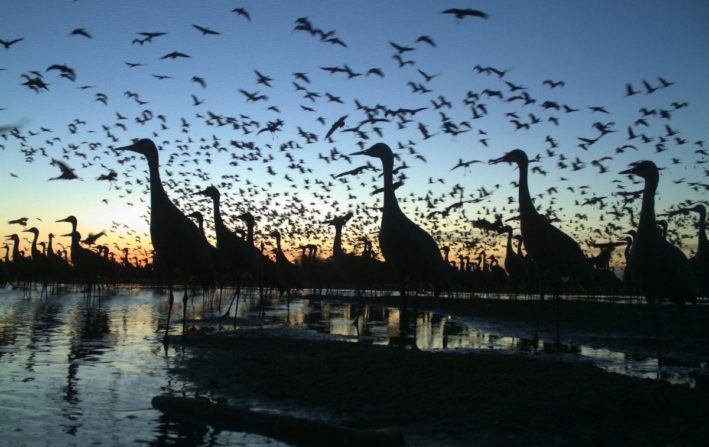
Cranes in flight at Crane Trust. Photo by Crane Trust
We’re at the Crane Trust Nature & Visitor Center in Wood River, Nebraska, to witness the annual spring migration of the Sandhill cranes, hailed by ethologist Jane Goodall as one of the earth’s greatest animal migrations – one that’s often compared to the epic migrations of the wildebeest and the caribou.
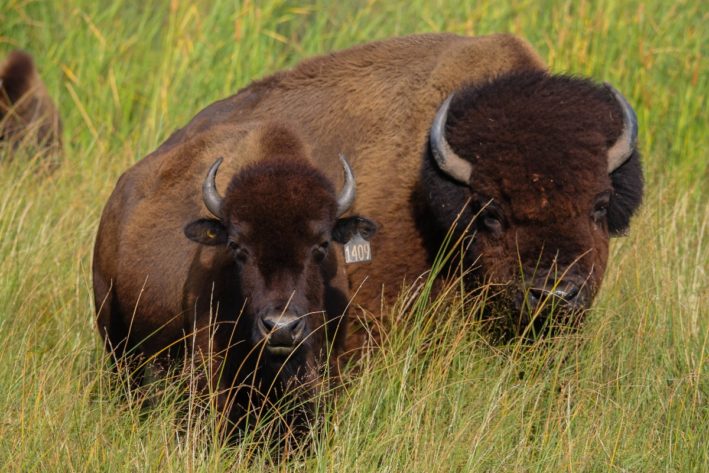
See bison at Crane Trust. Photo Courtesy Laura Stutte-Crane Trust.
Every year from mid- February to mid-April, more than 600,000 of these ancient birds – 80 percent of all the cranes on earth — wing their way to this remote, 80-mile bottleneck of the Central Platte River, a winding thread of riparian habitat in what was tallgrass prairie but is now a sea of corn. The cranes migrate here to fatten up on waste grain, gaining 20 percent of their body weight before resuming their northward migration to their Arctic and subarctic nesting grounds. En route, the birds follow 5,000-mile-roundtrip millennia-old route from their wintering grounds in Texas, New Mexico, Arizona, and Chihuahua, Mexico.
The ancient cranes are one of the earth’s oldest living birds, more than 34 million years old. They are among the world’s most enduring life-forms, having outlived millions of species, most of which are now extinct.
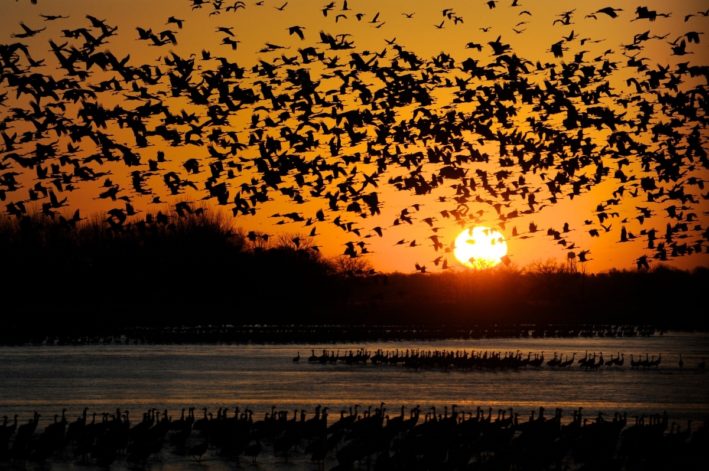
Cranes in flight over Crane Trust. Photo courtesy Crane Trust
Approaching in the sky from a distance, the birds look like wisps of smoke as they swoop and swerve in an ever-changing aerial ballet. Unlike geese, with their disciplined Vs, cranes fly in drifting lines that continually kaleidoscope across the sky. Whether stepping singly across a wet meadow or filling the sky by the hundreds and thousands, these 4-foot-tall birds with a six-foot wing span group together in large numbers, breeding in open wetlands and prairies and displaying to each other with exuberant dances that retain a gangly grace.
As the sun rises over the Platte, they rise from the river as if on cue and take to the sky in great winged flocks, disperse to nearby corn fields for the day to scavenge.
The Crane Trust, as well as the Iain Nicolson Audubon Center at Rowe Sanctuary near Kearney, Nebraska, are two of the best places on earth to witness the birds and their migratory and mating practices up close. I feel very fortunate to be visiting both of them during peak crane week.
If you build it, they will come
One of the world’s most ancient birds, Sandhill cranes have been winging the heavens for millions of years. Unfortunately, as North America’s prairie land was gobbled up by western expansion and farming, so was the crane’s natural habitat, and their numbers plummeted dramatically. Since 1978, the Trust, which manages about 10,000 acres of wild grasslands and wet meadows in the Big Bend region of the river, has been working tirelessly to protect and maintain the cranes’ critical habitat. Thanks to their efforts, their numbers have shot back up to about a half million.
To encourage bird and nature lovers of all persuasions to visit and support the cause, the Trust operates the swank Wild Rose Ranch, located on 4,500 continuous acres of native grassland prairie and wet meadows and housing the headquarters office, research laboratory, guest bunkhouse, Legacy Cabins, meeting/dining facilities, private crane-viewing blinds, and an outdoor deck and observation platform with breathtaking views of the tallgrass prairie and Platte River waterway.
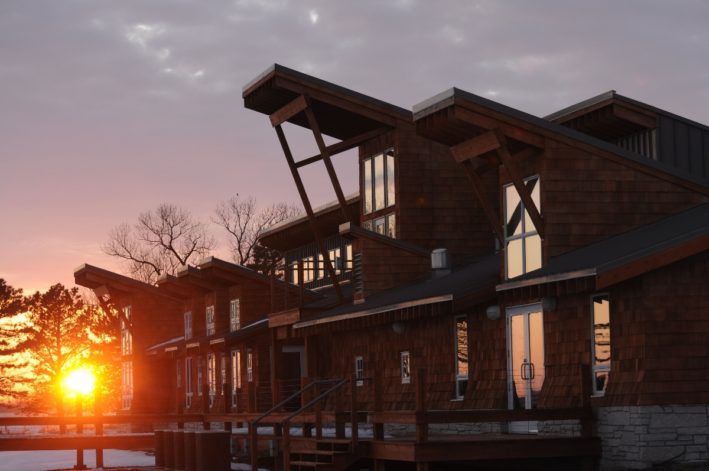
The Wild Rose Ranch. Photo by Crane Trust.
You can nab a room in a bunk or cabin or come for the day and watch the birds in blinds. The bare-bone structures have no insulation, heating, lighting or indoor plumbing, and are equipped only with wooden benches and slit windows for viewing. The long, low, plywood structures blend in so seamlessly with the river landscape that we didn’t see them until we were practically upon them.
The previous night over dinner, the Trust had warned us that early morning temps in the blinds could be “brisk,” Nebraska-speak for a brutal 20s and 30s. Our best chance of surviving our two hours in the blinds was to layer with a vengeance. I’m a California girl, so I not only layered two sets of down parkas and ski pants, but I lined my bed with stick-on hand warmers and then fell backwards into them, hoping some of them would stick.
As we set out in the pitch dark for the blind, the guide reiterated the importance of maintaining total and complete silence. In the dead still, I could almost hear my hand warmers squeaking against each other like hamsters, so I let the group pass and walked in alone. The clear night air had telescoped distances so that 20 miles looked like two. Lights twinkled on the distant horizon and a wilderness of grass met sky to remind me how small I really was.

Cranes feeding on the river at Crane Trust. Photo by Crane Trust.
Into the Frigidaire at the Sandhill crane migration
By 6:30am, we had arrived at the blind and claimed our prospective benches and windows. There wouldn’t be much to see until the sun rose, so I took a cat nap, waking with a jolt to the cacophony of thousands of cranes emitting a plaintive, prehistoric-sounding “Garrooo”. Amplified by the windpipe in its long neck, the Sandhill crane sound from a single call can carry a mile.
As the sun began to rise, I saw the river banks were paved with cranes for as far as the eye could see; hundreds slept upright in the frigid water, a bracelet of ice around their ankles. Smaller juveniles were batting their wings at and over each other in mock displays of prepubescent strength. Baby cranes paddled around parents like they were in a ducky pond and emitted hollow, high-pitched coos…
And more cranes were still coming, diving into the river like paratroopers, wings cupped and legs dangling. The Trust counts a section of birds by plane, then makes an educated guess as to how many cranes are crossing into their reserve.
By about 7am, most of the cranes had fled the river for the day. The watercolor sky streaked pink and purple as we hiked back across the fields to the dining room, where we feasted on cheesy omelets, hashed browns, bacon, bison sausage, yogurt and berries, oatmeal, pancakes, French toast juices, and strong, hot coffee.
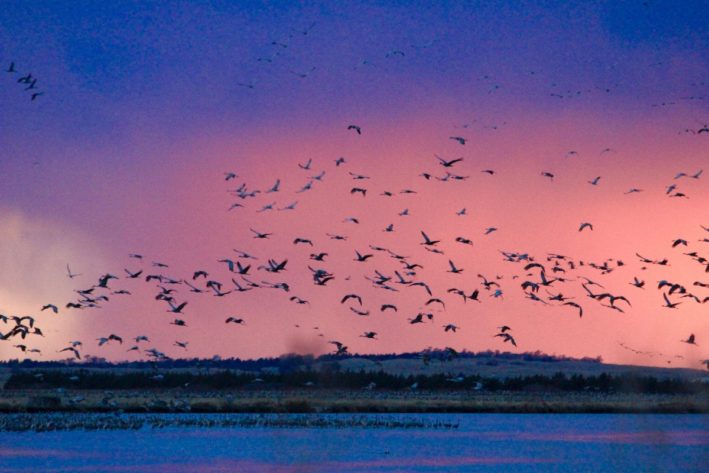
Cranes at dawn. Photo courtesy Crane Trust.
By the next day, the damp had camped inside my lungs, my payback for a careless, breakneck month of nonstop work and travel. As I lie in bed motionless, I envisioned the cranes soaring over Alaska’s Kodiak Island, around Upper Cook Inlet and resting at the Stikine River Delta.
With their unerring pacing and perfect eat-fly-love balance, they had the reserves to cover 200-300 miles a day whereas I could barely walk a foot.
I was out of breath and out of whack, but with the cranes as my totems, I was certain I could find my way back to moderation, strength and wisdom.
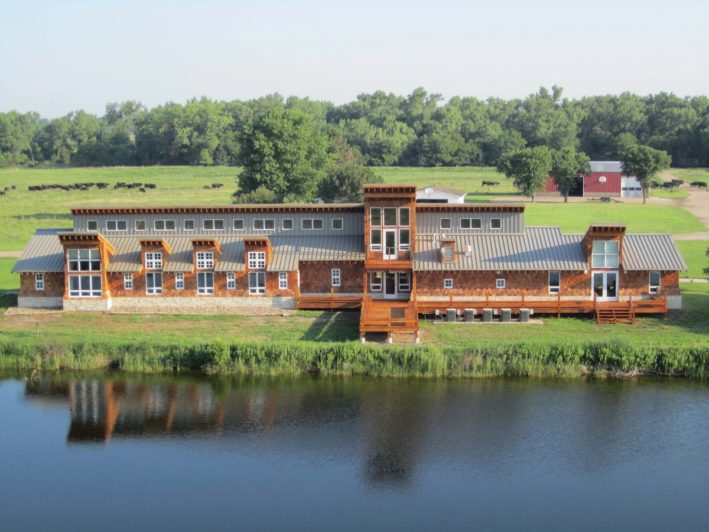
Crane Trust headquarters. Photo by Crane Trust.
More info about visiting during the Nebraska Sandhill Crane Migration:
The Crane Trust Nature & Visitor Center, located on 5,000 continuous acres of native grassland prairie and wet meadows owned and managed by the Crane Trust, includes nature displays, murals and touch-screens full of information, the Crimson Crown Gift Shop, Hornady Art Gallery, a butterfly garden, and a small research herd of American bison along the path to a 35-foot observation tower near two footbridges leading to 10 miles of nature trails along the Platte River. The Center offers a variety of crane-viewing options to ensure your experience is truly magical. They include group viewing blind tours, footbridge evening tours, photography blind tours and VIP viewing adventures and safaris that include guides, on-site lodging, meals and a limited bar including beer and wine. To get the best seat in town and/or reserve a VIP experience with lodging in 4-bedroom cottages or exclusive suites, meals, classroom instruction and guides, visit their website, or call 308-382-1820.
The Crane Trust’s Wild Rose Ranch is home to the headquarters office, research laboratory, dormitory, Legacy Cabins, meeting/dining facilities, private crane-viewing blinds, and an outdoor deck and observation platform with breathtaking views of the tallgrass prairie and Platte River waterway. Reservations are required to access the Ranch’s rare ecosystem, which includes an uninterrupted seven-mile stretch of the historic Platte River preserved by the Crane Trust to mirror the unique habitat used by sandhill cranes for millennia. For more info and reservations, visit their website.
The Iain Nicolson Audubon Center at Rowe Sanctuary offers a variety of guided tours from river blinds and for those who want to see the birds without braving the cold temperatures, an Indoor Crane Viewing Experience (evenings only), when you can view the birds from the comfort of the Iain Nicolson Audubon Center. Bring the kids to Audubon’s Rowe Sanctuary’s annual Family Crane Carnival. The one-of-a-kind carnival features hands-on activities, touchable exhibits, face painting, and much more.
Audubon’s Nebraska Crane Festival: Brings together hundreds of crane lovers from around the country to Kearney, Nebraska, to interact with a wide range of environmental speakers, take part in incredible birding trips, and experience the world’s largest gathering of Sandhill Cranes!
BONUS: Beyond the Birdies
To round out your visit, carve out some time to explore some of Nebraska’s hidden treasures.
- Blast from the past: Near the town of Grand Island, walk a portion of Lincoln Highway, the nation’s first interstate. Miles of highway are frozen in the past with old ‘camps’ and gas stations, funky motels and cabin courts, and classic diners. Check out the old Kensinger Service & Supply in Grand Island, established in 1937 and still pumping gas today.
- Horses, horses, horses: Drop by the Pony Express Station & Museum in Gothenburg, where riders refueled/restocked before galloping westward. The short-lived venture lasted just a year and went belly-up with the completion of the first transcontinental telegraph in 1861.
- Bond with a masterpiece: Visit the Museum of Nebraska Art in Kearney, where you can get close enough to masterpieces by Picasso and Monet to see the brush strokes.
- Try the beef: Nebraska is king when it comes to steak so sample some of the state’s dozens of steak houses. Don’t be put off by the funky/shabby exteriors of some of these joints. Even the homeliest hole-in-the-wall dishes up primo porterhouse, filet mignon and prime rib with all the fixings. For a steak house on the classier side, try the Coppermill Steakhouse & Lounge in Kearny. Don’t miss the Friday night all-you-can-eat buffet featuring snow crab and prime rib.
- Check out the coolest town in Nebraska: McCook is classic laid-back Nebraska, so spend a few hours soaking up the vibes. You’ll love the locals — most admit to keeping “a couple cows” (translation: they have a 50,000-acre ranch with thousands of cattle). If you ever wanted to watch the mating dance of the prairie chicken (these critters have nothing on the cranes and resemble short, squat cartoon characters), Calamus Outfitters will transport you in their claptrap school bus to an undistinguished patch of prairie, where the chickens strut out at dawn and start bickering. Back in town, grab breakfast at Sehnert’s Bakery, a combo bakery/deli and nightclub. The homemade cream horns are sinful and consider returning at night for live music, homemade pizza, a hometown bieroc (seasoned ground beef mixed with cabbage or kraut wrapped in bun dough), espresso drinks and cold brews.
- You’re in the army now: Fort Robinson was an active military post from 1874 to 1948, and the location of the death of famed Sioux Chief Crazy Horse. Named Fort Robinson State Park in 1962, today guests can lodge in former officers’ quarters, enjoy hearty mess meals at Fort Robinson Restaurant, go on nightly steak cookouts, see plays at the Post Playhouse and take jeep rides into the mountains to hunt for bighorn sheep.









0 Comments