











When best laid plans go awry, travelers can either go into panic mode or, like the fine example from Sandy Bornstein and her husband, create a Plan B and revel in it! Here’s how the traveling couple found themselves weathering an unexpected tropical storm when they visited Hilton Head Island.

Hilton Head Island, a year-round destination, is located about 40 miles north of Savannah and 90 miles south of Charleston. While approximately one-third of the visitors are lured by the island’s golf courses, the rest of the guests seek out the subtropical climate, pristine beaches, outdoor activities, and a coastal ecosystem that draws more than 200 species of birds. Even during the hurricane season, which runs from June until the end of November, visitors find their way to one of the largest barrier islands in North America.
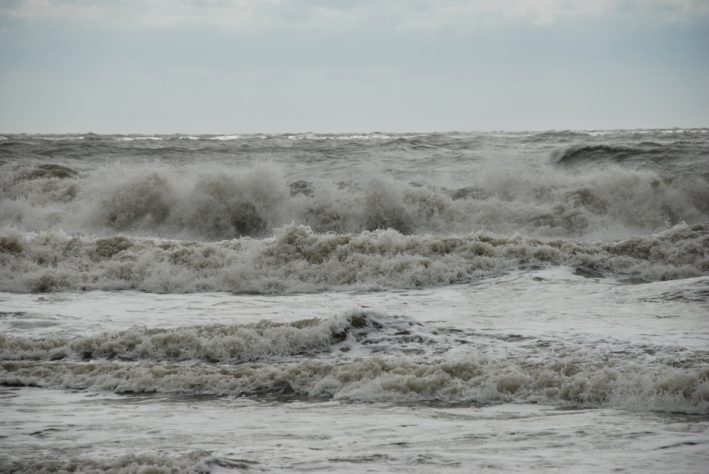
My trip to Hilton Head Island coincided with an unexpected tropical storm that switched directions. I didn’t cancel my plans. I simply readjusted my expectations. Plan B, a day exploring a coastal region, replaced plan A’s tranquil beach day. An impending storm with turbulent waters prevented my ocean swim and boating opportunities but did not deter me from seeing the South Carolina coast or indulging in its Lowcountry cuisine infused with fresh seafood options.
Checking Into the Sonesta Beach Resort
When we checked into the Sonesta Beach Resort, the lobby was jammed with people. Despite the threat of a rainstorm, other people obviously shared our flexible mindset. However, we did feel bad for the wedding couple and their guests who were also staying at the hotel. But like us, I’m sure that the visitors were accepting the less than ideal situation.
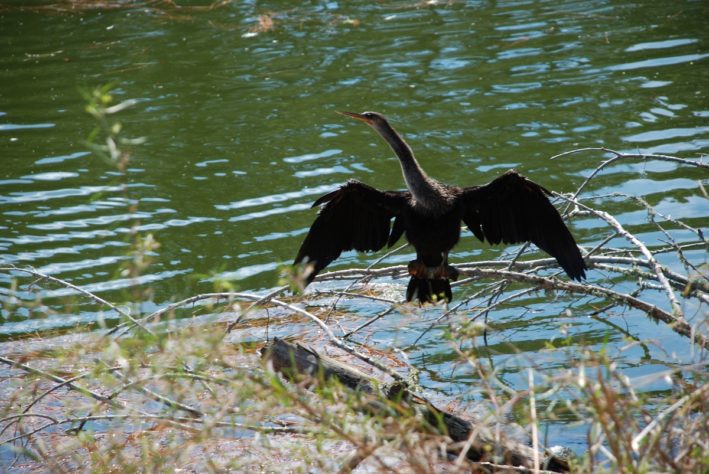
Despite the partially overcast skies and extremely high winds, some sun worshipers remained devoted to the beach and the pool lounge chairs. Only a few swam in the pool and no one ventured into the ocean’s rough and dangerous waters. The brisk wind probably kept most away. It’s hard to relax on the beach when the air is laced with particles of coarse sand. Even the local birds, the cormorants and the egrets, were finding refuge elsewhere.
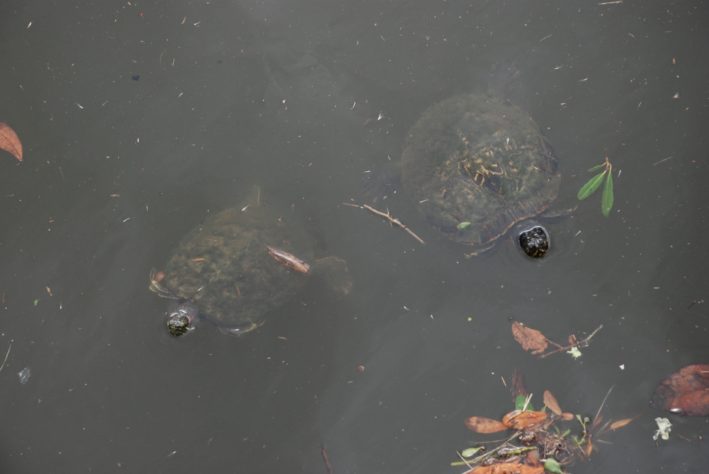
As we wandered around the resort’s lagoons, we stopped to watch a few turtles swimming in the water. The murky water prevented us from identifying the species. A nearby sign gave descriptions for the common Yellow-Bellied Slider and the Diamondback Terrapin. We would need to wait until the morning feeding time to witness the turtles venture onshore.
Our time outside was abbreviated as the thick gray clouds drew closer and dispersed oversized droplets of water. Everyone scattered quickly as the storm made its bold and disruptive appearance. Back in our hotel room, we reviewed our limited options. Just about everything on our “to do list” was no longer feasible. Even if the skies cleared for a short while, we were a bit reluctant to be caught in a deluge on a bicycle, kayak, boat, or horse. Walking and driving appeared to be our best bet. Weather permitting, we planned to take a midday walk at the Sea Pines Forest Preserve and then reevaluate our options in the late afternoon.
PLAN B
Exploring The Sea Pines Forest Preserve
One of the Sea Pines Resort’s gems is a protected area of land that is home to indigenous flora and fauna. The mature and well-marked trails date back to the 1970s when Charles Fraser created the Sea Pine’s master plan setting aside approximately twenty-five percent of the land for open space. In the process, a 605-acre plot of land became a forest preserve. Today, it is the largest tract of undeveloped land on Hilton Head Island. Had the weather been more predictable, we may have arranged for an onsite alligator and wildlife boat tour or horseback trail ride. Bicycles were not an option since they are not permitted on the walking trails.
We packed our raincoats, bottles of water, and protein bars before driving a short distance to the resort’s gate. Keep in mind that vehicles entering through the gate are charged a daily fee. Road construction prevented us from parking nearby. Eventually, we found an entrance and a map. The overnight storm had left an abundance of branches, leaves, and deep puddles on the established pathways lined with dried out pine needles. Having recently visited a Charleston plantation, it was hard to imagine that this heavily wooded area was used from the 1700s until the 1950s, to grow rice, indigo, and cotton.
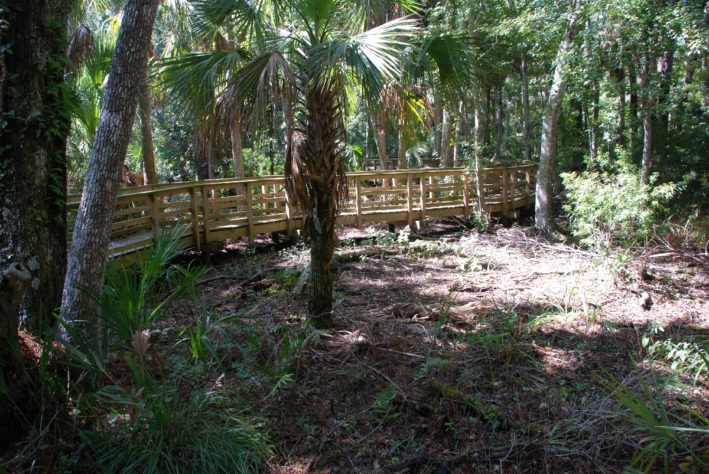
Low areas that are prone to flooding were explored via raised wooden boardwalks. Excellent signs inform pedestrians about the local vegetation, wildlife, and points of interest in this wetland area filled with swamps, bogs and shallow pools of water. While our printed trail map helped us plan our route, numbered direction signs are an additional aid and a great way to pinpoint one’s location in the event of an emergency.
One sign identified the destructive signs of a few types of woodpeckers. Another sign described the ebb and flow of water into the swamps and the dark stains on the base of the trees that recorded this occurrence. Other signs shared descriptive information about what could be expected in the immediate area. I had been admiring the silvery-gray threadlike material clinging to branch limbs for quite a while before I came upon a sign that identified this plant substance as Spanish moss.
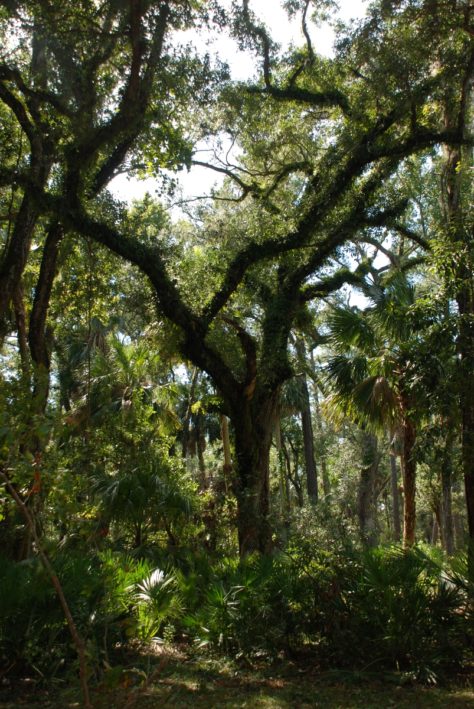
Adjacent to Lake Joe, visitors were made aware of the alligator habitat with the simple and humorous statement, “No Swimming Survivors Will Be Ticketed.” Fortunately, no American alligators were sighted onshore. Large ripples in the distance suggested a presence in the middle of the lake. The more secluded Lake Thomas was a mecca for bird enthusiasts. But then again, all along our journey, we heard a symphony of melodic sounds including an occasional hooting owl. Even though we only encountered one family during our three-hour hike, the local marsh rabbits, whitetail deer, American alligators, yellow-bellied turtles, snakes, and bobcats remained out of sight.
We stopped to admire the remnants of an Indian Shell Ring, a site listed on the National Register of Historic Places. Around 4,000 years ago, an indigenous group of people started to create this mysterious ring of shells and artifacts that is 132-140 feet in diameter with a ring wall that measures an average of 25 feet wide at the base. Scientists believe that the ring was built in stages and then abandoned about 3,500 years ago, but no one knows the purpose of the structure or why it was suddenly deserted. Archeologists have discovered around 50 shell rings along the coasts of South Carolina, Georgia, and Florida. This site is the oldest known site on Hilton Head Island.
After several hours of walking, sunshine was finally replacing the thick cloud cover. We walked back to our car so that we could explore a bit more of the Sea Pines Resort before we headed to our hotel.
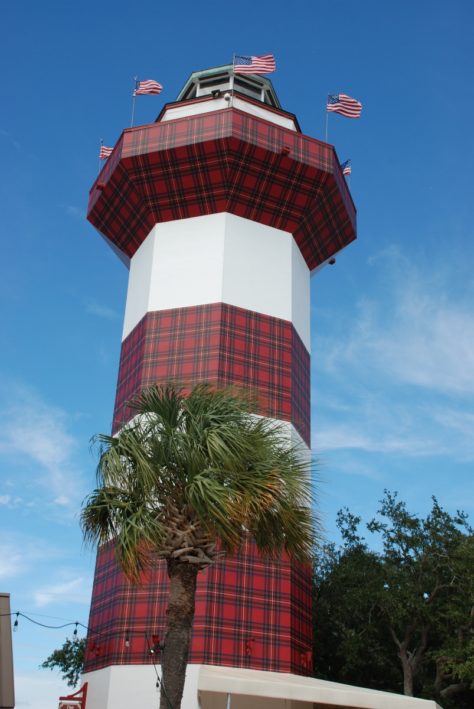
Harbour Town
Parking was a premium at this tourist attraction. It appears that many followed the online recommendation to visit this small area that has shops, restaurants, and a playground for kids. We spent more time waiting for a parking spot than walking around. Then again, shopping is usually not our main interest.

Beach Walk
Even though the skies had finally cleared, beach signs still alerted visitors to the dangers of going into the ocean. A walk along the extremely wide white sand beach was our best option. Waves rolled in and out as pedestrians frolicked along the coast and bicyclists peddled on the hard packed surface. Small birds scampered along the shoreline as larger birds swooped down to catch prey from the sea. It was the first time that I had ever encountered a beach that didn’t cave to the pressure of one’s feet. Individuals, couples, and families took advantage of this unusual beach pathway by renting bicycles.
Saying Good Bye to Hilton Head Island
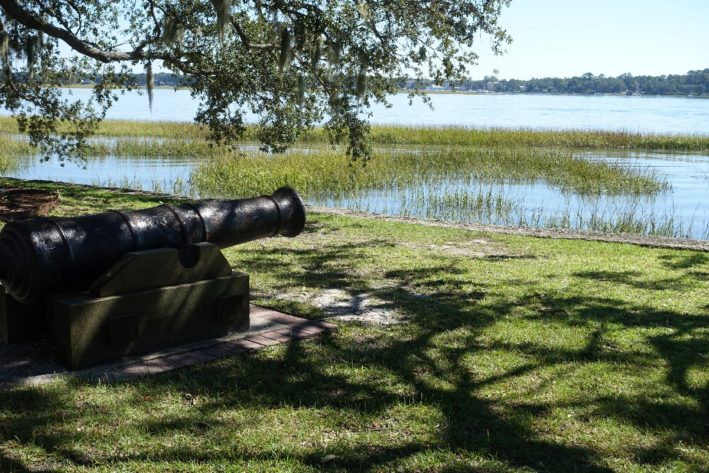
Since our flight departed from Charleston, we had to leave sufficient time to drive back to the city. Instead of squeezing a small amount of morning beach time before our mandated checkout time, we opted to depart after breakfast and drive to Beaufort, a town filled with history. Even though we were never able to experience our laid-back beach vacation, we enjoyed other natural aspects of this coastal environment.
— Story and photos by Traveling Bornsteins
Hungry for more? Read about Sandy’s culinary travels in South Carolina’s Low Country. And here’s a cookbook review to help you do your own Southern-style cooking, no matter where you live.









0 Comments