






“When in Rome…” the saying goes, encouraging us to do like the locals do. We’re all about that on RealFoodTraveler.com. Here, writer Betsa Marsh shows us how the locals did it way back when, and in present day, where Spain provides the Roman spa experience to visitors.

Spain’s Roman spa recreates relaxing baths, reclining meals
The last Romans might have wandered out of Spain more than 1,500 years ago, but don’t tell Santiago Martinez and Noemi Reina that. They live the Roman way every day in their intimate Spanish bed and breakfast inn, Termas Aqua Libera.
The B&B is tucked behind a typical stucco house façade in the small village of Aljucen, about a 15-minute drive north of Merida in Spain’s Extremadura region.
Merida is one of the world’s great Roman cities, with excavated forum, temple, theater and amphitheater complexes. The Roman Bridge spans the Guadiana River for nearly half a mile, as it has since Emperor Augustus invited his retired soldiers to settle Augusta Emerita in 25 BCE.
Merida’s 16,000-seat Roman amphitheater is a UNESCO World Heritage Site.

Spa recreated to the Roman blueprint
Martinez is an archaeologist caring for Merida’s monuments, so every aspect of the inn’s recreated Roman house, courtyard and baths is accurate to the historic record. “Santi” and his wife Noemi, an agricultural engineer, are so devoted to the ancient ways that they give a 50% admission discount to guests who dress in Roman costume.
Overnight guests eat breakfast in the front atrium, then might take the waters in the home spa. Spa-goers head first for the frigidarium, the coldest water, then hot, then tepid.
Hot and cold are basically one-person plunge pools, while the tepid pool is big enough for six or so. The lights are low, the air misty and the music soothing.
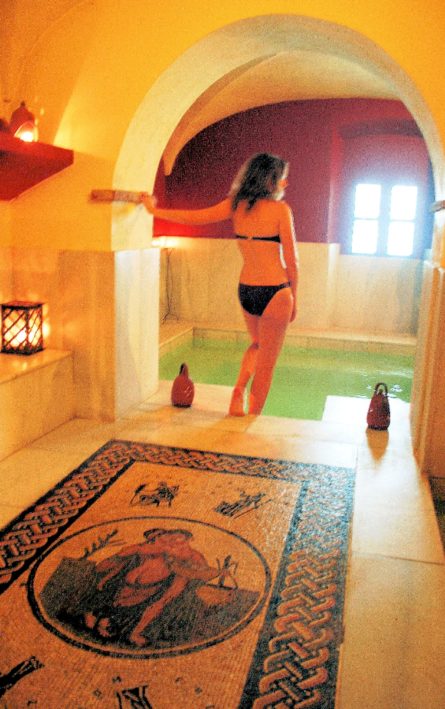
The centerpiece is a romantic tile mosaic in the spa floor, recreated by Noemi from a famous scene discovered in Sicily. In the central medallion, a couple embraces, surrounded by four goddesses. “The Romans,” Noemi quipped, “invented the bikini.”
For their thermal spa, Santi and Noemi followed the Roman measurements from two Merida landmarks, the House of the Amphitheater and The Marble House.
The Romans had no soap, so baths were important, Noemi said. They used oils and body scrapers to clean themselves.
While the new thermal spa is accurate to the inch, the heating is 21st century. The Romans would have had slaves stoking fires to heat the pools by hot air. Noemi and Santi use firewood and biomass pellets made from recycled olive pits.
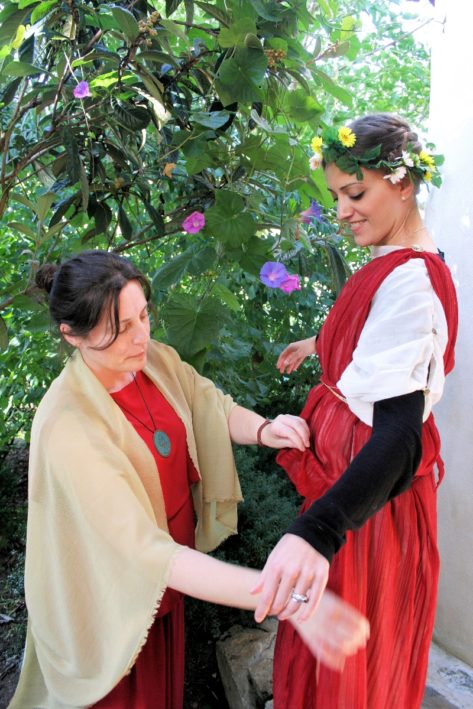
Dressing the part with robes and floral crowns
After the soothing waters, some guests book massages, the better to relax before a Roman meal. Noemi helps guests garb up in Roman-style tunics and stoles, and everyone heads for the triclinium in the outdoor courtyard.
Romans often dined on these reclining benches, elevated on one side around a central, shallow pool of water. The Termas Aqua Libera’s marble triclinium has been built to the exact measurements of one found in Merida, and the central floating pool to a description by historian Pliny the Younger.
While Romans imported marble from Portugal, Santi and Noemi sourced marble from another part of Spain.
“The Romans in Merida had a very rich culture,” Noemi said, “and had triclinia for different occasions. The smallest Roman house found in Merida was 600 square meters. Some houses had four different rooms for eating. This is the style for outdoor eating.”
Noemi counters one of the Hollywood misperceptions about Romans, that they lazed about on couches, gorging on food. “You can’t conquer an entire empire if you’re overeating and lying down all day.”
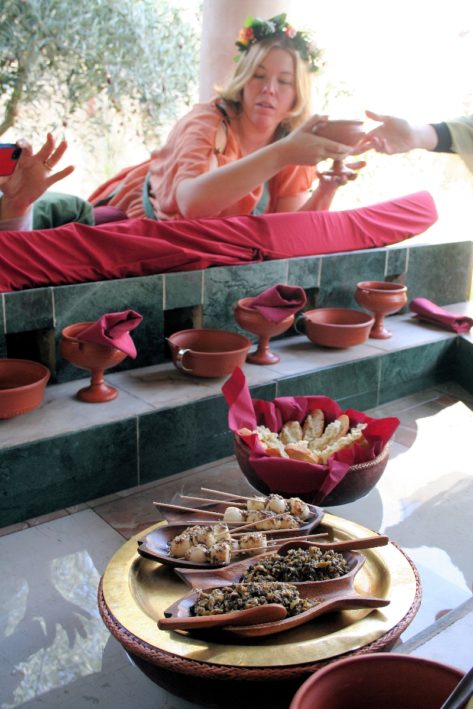
Savoring the original Mediterranean diet
The Termas Aqua Libera meal is balanced courses of Mediterranean vegetables and lean meat, skewered by guests as wooden bowls and platters float by in the center of the reclining couches. The Termas’ triclinium is made for nine, so friends can cozy up and gossip between courses just as Romans did millennia ago.
“The Romans had very long meals, with many courses and lots of conversation going on at once,” Noemi said. “Their heads were close together.”
And because Romans believed flowers kept you from getting drunk so quickly, everyone—men and women—wears a floral crown.
The rose petal wine is diluted, as the Romans drank it. “It was taken like a soft drink so they didn’t get drunk too fast.” And beer? “Beer was for barbarous people. A decent house drank wine.”
Noemi sets each course afloat for the reclining banquet of black-and-green olive relish and grilled tuna, accompanied by bread, cheese and Cornish hen eggs with juniper sauce. A salad with olive oil and violets floats by. Followed by hazelnut pies, carrots and turkey with more hazelnuts.
“The Romans ate with their hands,” Noemi said, “and it’s OK here.”
Dessert is a sweet, honeyed cream of pine nuts, in the spa’s walled garden of olive trees, roses, lantana and an orange tree by the pool. This Roman feast may leave guests revved up to tour the ancient treasures of nearby Merida, or better yet, take a nap under that orange tree.
— Story and photos by Betsa Marsh
Hungry for more? RealFoodTraveler.com has published many articles about Spain in the past. Take a look. Also, read what Betsa has written about the Baltics.







0 Comments