











These unusual and frightening times we are living in, with a pandemic in full force, got Rich Grant, our resident expert on the 1st president of America, thinking about how he handled an extremely difficult time in our history. Rich walks us through George Washington’s accomplishments in the footsteps of his life in Philadelphia, guiding us to places we can still see today (when we can travel again). And with more Americans getting in their cars for travel, it seems like a perfect East Coast road trip destination.

George Washington’s Philadelphia: Discovering How True Leadership Saved America During Our Greatest Crisis
During this terrible COVID-19 pandemic, it is easy to think this is the greatest crisis America has ever faced. But it is not. There would not even be a United States of America, if we had not, at every critical juncture in our early history, been provided with brilliant leadership that led us to the razor thin difference between success and failure. The one name that is always mentioned for providing that leadership at these critical times is George Washington.
Almost every single one of the important moments in our nation’s early history involved George Washington, and surprisingly, they all occurred in and around Philadelphia. In 1776, Philadelphia was, after London, the second largest city in the British Empire with a population of 40,000 people and some 6,000 impressive brick buildings. Miraculously, 2,000 of those 18th century brick buildings still survive.
That means today, downtown Philadelphia is America’s most European-looking city. If you can’t go to Europe any time soon, come here for a knockout city of brick sidewalks, cobblestone streets, beautiful squares with wood benches, huge spreading trees, pedestrian walkways, old churches with quiet graveyards, cozy taverns lit by candles, food markets, outdoor cafes, flickering gas lamps and an overwhelming sense of history.
Philadelphia was also George Washington’s favorite city. He lived here many years and practically everything important in his life took place in or around this town. So who better to be our guide? Let’s follow George around to visit some Philadelphia historical sites.
Where better to start than the most important building in early American history? It was here in May 1775, after the battles of Lexington and Concord, that in the midst of a violent revolution, the Continental Congress appointed George Washington as commander in chief of America’s first army. He began this military career with a self-effacing speech that you simply don’t hear in the 21st century, telling Congress, “I, this day, declare with the utmost sincerity, I do not think myself equal to the command.”
Master Carpenter Edmund Woolley had built the hall in 1747 for Pennsylvania’s colonial government. Because it was the largest building in the largest city in the colonies, it became the site for the Second Continental Congress. The Declaration of Independence was approved here in July 1776 and Washington presided over the Constitutional Convention held here in 1787.
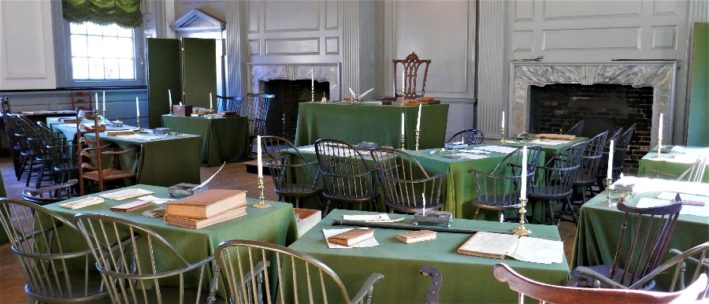
Independence Hall as it was during the writing of the Constitution with George Washington’s chair at the front.
Today, the room is laid out as it was when creating the Constitution with the chairs of the 55 delegates in a semi-circle facing the actual chair Washington sat in. We tend to focus on 1776 as the birth of America, but actually, history has shown most revolutions fail after they had a military victory. The future of America was preserved in 1787 when 55 delegates filed into this room. You can go in the same door and stand on the same floorboards. Seldom in history has such a small room held such men.
Beside Washington, there was Alexander Hamilton, Ben Franklin and James Madison. These 55 delegates would supply America with 2 presidents, 3 cabinet members, 16 U.S. senators, 11 House members, and four Supreme Court justices. All of them were involved in the revolution; 23 fought as soldiers. No matter what your political feelings or beliefs today, to stand in this room is an historic moment everyone should experience. I was so moved, I came back later in the evening at twilight to walk around the building. I was so entranced, I circled it three more times until it grew dark.
The delegates met here from May 25 to Sept. 17, 1787, with the daunting task of creating a new form of government unknown on the planet. It is hard to remember today, but the concept of democracy and the United States did not exist at this time. These delegates were trying to create a country that would be “of the people, by the people and for the people.” A daunting challenge in the world of 1787.
Because they did not want “leaks,” the shutters were drawn and the room was swelteringly hot. They argued, debated, yelled, fought, made compromises followed by long speeches and then argued some more. A dozen of them owned slaves, and slavery was a huge issue. Those from smaller states wanted to preserve their power; those from larger states wanted more power. They feared traitors, and, surprising to most people today, they actually feared true democracy and majority rule, which in a time where few people were educated, they equated with mob rule. But as it got hotter and hotter in August, the speeches grew shorter and the compromises became more frequent.
We can’t know what these delegates would think of America today, but we do know what they thought of the Constitution they eventually signed. They were mostly disappointed. To them, the document was a series of compromises. Each delegate might have won a few battles, but lost many others. The public greeted it with the same lack of enthusiasm, even when the Bill of Rights was added as amendments.
The delegates in this room could not possibly imagine they had created what would become the oldest written government constitution in the world, a document that would influence more than 700 other constitutions created over time in 200 nations.
As the delegates left the hall for the final time, a lady in the crowd shouted out to Ben Franklin, “Doctor, what have we got? A republic or a monarchy?” to which Franklin supposedly responded, “A republic, if you can keep it.” And then they all went to City Tavern.
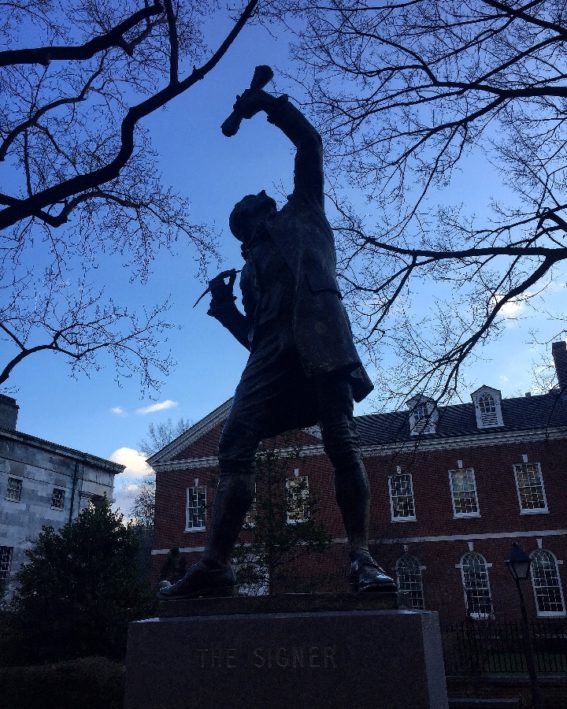
A statue honoring the signers of the Declaration of Independence next to Independence Hall, at dusk.
It’s a pleasant 5-minute walk from Independence Hall to my favorite colonial tavern. John Adams called it “the most genteel tavern in America.” We can only assume he meant “refined, respectable, polished, proper and polite.”
Who knows when it will open again, but before the virus you were able to enter City Tavern through the front door, but I preferred to approach it from the rear, getting off Chestnut Street and walking through Liberty Square, past Independence Hall and Carpenter Hall, strolling through a quiet park, while slowly leaving the modern world behind in the shadow of 18th century buildings. Continue walking along by the First Bank of the United States, then take a turn on Dock Street and you come upon your first pretty view of the tavern sign and the pub’s backyard. Entering through the backdoor had another great benefit — it took you immediately to City Tavern’s bar, where I prefer to sit.
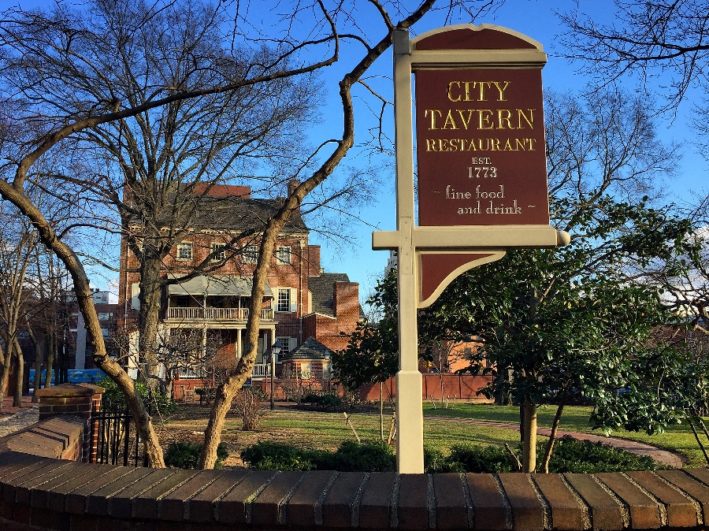
The back entrance of City Tavern.
Now when the tavern opened in 1773, the ‘bar” was not a long saloon bar as we know it, but rather an area where the liquor was stored. It was literally a small room made of bars, like a jail cell, that could be locked for safety when the tavern owner was off waiting on patrons. Today, the bar in City Tavern looks the same as 1773, but surrounding it is a cozy wood-paneled room of tables and booths circled around a fireplace.
Beyond serving food and drink, colonial taverns were the nerve centers of the city. A “subscription room” in City Tavern had all the newspapers of the day and men gathered here in a room filled with tobacco smoke and politics to read and discuss the latest events. It was the Facebook of 1776.
In was in 1775 that Paul Revere rode to City Tavern from Boston to bring the news of fighting at Lexington and Concord. While drafting the Constitution in 1789, George Washington took a table at City Tavern and dined here often. So did most of the other 55 delegates. On the day they finally finished writing the Constitution, Sept. 14, 1787, Washington and 54 other gentlemen gathered here and consumed seven bowls of rum punch, eight bottles of cider, 34 bottles of beer, 54 bottles of Madeira and 60 bottles of French Bordeaux. Today, their bar tab would be $15,400.
In the 21st century when people argue about the Constitution and what the Founders meant by this or that, there is one point no one can argue: The intent of the Founding Fathers on Sept. 14, 1787, was to get blitzed.
After all that drinking, what did they eat? Wealthy people in Colonial Philadelphia ate very similar food to us, but of course, it was much more difficult to prepare. Beef, chicken, hams, baked oysters, lamb, game and all varieties of fish. Banquets could offer up to 140 different selections. Liquor, coffee, tea and ice cream were available and everyone drank beer and hard cider because they were much safer to consume than water.
Me? Well, for lunch I had the excellent and generous portion of cornmeal fried oysters and a selection of Revolutionary ales. Made by local Yards Brewing Co., and served beautifully on a wood platter, these historic ales include General Washington’s Tavern Porter, brewed from a genuine recipe of George’s on file in the Rare Manuscripts Room of the New York Public Library; Thomas Jefferson’s 1774 Tavern Ale, a beer he brewed twice a year that is now brewed following his original recipe; and Poor Richard’s Tavern Spruce, based on Benjamin Franklin’s recipe, written while he was the ambassador to France.
Of course, they all taste terrible and are overpriced. Still, how often do you drink history? You may forget a thousand beers you drink in your life, but you will never forget these, served in this setting.
The first City Tavern fell into disrepair and was torn down in 1854, but working from the original plans, the National Park Service built an exact replica in 1975. Is it touristy? Yes, of course. And a bit expensive. But the Tavern serves lunch and dinner with a colonial inspired menu, waiters and waitresses dress in 18th century costumes and the dining rooms are lit by candlelight. At the very least, sit in the bar, order an appetizer and the Revolutionary beers, and drift back in time.
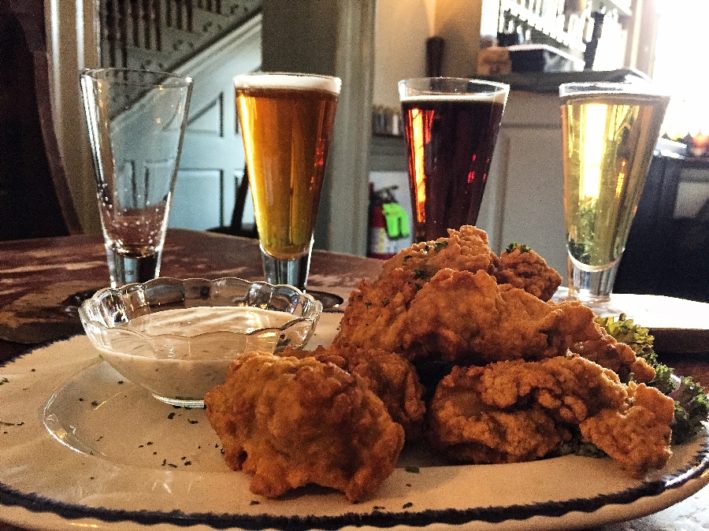
Cornmeal Fried Oysters plus a flight of a platter of Revolutionary Ales made from recipes originally used by George Washington, Thomas Jefferson and Ben Franklin.
Museum of the American Revolution
It’s just a block walk from the tavern to this new high-tech museum that opened in 2017 and tells a vastly different story about the Revolution than you heard in high school. You soon learn that the ugliness in 1776 makes today’s political divisiveness look rather tame.
At the start of the revolution, there were two million colonialists living in North America – a third of whom were rebels, another third were loyal to the king, and the final third just wished the whole thing would go away. Also living here were another million souls caught up in the war without any choice: enslaved Africans (who made up one out of five people on the continent), Native Americans, French in Canada and Spanish in Florida.
It was a brutal civil war of death and destruction. In 1776, to put the rebellion down, England sent the largest armada of ships and professional fighting men the world had ever seen. Washington had a rag tag army that spent as much time retreating as they did fighting. But the rebels did stop running away long enough to counterattack at Trenton and Princeton on Christmas 1776; both these victory battlefields are just 40 minutes from Philadelphia and that campaign is given major attention at the museum.
Of course, Washington is the main character here, but there are dozens of other people in the museum you never heard of. Young boys from Germany, conscripted to fight as Hessians for the British; poor Irish lads who ended up in the British army; women and camp followers, who suffered as much as the men; Native Americans who ended up fighting for both sides and lost everything, no matter which side they supported; and enslaved Africans, who also fought on both sides and were betrayed by both.
It was no picnic living during the Revolution. Paintings, artifacts, high tech exhibits and videos make it effortless to follow the battles and violence. As do two very unusual exhibits, worth the entrance price alone. One is a crazy life-size diorama of a snowball fight that took place when the Rebel army was camped in 1775 at Harvard in Boston. Apparently, Washington was outraged his soldiers were fighting each other with snowballs and jumped into the fray to tear them apart. Maybe it was the Revolutionary ales I just drank at City Tavern, but it seemed insane to devote this much attention to a snowball fight. But it is fun. You get to see George in the middle of the fray, life-size and in full-rig uniform with gold epaulets, swinging fists with the best of them.
The other is George Washington’s tent. You enter a large auditorium, take a seat, watch a film, and then with dramatic lighting and music, the stage lights up and there is George Washington’s tent. It’s interesting. For perhaps 30 seconds. But despite changing backgrounds and lighting, there is simply not much you can do with a tent. The audience seemed to leave with me scratching our collective heads, while moving on to other fascinating and interactive exhibits.

George Washington breaking up a snowball and fist fight in Boston in the Museum of the American Revolution.
What did colonial Philadelphia really look like? Well, if you walk a few blocks from the Revolutionary War Museum to Elfreth’s Alley, you can see. This is the oldest continuously inhabited street in America. The 16-foot-wide cobblestone alley is lined with 32 brick rowhouses built between 1728 and 1836. It is incredibly picturesque. Originally, these were the homes of grocers, shoemakers, tailors and other tradesmen who worked on the bottom floor and lived up above. Today, they are all private houses, but two of them built in 1755 operate as a small museum providing a glimpse of colonial city life. Of course, the alley probably didn’t look this pretty in the 19th century, but today, it can hold its own with any quaint backstreet in Europe.
George Washington marched his army down this street in 1777 en route to the Battle of Brandywine (he lost that one). It is easy to tell which houses were here at that time. Homes from the revolutionary era had front doors that opened directly onto the street. Because the streets were filthy, the stoop was invented later in the 19th century with doors that opened a foot above street level onto a stone block.
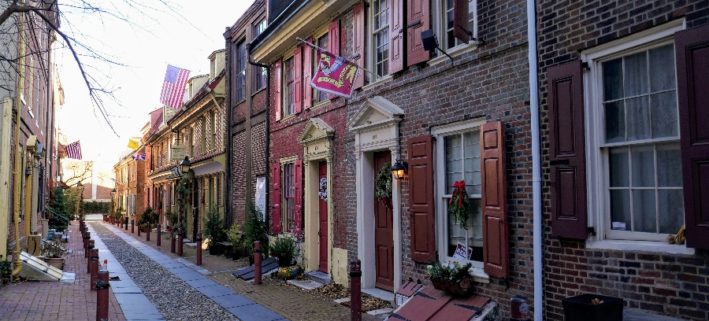
Elfreth’s Alley shows what Philadelphia would have looked like at the time of George Washington. He marched his army down this street in 1777.
As the legend goes, George Washington once visited Betsy Ross’s house, and since it was only a block away, I did too. George allegedly asked her to make the nation’s first flag, the one with 13 white stars in a circle on a blue field with red and white stripes. Betsy suggested using five point stars instead of six, and she showed George how it was easier to cut them. That last part about cutting stars is true, and living historians at the house delight in showing you an easy way to cut perfect five point stars.
For the rest? Well, it could be true. George did know Betsy Ross and had hired her as a seamstress. She did sew flags for the U.S. Navy. She might have lived here, but probably she lived next door. It really doesn’t matter — the house was built in 1740, is authentic and was at one time a tavern! Altogether, it’s a great piece of Americana, even if the legend didn’t start until one hundred years later in 1876.
You get to wander around the house, climb narrow stairs and meet living historians. In the basement, I met Phillis, a free black woman who worked as a laundress. When you hear how hard it was to wash clothes back then (it took 24 hours and was back-breaking), you can see why most people did very little washing.
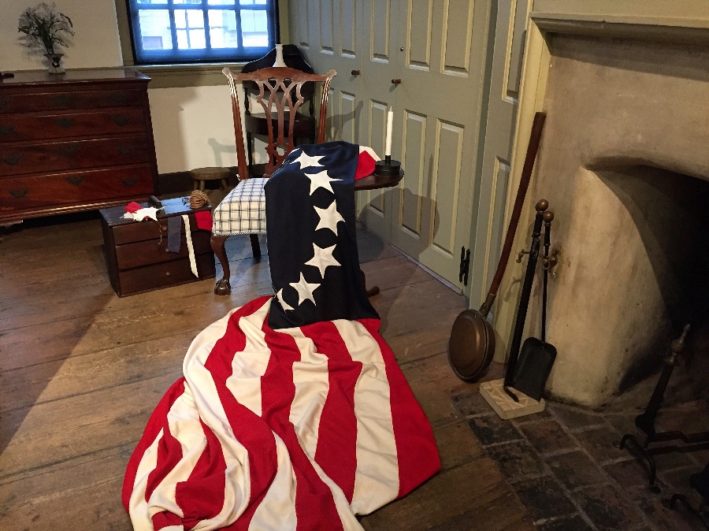
Betsy Ross House, as it might have appeared when Betsy might have been working on America’s first flag.
George Washington in Philadelphia: Learning about contemporary America from thoughts and political ideas created here in the 18th century
George Washington’s house in Philadelphia was located almost on the front lawn of Independence Hall. It served as the first “White House” from 1790-1800, with President John Adams also living here Incredibly, the house was torn down in 1954 and a public toilet was built on the foundation.
Even that is now gone, replaced with an amazing exhibit that shows the outline frame of the original house. But rather than celebrating the presidents who lived here, the exhibit tells the story of the eight enslaved Africans that Washington brought with him.
George was not perfect. He and Martha Washington owned 315 human beings, the sixth largest number of enslaved people in Virginia. When he came to Philadelphia as President, he brought his favorite chef, Hercules, Martha’s favorite personal servant, Ona Judge, and six other enslaved to run his household. There was one problem. Pennsylvania was a free state – any enslaved person living here for six months would be free.
Washington knew that, and meant to shuffle his enslaved out of the state for short periods after five months to “reset” the six month rule. However, both Hercules and Ona Judge learned of this law and instead of being “shuffled,” ran away to their freedom. Despite many efforts by an outraged George and Martha, they were never brought back.
You also learn that Washington fled this house in 1793 when there was an epidemic of Yellow Fever that killed one out of every ten people in the city. With more than 100 people dying a day, public facilities were overwhelmed. Washington and his family escaped to the suburbs along with 20,000 other residents, but 5,000 died before an early frost in November killed the mosquitos that were responsible for spreading the disease.
It is certainly an odd feeling to be here. The irony is overwhelming. Especially since the former house site also serves as the entrance to the “Liberty Bell,” that famous symbol of freedom.
Of course, the irony of this location is not lost on international visitors. Before Coronavirus, they were busy speaking in a dozen languages, while they snapped selfies of a monument dedicated to African enslaved people that sits directly in front of Independence Hall, the home of the famous statement read here in 1776 that “all men are created equal.” What international visitors thought of this situation, can only be imagined. But if this complexity of American history intrigues you, then keep walking another block through the park to the next stop, which will completely blow your mind.
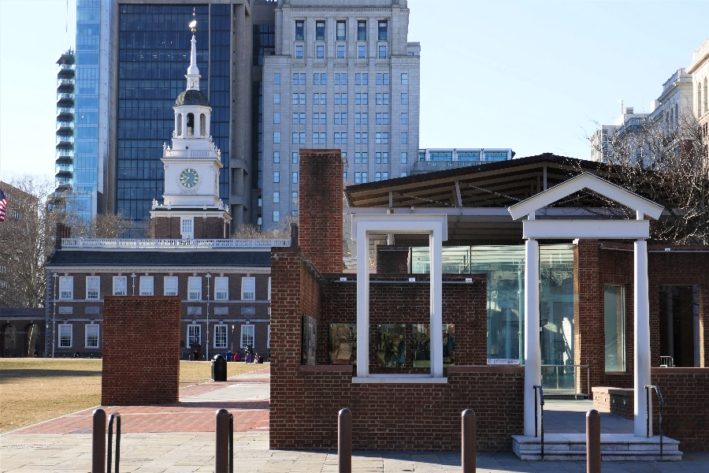
Washington’s house with Independence Hall in the background.
The National Constitution Center
Located at the far end of the long Mall facing Independence Hall is what I have come to believe is the most important museum in the nation. Architecturally, it is not that outstanding, but inside is one of the most emotional experiences you will ever have in a facility of this kind.
Before the Coronavirus closed the museum (and hopefully when it reopens) the experience here begins with actors and a multimedia show that tries to explain how strangely wonderful and revolutionary the five pages of the Constitution were to the world in 1787, when for the first time in history a government statement began with the simple words, “We the People…”
Of course, in 1787, “we the people,” was a very narrow expression, excluding enslaved Africans, people with no wealth, women, and so many others. It is the challenge of this museum to explain how over time, America has tried to enlarge, redefine and rewrite in law those three words, “we the people.”
It is a frightening and bloody story. Some 700,000 men died in the Civil War and thousands more African Americans were lynched in the Jim Crow era. This is a tale of the laws of America — bootleggers and gangsters, assassinations, the Ku Klux Klan, Vietnam, impeachment, abortion, demonstrations of a half million people, women’s rights, gay rights, mass murderers, prisons, flag burning, hatred, bigotry, and yet … and yet, through it all … rings the desire of multitudes of people to create a government that would be defined by three simple words: “We the people.”
There is no political agenda in this museum. Here, for all to see, is the dark side. You can learn that the United States is one of only three constitutions on the planet that protects the right “to keep and bear arms.” You can see that since the 1980s, America offers far fewer protections of liberty than many other industrial nations. But you also learn the magic of these five pages written more than 200 years ago and amended only two dozen times that have guided this country through so many challenges.
Today, in an era of great division, the museum points out that our challenges may not be the fault of these five pages written two centuries ago, but perhaps it is instead the fault of those of us who have not taken the time to understand the Constitution, and, as George Washington and our Founders intended, made the effort to continually update the document to meet the changes of the 21st century. Visiting Philadelphia, to see where our country was born and where it may need to change, is one great step in the right direction.

NATIONAL CONSTITUTION CENTER has life size sculptures of all the signers of the Constitution. You can walk around them and compare their sizes (George Washington is the tallest). If the room seems small for this many statues, it is the same size as the room in Independence Hall where the signing took place.
IF YOU GO for the road trip food, don’t forget that beyond being educational in a historical sense, Philadelphia is just plain fun. And a town of delicious food, beer and specialties, like cheesesteaks, seafood, soft pretzels, Italian ice, and funnel cakes. It takes a minimum of two days/nights to see the city, more if you want to see the many art and scientific museums too.
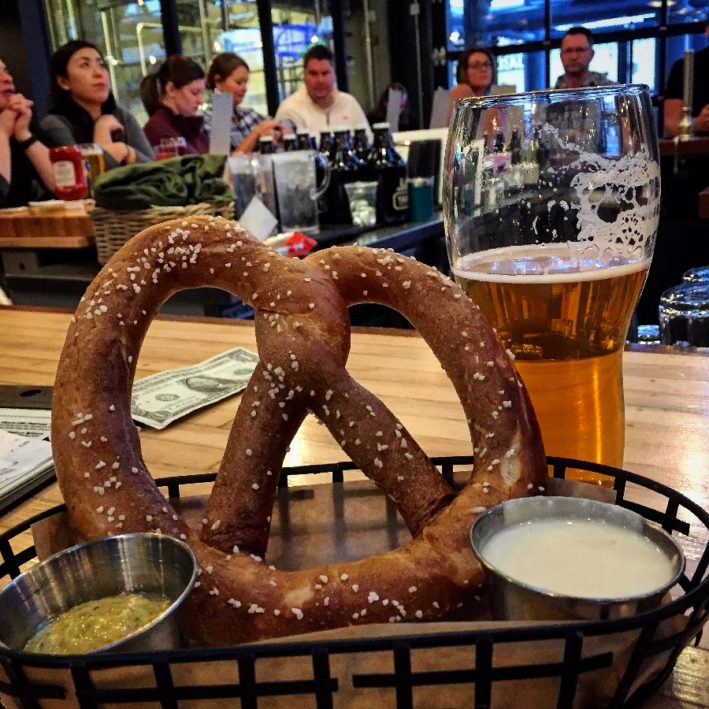
Big, soft pretzels are a Philly food specialty. They go especially well with a beer.
Don’t miss Reading Terminal Market. Built in 1893, it is one of the oldest and largest public markets in the nation with 80 merchants stuffed into every inch of the old building, offering counter seating and every imaginable food item from Cajun, Dutch, Soul, Latino, Thai, Middle Eastern, and of course, cheesecakes. Taverns are another Philadelphia specialty and there are a group of wonderful ones along 2nd Street near City Tavern, including Khyber Pass Pub and the very pretty, Plough and the Stars. Old Bookbinders, once Philadelphia’s most famous seafood restaurant, is now another historic pub down the block from City Tavern and called The Olde Bar.
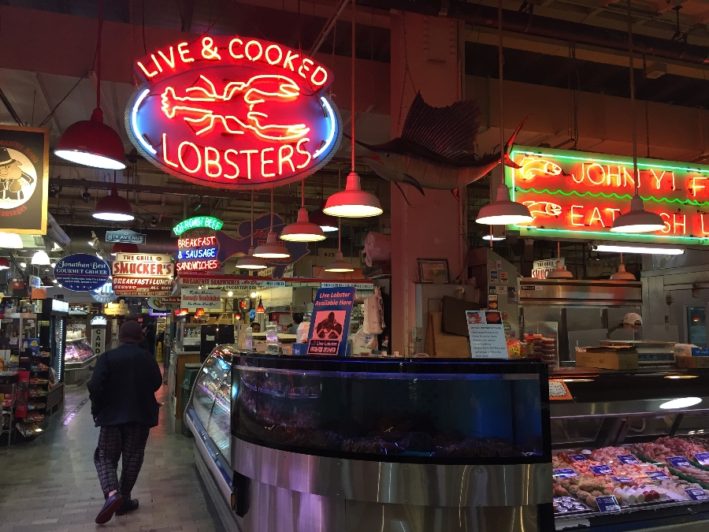
Reading Terminal Market is a must-stop for foodies in Philadelphia.
Want to know more about George Washington in Philadelphia and about visiting? Visit visitphilly.com.
— Story and photos except where noted, by Rich Grant
Hungry for more? Enjoy some of Rich’s other articles about the 1st president of America, such as 5 Reasons to Follow George Washington to Barbados, and his 2-part series of where to go drinking where Washington did; You can start making plans to visit Philadelphia with Booking.com, one of our affiliate partners.
RealFoodTraveler.com is a member of affiliate marketing programs including Amazon Services LLC Associates Program, GourmetAds, Cookly.Me, and AWIN, affiliate marketing organizations that pair publishers with advertisers whose content matches the needs of the readers. Affiliate marketing programs are designed to provide a means for sites to earn a small amount of advertising fees by linking to to their advertisers while providing convenience for the reader. Affiliate links do not change the pricing, nor experience for the reader.
Keep this list of places to see in Philadelphia handy by pinning them to Pinterest.








0 Comments