











Travelling by train is an immersive experience! Writer Carole Jacobs gives RealFoodTraveler.com readers a real taste for the full experience, from the thrills and chills to the flavors of riding the Cumbres & Toltec Scenic Railroad. In the process, she also provides a behind-the-scenes view of the food scene, which will make passengers appreciate their meal even more. And, as a bonus, Carole lists additional ways to satiate the desire to go all in on going all aboard.

Plan your journey by train by saving this article to Pinterest as reference. Photos courtesy Cumbres & Toltec Scenic Railroad. Graphic by RealFoodTraveler.com.
Cumbres & Toltec Scenic Railroad:
A Ride Back in Time on the Highest, Longest and Most Authentic Steam Train in America
Woo-woo!
The steam train pulled slowly from the historic depot in Chama, New Mexico, smudging the fresh mountain air with billows of black coal smoke.
Before I could even settle into my plush seat, the scenic journey began as the train coiled up-up-up through rolling meadows and across a high trestle bridge spanning a rushing creek. Behind and already far below us, the Chama Valley fanned out like a patchwork quilt in Indian summer hues.
I was aboard the Cumbres & Toltec Scenic Railroad, the highest, longest, and most authentic steam-operated railroad in America.

The Chama Depot, where the journey began. Photo courtesy Cumbres and Toltec Scenic Railroad.
An engineering marvel of its time, the train route was originally built in 1880 to transport passengers from Denver to Mexico. But when gold and silver were discovered in remote regions of the San Juan Mountains, the train was repurposed to carry out the loot instead.
When the gold/silver boom went bust in 1890, the train’s vital role also ended. The tracks stood empty until 1970, when Colorado and New Mexico, seeing the train’s enormous tourism potential, purchased the most scenic part of the route, as well as the steam locomotives, freight and work cars, and maintenance facilities, thus saving the train from extinction. Today, the legendary train has been designated a National Historic Landmark.
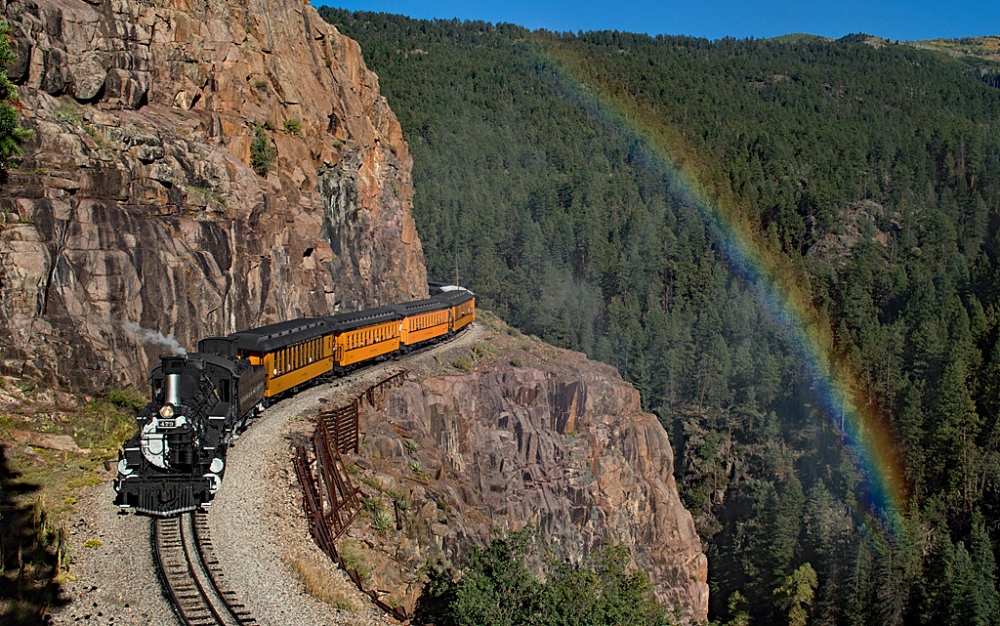
In its epic 64-mile journey up and over the precipitous San Juan Mountains between the historic railroad towns of Chama, New Mexico and Antonito, Colorado, it inches along vertical canyon walls through Toltec Gorge, burrows through two long tunnels blasted from the rocky San Juan Mountains, steams across the 137-foot-high Cascade Trestle spanning a roaring river, and chugs to the top of 10,015-foot Cumbres Pass, the highest point ever reached by any steam railroad in North America. As the train rollercoasters from craggy peaks to yawning chasms, it crisscrosses the Colorado and New Mexico border 11 times.

The Cumbres & Toltec on a trestle. Photo courtesy the Cumbres & Toltec Scenic Railroad.
Rising through the seasons
The train climbed more hills, crossed more trestles, and rounding another tight corner, suddenly deposited us in autumn. The train threaded through stands of blazing aspen whose colors became progressively brighter and bolder the higher we climbed. Out one window, pockets of yellow and orange aspen lit up vast stands of brooding conifer. Out another window, a solitary aspen blazed crimson against a craggy cliff face.
As the train corkscrewed up to 10,015-foot Cumbres Pass, the highest point of the journey, it chugged around Tanglefoot Curve, a loop so tight that the train seemed to almost fold in half. We raced to the observation car to get photos of the train coming and going.
After crossing another high trestle, the train hugged a sheer rock face and rolled into what looked like a movie set for “The Sound of Music:” High, rolling meadows raced to tall, dark pines, and a handful of weathered-looking structures clung to a summit.
The train blew its whistle as we approached the historic 1884 railroad settlement of Osier. Rolling past an old water tower and a tiny tumbledown shack that was the old Osier Depot, the train screeched to a halt at a big yellow station house that once serviced railroad workers.
“Lunch time!” announced the costumed docents who were narrating the journey. “We’ll be here an hour, and don’t worry, there’s plenty of food for everyone!”
For scenic wonders, nothing beats train travel, especially on the Cumbres & Toltec
There really is something about a train that’s magic: Planes may get you there faster, but by collapsing the distance between here and there, they turn what might otherwise be a visual feast past natural wonders into a blank void.
On trains, the journey, not the destination, is the point of traveling.
And when it comes to visual feasts, the Cumbres & Toltec’s cinematographic scenery is such a star player that it landed the train in more than a dozen Hollywood films, from “Wyatt Earp” with Kevin Costner and “A Million Ways to Die in the West” with Seth McFarland to “Hostiles” with Christian Bale; “The Harder They Fall” produced by Jay-Z, and “Indiana Jones & the Last Crusade,” with River Phoenix and Harrison Ford as the young and adult Indy.
While we weren’t allowed to ride on top of the cars like Indy did in the movie, we enjoyed equally-unobstructed views of the passing scenery by riding on the platforms between cars, or by heading to the outdoor gondola observation car.

Enjoying the unobstructed views. Photo courtesy the Cumbres & Toltec Railroad.
Lunch at 10,000-plus feet
During the train’s early years, the fare from Denver was $20, and a “good meal” at the station house cost 75 cents. The bargain fares may be long gone, but it was clear the “good meal” was still around.
Filing into the historic station, we were ushered to a bountiful buffet that pays tribute to the train’s regional and historic roots: There was roasted chicken with a Southwest marinade, and BBQ pork; blue corn, green chili and cheese enchiladas and spicy meat loaf; brown rice and roasted potatoes; red chili soup and beef stew, blackberry and peach cobbler, triple chocolate cake, and in a nod to the 21st century, vegan apple crisp.
“It’s regional food, but we also looked at the original meal when the train first started and tried to go back to the roots,” says Chef Victoria Bruneni, who heads up the train’s lunch operation.
How she got that gig is a story in itself.
When she’s not cooking and feeding the 200-300 train passengers who arrive in Osier every day between June and October, Bruneni is the owner of the Santa Fe-based catering company, What The Truck which caters everything from small and medium films to conventions, weddings – you name it.
Last summer, a fire destroyed the kitchen at the station house. Suddenly, the train needed a place (and a chef) to feed its hundreds of hungry passengers.
With 27 years of experience under her belt, as well as a mobile kitchen truck that could actually make it up rugged dirt roads to 10,000 feet, Bruneni was the logical choice.
Despite the mobile kitchen’s cramped quarters (“65 feet from nose to tail”) and a temperamental oven that periodically shot out flames for no discernable reason (“The first time it happened, it caught one of my employee’s hair on fire,” says Bruneni), the crew managed to put out 22,000 meals in the 2022 season.
This year, they’re operating out of a spacious new kitchen in the station house built by the train company. And while cramped quarters and a shooting-flames-oven are no longer issues, “There are still have many challenges that must still be dealt with on an ongoing basis,” says Bruneni.

Chef Victoria Bruneni at Osier. Photo courtesy Victoria Bruneni.
Challenges of cooking in the wilds
Beginning with the location off-the-grid at 10,000 feet, where there’s no electricity, no phones and no stores. (The closest supermarket is many miles down a dirt road.)
“The nature of relying on things off the grid, well, stuff goes wrong,” says Bruneni. “Because we have walk-in freezers and refrigerators but no source of electricity, everything has to be on generators 24 hours a day. This means we have to get service people all the way up here on a regular basis to fuel and service the propane tanks.”
Another challenge is “cooking at an incredible high altitude,” says Bruneni. “The water boils faster up here, but it doesn’t necessarily cook things faster,” she says.
“Plus, we constantly have to adjust recipes to get them to work,” Bruneni says. “A cornbread recipe that came out perfect down in Santa Fe, which is 2,000 feet lower, didn’t rise up here in Osier at all.”
While the food prep required to feed 200-300 passengers every day is daunting at any altitude (“We prepare 60 pounds of meat loaf at a time and are cutting 400 pounds of potatoes a week,” says Bruneni), cooking for a crowd when you’re miles away from a supermarket can double (triple, quadruple) the daunting factor.
For the mountain of food supplies she needs on a regular basis, Bruneni has to rely on a twice-a-week delivery truck that meets her at the Antonito Depot, at the bottom of the mountain.
“From there, we have to drive it up to the summit on a dirt road,” she says. “In nice weather, this takes 45 minutes. But if it’s raining, the dirt road can get treacherous, and it takes much longer.”
In addition, Bruneni has to juggle the logistics of getting a kitchen crew to 10,000 feet every day. “I have about 12-16 employees that come up every day from Antonito, and I also bring a rotating core crew of about five people from Santa Fe, which is three hours away,” she says. The Santa Fe crew sleep in the 100-year-old section house, which has seven bunks.
The sunny side of Osier
Despite the many challenges, Bruneni says feeding the train for the past two seasons has been a wonderful experience.
“The lack of space and kitchen facilities isn’t as much of a challenge this year now that we have a new kitchen, “and any chef would be jealous of the views from my kitchen,” she says.
But the real ace in the hole is her staff, Bruneni adds. “I have such an incredible team, and even though we have some form of a disaster on a daily basis, we manage to pull through and get everyone fed.”
By hell or high water, Bruneni and crew plan to feed 32,000 passengers by the end of the 2023 season in October.
At which point, she’ll put up her feet and relax?
“Well, no,” says Bruneni. ”My catering company in Santa Fe runs year-round, so I never really stop.”
It’s all downhill from here
After a hefty lunch, we waddled back on the train and settled in for the journey down to Antonito, traveling along a section of track that’s become notorious for – incidents.
At Toltec Gorge, a rocky chasm that plunges 800 feet, a passenger train derailed and rolled down the steep hillside in 1881. We held our breath as the train snaked carefully along the narrow ledge.
Calico Cut’s rusty-red, orange, purple, marrow- and tan-colored loose clays were beautiful to behold but are so soft they’ve caused many avalanches and mudslides.
And on a bitterly cold night in February 1948, an avalanche roared down the steep slope at Phantom Curve, where a rock spire casts a ghostly shadow. The avalanche plowed into the train and sent the coaches sliding down the side of the canyon–so slowly that some passengers were not even rocked from their seats. The passengers managed to climb back up the hill to the train, where they warmed up in the baggage cars until the hospital train arrived.
On our modern journey, as the train descended the mountain, the terrain softened and the brown hills flattened into a broad plain punctuated by distant high peaks. In the waning light, we sped towards Antonito, a dusty windswept outpost founded in 1880, and, then as now, the end of the line.
For more information, and to book a trip (trains run from Chama and Antonito and include full-day, half-day and special excursions on geology, botany/wildflower, brunch and dinner trains), visit the Cumbres and Toltec website, here, or call 1-888-286-2737.
BONUS: 8 More Can’t-Miss Scenic Trains in America
The Durange and Silverton Narrow Guage Railroad. Photo courtesy Flickr.
From Alaska to North Carolina, here’s eight more trains that highlight some of the country’s most dramatic scenic wonders.
- Durango & Silverton Narrow Gauge Railroad, Durango to Silverton, Colorado: The National Historic Landmark train once hauled silver and gold on track laid in the late 19th century. Today, the 7-hour round trip journey displays eye-popping views of rushing rivers, plunging gorges, waterfalls cascading down mountainsides, and sparkling aquamarine lakes, with a lunch stop in the fascinating gold rush mountain town of Silverton.
- Rockies To The Red Rocks (Rocky Mountaineer) Denver, Colorado to Moab, Utah: Rocky Mountaineer has long been synonymous with ultra-scenic luxury train travel in Canada. Their first route in the U.S. offers more of the same as it traces the Colorado River, with views of red-rock mountains, canyons, and cliffs. You’ll also the Rocky Mountaineer’s classic gourmet dining and crafted cocktails under beautiful glass-domed ceilings.
- Denali Star Train, Anchorage to Fairbanks, Alaska: This 12-hour, 350-mile journey from Anchorage to Fairbanks choo-choos past enchanting views of glistening snow, frozen rivers and glaciers galore, views of Mt. McKinley, and close encounters with bears, moose and eagles from the safety of your train window. Keep your eyes peeled for the Northern Lights!
- Grand Canyon Railway Williams, Arizona To Grand Canyon South Rim: On this historic train, all the cars have fascinating former lives, and some even have glass-dome ceilings. From the quaint town of Williams, you’ll ride through pine forests, prairies and high desert solitaire, get a chance to spy on pronghorn and bald eagles, and arrive at the Grand Canyon’s epic South Rim two hours and 15 minutes later for world-class scenery of “The Big Ditch” and its forested environs.
- Tennessee Valley Railroad, Chattanooga To Delano, Tennessee: Enjoy a 50-mile roundtrip through the beautiful lower Hiwassee River gorge on a 5-hour round trip that takes you to the top of the famous Hiwassee Loop, where the tracks cross over themselves as they corkscrew up the mountain near Farner, Tennessee. (There are only 6 of these loops in North America and this is the only one East of the Mississippi River.) Your conductor will narrate the tour and may even play his banjo! Go in autumn and you’ll also enjoy awesome fall foliage.
- Cuyahoga Valley Scenic Railroad, Independence To Akron, Ohio: Experience Ohio’s only national park on a train journey that begins at Rockside Station in Independence, Ohio, and ends about 3 and a half hours later at North Side Station in Akron. You’ll roll past dramatic views of the Cuyahoga River, wildflowers in spring, and blazing forests in fall. Hop off to hike the park’s trails or waterfalls, and catch a return train when you’re done.
- Conway Scenic Railroad, Conway, Vermont: Nestled in the heart of Conway, New Hampshire, you’ll find the Conway Scenic Railroad. The Victorian-era station in North Conway Village, built in 1874, is worth the trip alone. For a trip back in time, book a seat on an antique coach built in the 1920s. The 1.75-hour excursion takes you over the river and through Mt. Washington Valley and Crawford Notch. The ride is particularly beautiful in autumn, when the forests are flushed with fall colors.
- The Great Smoky Mountains Railroad, Bryson City, North Carolina: Various routes originate here, but the four-and-a-half-hour Nantahala Gorge excursion is a scenic stunner, winding along the woodsy Nantahala River and crossing the Fontana Lake by bridge. Come in autumn for breathtaking fall foliage and geta front-row view of Fontana Lake, the historic Fontana Trestle, the Great Smoky Mountains National Park, the Nantahala National Forest, the Nantahala and Tuckasegee Rivers, historical structures, and more.
-Story by Carole Jacobs, RealFoodTraveler Health & Fitness Editor
Hungry for more? Read about the culinary scene aboard the Rocky Mountaineer.









0 Comments