





Juan Pedro Jiménez greeted our group by taking each woman’s hand as though he was going to kiss it, but instead bowed and placed it close to his forehead, saying “Señora.” The men got a firm handshake and “Caballero.” We didn’t need our translators to tell us we were in for a warm experience at Juan Pedro’s family-run Restaurante Venta El Albero, in business for 42 years. Located in Jerez de la Frontera, the city we were visiting in Spain, this was the start of a special behind-the-scenes glimpse we travel writers were privy to and a fantastic lunch anyone can have.
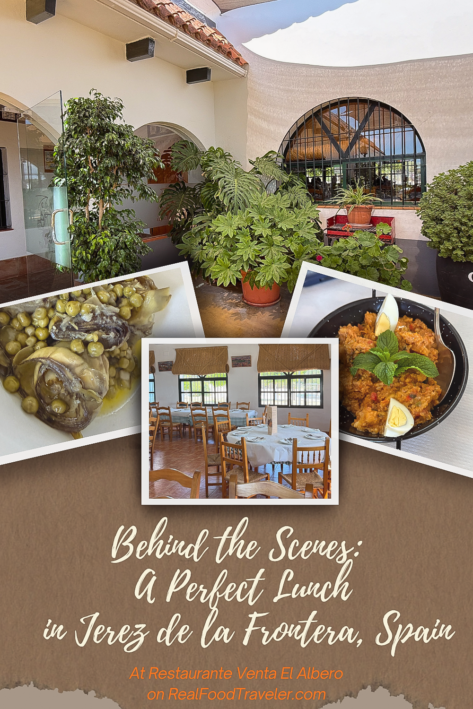
Save this article to Pinterest to help you plan your own visit to Restaurante Venta El Albero in Jerez de la Frontera. Photos by Courtney Drake-McDonough. Graphic by RealFoodTraveler.com.
Hungry for more? Find out what to eat, drink and do to experience the essence of Jerez de la Frontera, Spain.
I was in Jerez de la Frontera as part of a media tour in recognition of the city’s prestigious designation as Gastronomic Capital of Spain 2026. Having lunch at Venta El Albero, and meeting Juan Pedro, was one of the ways we were experiencing authentic, truly local cuisine.
Juan Pedro led us through the restaurant not-yet-open for the day, to the kitchen where he introduced us to multiple generations of women in his family – mothers, aunts, daughters, cousins – all working around a large island in the center of the kitchen. One woman was peeling the charred skin and seeds off of red peppers the size of my outstretched hand. Another had shredded tomatoes into a bowl next to slices of day-old bread and a plate of sliced white onion and whole garlic cloves to make Sopa de Tomate Jerezana (Jerez-style tomato soup).
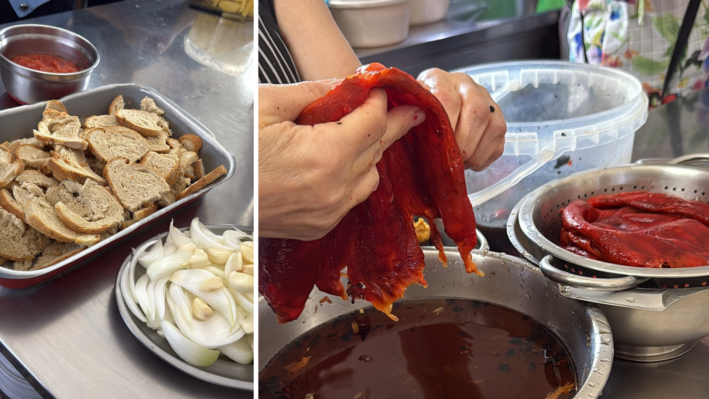
In the restaurant’s kitchen, we saw the ingredients for Sopa de Tomate Jerezana (left) and a woman peeling large red peppers that would be used in other dishes (right). Photos by Courtney Drake-McDonough.
The women generously let our group join them around the island, not to help but to ask questions and take tons of pictures. This was a rare opportunity to see a family of women working together in the restaurant’s kitchen, each with their specific part to play in the meal prep.
I positioned myself near the matriarch of the family which turned out to be a serendipitous spot in which to stand. She was making Berza Jerezana (or Berza for short). This dish, very local to Jerez and the surrounding areas, is a traditional country peasant field worker dish. Different variations are found in agricultural regions of Spain.
The dish starts with garbanzo beans (a staple ingredient in Jerez), chopped kale, chard, celery or cabbage depending on what’s in season. Chard from the garden was being used when we visited. lots of chard was used when we were there. That was topped with curved links of chorizo, blood sausage, and two cuts of pork (shoulder plus one that basically translates to the waddley area underneath the pig’s chin). Brick-red pimentón de la Vera (smoked paprika), a staple of the area, was generously sprinkled on top along with a crumble of a mixture of whole garlic, handfuls of salt and other things I could not see, frankly, pounded together in a mortar and pestle. Maybe, probably, water or broth was added after that (I wasn’t present for that step), but we saw one pot of the mixture already made and ready to serve. It was brothy but thick and reddish. We’d all soon get to have a taste.
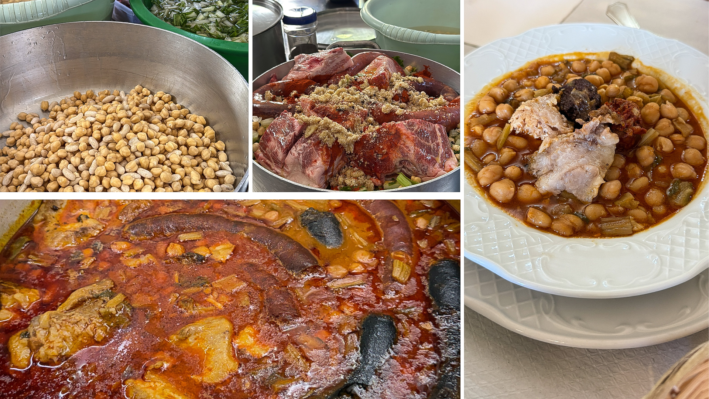
Various stages of Berza Jerezana stew being made at Restaurante Venta El Albero in Jerez de la Frontera. Photo by Courtney Drake-McDonough.
I could have stayed in that kitchen for hours, soaking up the scene, and helping too, if they’d let me but I would have been interrupting their orchestrated process, honed by years of working together. Juan Pedro led us past tubs of squid, caught that morning, and a bowl of large lemons and mint procured from his garden, also that morning. He was anxious to show us the garden.
It had been a rainier than usual spring in Jerez so the growing season is behind a bit, he told us. The eggplants and tomatoes should be farther along but the green beans were just right. He picked a handful while talking to us. He proudly presented the chard and ran his hand through the actual bathtub of spearmint before holding his hand up to my face so I could smell the essence. He laughed when I smiled and identified it correctly.

Greens and herbs growing in the garden at Restaurante Venta El Albero in Jerez de la Frontera. The garden’s bounty sources the restaurant. Photo by Courtney Drake-McDonough.
Juan Pedro showed us the tomato plants that are only in the flowering stage now but will grow fruit as “big as bull’s testicles” (his description, not mine) and others that will look like little red pumpkins when ripe. The chickens followed him to bushes of berries in various stages of ripeness, one of their favorite things to eat. It sounded like Juan Pedro said they were “mora” berries which translates to “mulberry.” He told us that, if you get the berry juice on your clothes, it will stain but you can use the unripe, white berries, to remove it. Good to know.
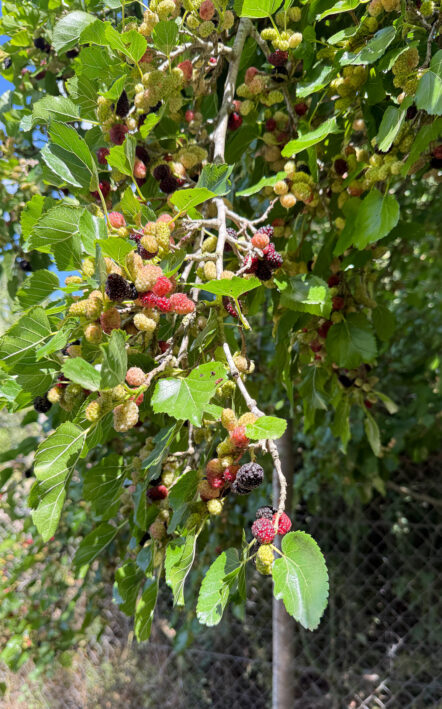
A “mora’ or mulberry bush in the garden at the restaurant. Photo by Courtney Drake-McDonough.
Hungry for more? Learn how to eat like a Spaniard in this podcast.
We walked back to the kitchen, past a large, curved pressure cooker sitting outside the kitchen in a grocery cart. Why it was there, I’m not sure, but it stood at the ready and reminded me of my grandmother’s pressure cooker, which I still use. The whole experience reminded me of the women in my family sitting around a table, prepping for a large meal. Even some of the aromas were familiar – onion, garlic, fresh thyme, tomatoes heating up. I felt so fortunate to have been witness to the whole scene.
The final steps were being put on lunch – the items people would be ordering once the restaurant opened for the day in about an hour.
I went with part of my group to the nearby The Carthusian Monastery, which was historically instrumental in the protection of the Andalusian breed of horses the region is famous for. Recently opened for public tours, we took an abbreviated spin through the beautiful place, while the family finished preparing for opening the restaurant. It’s a beautiful place with serene scenes inside and out.
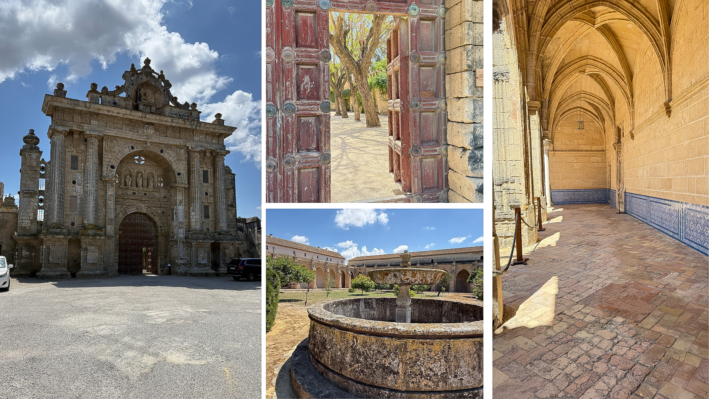
Scenes from The Carthusian Monastery near the restaurant in Jerez de la Frontera. Photos by Courtney Drake-McDonough.
One of our guides stayed behind and got to see the full staff sit down to the “family meal,” a term used in restaurants for the meal they share before the patrons come. She said they laughed, ate, cleared the table, changed out of their casual clothing and into their work clothes – a crisp blue and white stripe shirt for Juan Pedro which looked so sharp on him.
We returned to the restaurant from the monastery to a long table set and ready for us. Course after course was presented, nicely paced, served family style, naturally.
There were par-boiled potatoes with white onion in a vinegar dressing, Patatas Aliñadas – something often seen at restaurants in Jerez and Cádiz province, and the Sopa de Tomate Jerezana, warm, thick and spoonable. Mint had been added at the last minute making the simple ingredients seem more complex. Juan Pedro said the dish was considered peasant food – a way to use up ingredients, cheaply – and that every family puts its own spin on the dish.

Patatas Aliñadas and Sopa de Tomate Jerezana served at Restaurante Venta El Albero. Photo by Courtney Drake-McDonough.
Hungry for more? Try this recipe for Patatas Aliñadas to make it at home.
Those were followed by Croquetas, found throughout Spain, not just in Jerez, made from pork and chicken cooked in broth that resulted in a creamy filling with lightly crisp exterior, maintaining its capsule shape.
Then came Alcauciles con Chícharos, a.k.a. alcachofas con guisantes artichokes (thank goodness they were in season during my visit), cooked in olive oil until creamy, yet still maintaining their shape, with green peas. I wouldn’t have thought to put the two vegetables together, nor to cook the artichokes in olive oil but it was decadent.
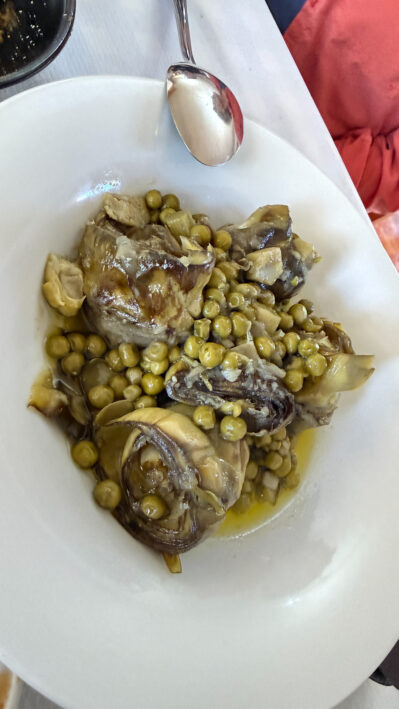
Artichokes and peas, aka Alcauciles con Chícharos, served at Restaurante Venta El Albero. Photo by Courtney Drake-McDonough.
We were nearly full already but the main dishes hadn’t even come out yet! The Berza Jerezana I’d been standing by came next, with plump garbanzos that had just the right amount of firmness and pieces of the various meats. The different textures and flavors combined into something cozy and delicious.
A platter of slow-roasted bull’s tail came next, with bits of carrots and peas in a broth, served with crispy fries. I’ll be honest, I wasn’t too keen to try this dish, what with it being bull tail and all. But what kind of Real Food Traveler example would I be if I didn’t? The texture was like lamb shank and the flavor was simply meaty. The fries were darned good too!
Plates of dessert came next and I was simultaneously grateful to see the huge meal coming to its logical conclusion and so stuffed I actually contemplated passing on the offering. Thankfully, I pushed myself to the limit for a small square of Tocino de Cielo and another of an almond cake. I’d had the Tocino de Cielo almost every day on this trip because practically every restaurant serves it. Found all over Spain, it hails from Jerez. The dessert came about because, centuries ago, after using egg whites to purify sherry, there were many egg yolks leftover. The idea came about to give those yolks to the nuns who created the creamy dessert. The custard uses whole eggs and then a bunch more egg yolks plus sugar, with a richly caramelized top to create a silky, almost-too-sweet, dessert. I said “almost” too sweet – I would never reject it.
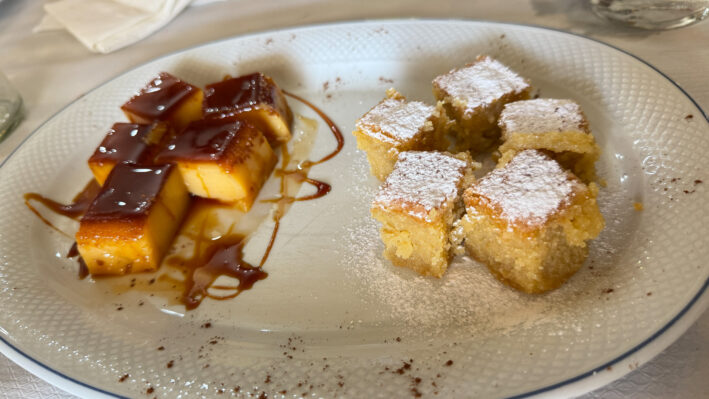
A plate of squares of Tocino de Cielo, left, and almond cake, right, was served to our group for dessert. Photo by Courtney Drake-McDonough.
Hungry for more? Hear a personal story behind sherry-making in Jerez de la Frontera in this podcast.
One of the servers, Juan Pedro’s handsome son-in-law, brought tiny glasses (like candle votives) of deep red wine and suggested we have a sip of wine with our bites of custard. He says that’s the best way to enjoy the dessert. He was not wrong!
Our meal was delicious, made all the better by having had the privilege of going behind-the-scenes with the family. While that experience isn’t available to most diners, let me just tell you, dear readers, know that what is behind every bite of a meal at Restaurante Venta El Albero is the very freshest ingredients – produce from the garden out back, seafood caught that morning, and other items procured from Juan Pedros’ friends. And there’s family. Definitely family, the best ingredient.
Restaurante Venta El Albero is open limited days and hours. Reservations are required. The website is ventaelalbaro.com.
-Story and photos by Courtney Drake-McDonough, Publisher & Managing Editor, RealFoodTraveler.com
Hungry for more? Get an insider’s guide to all-things-Jerez in this podcast.
Please note, as is common practice in this industry, this was a hosted visit, however, all opinions are honest and based on the author’s opinion for the purpose of informing our readers.






0 Comments