





Coffee made well is a wonderful thing. Coffee made well, properly, and with style is an Italian thing. Writer Sharon Kurtz shows us how to navigate the coffee culture in Rome and, moreover, how to order like a local.

Keep these coffee culture in Rome tips handy by pinning them to Pinterest.
Navigate the Coffee Culture in Rome… and how to order like a local at the most historic cafés in the Eternal City
Italians love their coffee – and the coffee culture in Rome is filled with rituals and nuances that are not always easy for outsiders to understand. There are a few basic rules to follow to avoid being considered “uncivilized,” as these traditions and unspoken rules around coffee can make it confusing for tourists to order coffee in Rome. Before I dive into the rules, you have to know how to say coffee in Italian: un caffé (with accent on é).
You never see Romans walking around on the street with a coffee cup in their hands – it simply is not done. Romans like their coffee fast, strong and burning hot. They’ll pop into bars five or six times a day for a quick cup, gulped down at the counter over some banter with the barista. That’s the philosophy, it’s part of the lifestyle. For an authentic experience, join the masses at the counter. The clink of the ceramic cups and routine of shaking sugar packets and stirring the contents makes you feel so Italian, and one you won’t get from the table.
Getting ready to spend some time in Rome, I decided it was time for me to decipher the code, experience the rituals and learn how to order like a local. Before I get into my café recommendations, I’ll first share a number of tips and advice on ordering and drinking coffee in Rome.
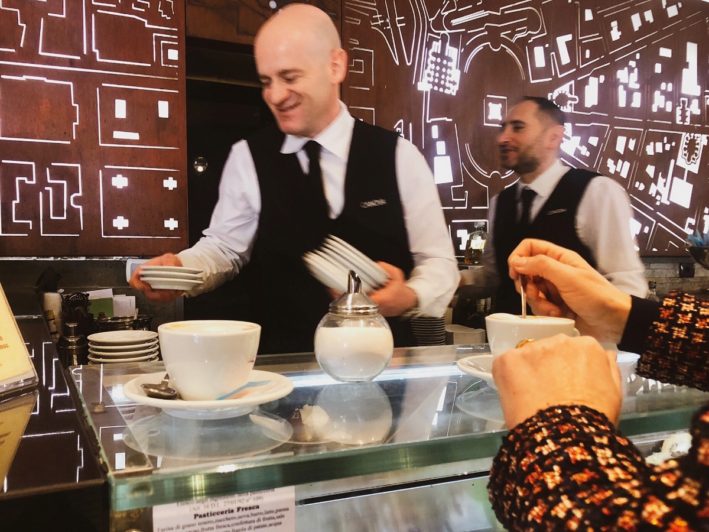
Standing at the counter for a quick cappucino while engaging in some friendly banter with the barista is part of the Italian lifestyle. at Caffe Canova.
What is the most typical way to have coffee in Rome? OR When in Rome, drink coffee as the Romans do.
First of all, it’s important to know that what we call a “café.” Italians may refer to as a café or a “bar.” You’ll see hundreds of bars and cafés around Rome, on almost every corner and sometimes up to three or four in one block. If you think that most Romans are lingering over their coffees on a picturesque café terrace, you’ll discover soon this is not very typical. In fact, most never even sit down to have their coffee. Romans have strong opinions about their favorite bar, barista and coffee preparation – the Italian 30 second breakfast is an espresso and a pastry, eaten at the counter before whizzing off on the moped to work.
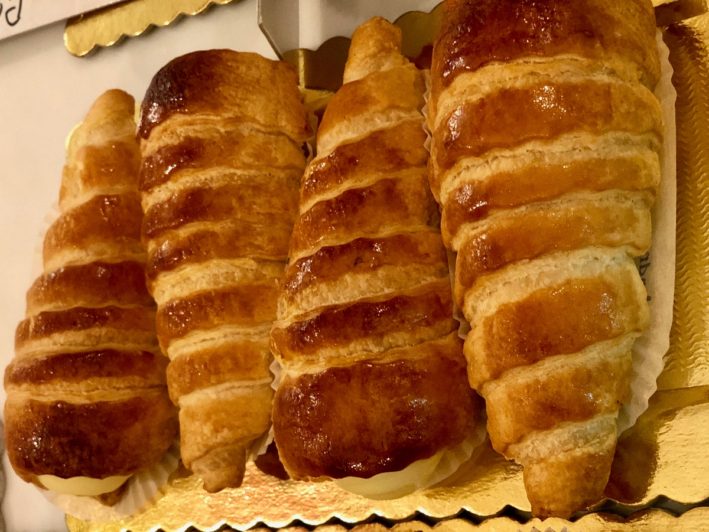
For countless Italians, the breakfast duet of a cornetto and cappuccino is a daily ritual. The Cornetto, meaning “little horn” in Italian is either vuoto (empty) or filled with jam, pastry cream, chocolate or Nutella. It is enjoyed bite by bite between swallows of cappucino.
What are the typical Italian coffee drinks?
These are some common drinks that you will find at any café in Italy:
- caffé: a shot of espresso with crema on top – a flavorful froth made when air bubbles combine with the fine-ground coffee’s soluble oils. The strong presence of crema indicates a quality, well-ground coffee and a skilled barista;
- caffé lungo: an espresso shot with more water drained through (generally twice as much as in a typical café);
- caffé ristretto: an espresso shot where less water than normal is allowed to drain through, so it is shorter and tastes stronger and richer;
- caffé americano: expresso shot with hot water added afterward, the most similar to a traditionally brewed drip coffee;
- caffé macchiato: meaning “stained” or “spotted” coffee, this is an espresso with a splash of hot, foamy milk on top. It’s delicious with a bit of sugar;
- caffé latte: espresso shot with a large amount of steamed milk, served in a glass or large cup, similar to an American latte;
- Mocaccino: a shot of espresso with a bit of hot chocolate added
- caffé corretto: a shot of espresso with a splash of liquor added, the liquor used varies but grappa is common;
- shakerato: a shot of espresso that is shaken with ice. Sugar can be added before it is shaken. Usually served in a clear drinking glass, primarily served in summer;
- granita di caffé: iced espresso with cream, it’s served with “panna” (double cream) at the bottom, followed by a coffee, iced and crushed, and topped off with more panna;
- cappuccino: saving the best for last, Italy’s most famous coffee drink is a warm, soothing, perfect ratio of espresso to steamed whole milk, frothed to perfection.
But cappuccino comes with a caveat – you cannot order one after noon, unless you want to risk being scorned. They believe dairy upsets digestion, deeming the drink far too heavy for an afternoon coffee break. You will never see an Italian order a cappuccino after dinner, and they’ll give you very funny looks if you do otherwise. Maybe they’re on to something, or may-be it’s one of the rituals that we will never understand, but either way, if you want to fit in, stick to ordering a cappuccino for breakfast.
Coffee Culture: How do you order coffee in Rome?
- It is polite to announce a greeting like buon giorno after entering the bar.
- Decide what you want to order.
- Check the price on the menu. Normally there is a menu posted, and it will usually have different prices for those drinking “al banco” (standing up at the counter) or those drinking the same drink “al tavaolo” (sitting at a table). Note that if you choose a table, you’ll pay more for the table service.
- Decide where you want to drink your coffee, standing at the counter, or sitting at a table.
- If you choose to drink your coffee at the counter, watch as the others order and do the same. Sometimes you pay the cashier at the register, then hand your receipt to the barista. Other times you order first and drink your coffee, then pay at the register after you have finished your coffee.
- If you choose to drink at the table, you can linger over your coffee and take your time enjoying it. You’ll get the bill and pay after you finish.

The espresso machine was invented in Italy and dates back to the late 1800’s, a method for preparing coffee where highly pressurized hot water is forced over finely ground coffee. Espresso refers to both the brewing process as well as the resulting drink. This barista is preparing an espresso at Sciascia Caffe, open since 1919, celebrating its 100 year anniversary.
Coffee Culture in Rome: A Brief History of Coffee in Italy
While no coffee is actually grown in Italy, the country is famous for roasting and blending of coffee and for its coffee culture. Coffee was first introduced into Italy in the 16th century. Over the centuries, Italy has developed a deeply ingrained coffee culture with a number of rituals and traditions, and Italy is sometimes referred to as the “spiritual home” of coffee.
It was in Italy where espresso was invented in the 19th century. Espresso refers to both the brewing process (forcing a small amount of nearly boiling water under pressure through finely ground coffee beans) as well as the resulting drink.
Famous Café’s in the Historic Center of Rome
“All roads lead to Rome” – and to its cafés and bars as well. I have chosen 4 historic cafés located in the tourist areas near the center of Rome. Once you’ve made sure to master the art of drinking coffee in Rome like a local, head over to one of these cafés to taste some of the best brews in the city. Each cup comes with a great atmosphere to accompany your caffeine kick. I have visited each of these establishments with the primary consideration being the coffee, of course; but also factored in location, ambience, history and uniqueness.
Sant’ Eustachio II Caffé
A legendary blend of 100% arabica beans, tradition and a frenetic atmosphere are just a few of the reasons that a dedicated local clientele and tourists keep flocking to this café. Located in the heart of Rome, just a few steps away the Pantheon, this cheerful café, with its signature yellow packaging is lauded as one of the best espressos in the city. Founded in 1938, it continues to create its own secret blend of coffee. The café has outdoor tables and prides itself on continuing to use an antique wooden coffee roaster from the 1940’s to toast its quality Arabica beans.
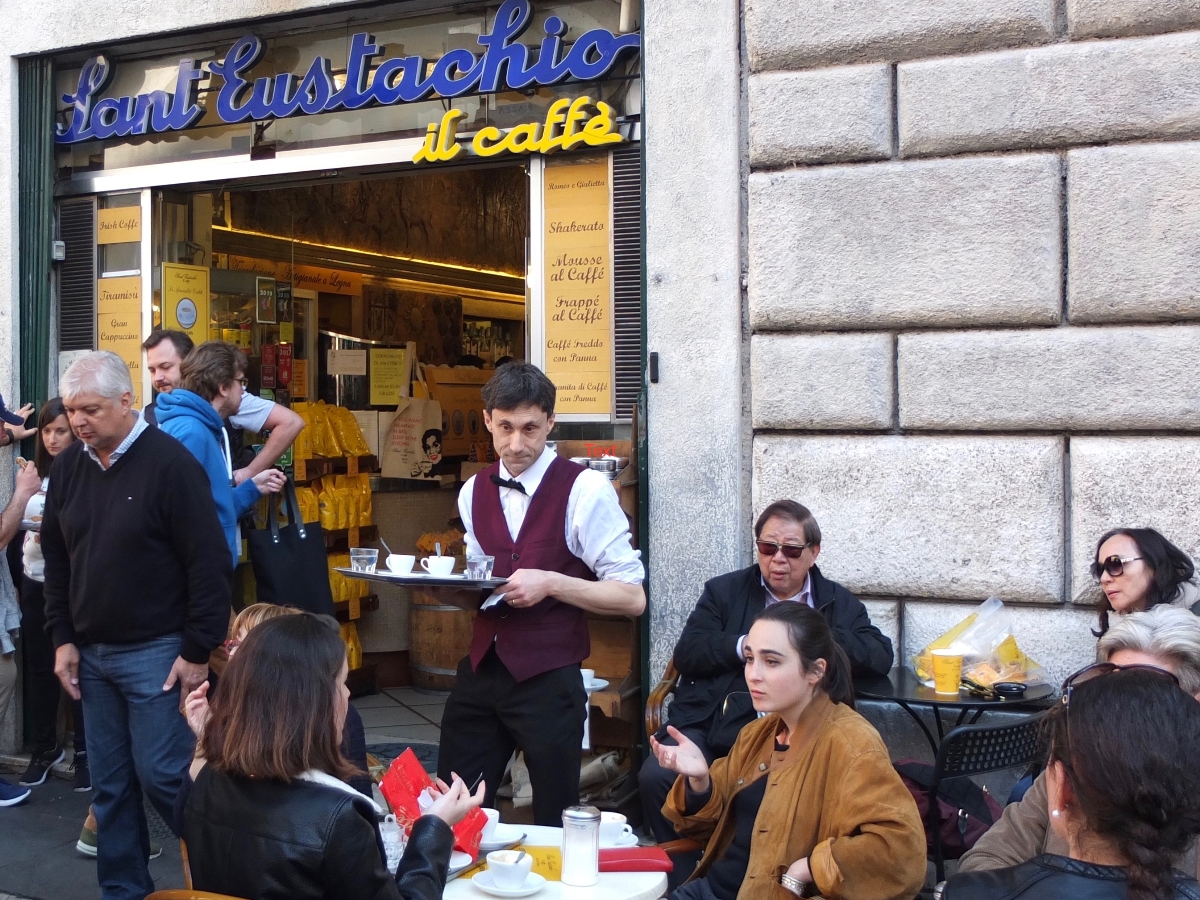
Sant’ Eustachio II cafe in the heart of Rome has a dedicated local clientele and is lauded as one of the best espressos in the city.
Sant’Eustachio II Caffé, Piazza di S. Eustachio 82, Rome Italy +39 06 6880 2048 https://www.santeustachioilaffe.it

The signature cheerful yellow ceramic cups and packaging at Sant’ Eustachio II Cafe, lauded as one of the best espressos in the city. The brown bottle picured is Liquore al caffe – a strongly flavored sweet liquor made from the finest coffee, frequently served chilled after a meal.
Tazza D’Oro
A stone’s throw away from the Pantheon, Tazza D’Oro is well known for its proprietary blend – Regina dei Caffé and remains one of the few artisan roasters in the historical center. Founded almost 70 years ago, it is still as fascinating as it was in the old days. “It’s as if time stopped here”, said a local long-time customer at the counter. One of the popular drinks is “granita di caffé”- it’s served with “panna” (double cream) at the bottom, followed by crushed ice and espresso, and topped off with more panna. I can personally attest that it is very refreshing!
La Casa del Caffe Tazza d’Oro, via degli Orfani 84, Rome, Italy +39 06 678 9792
http://www.tazzadorocoffeeshop.com
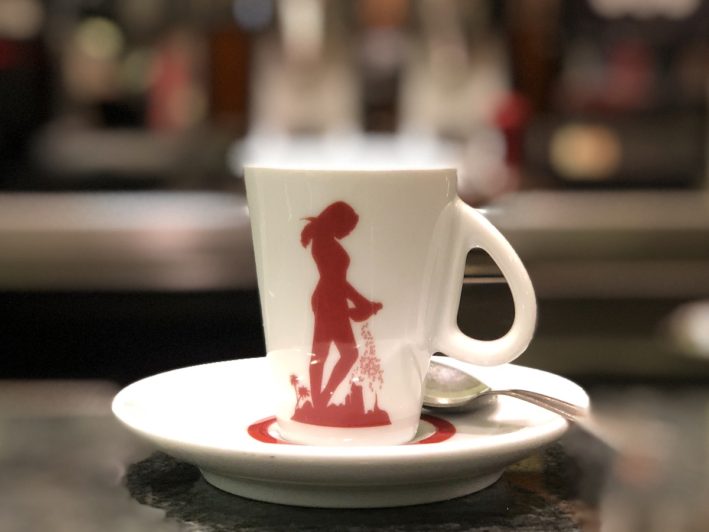
This is ceramic cup of steaming espresso with signature logo is from Tazza D’Oro, a historic bar in central Rome. The clink of the ceramic cups and routine of shaking and stirring sugar packets while standing at the counter makes for an authentic Italian experience.
Sciascia Caffé
At first glance, it appears to be an old-style Italian pharmacy frozen in time. Open since 1919, and celebrating 100 years in the same location, Sciascia Caffé is located in Prati neighborhood, not far from the Vatican. Rigorous bean selection and skilled baristas result in a superb coffee experience. I tried the specialty, un caffé con cioccolato – espresso with chocolate – and I quickly understood why coffee fanatics are addicted to Sciascia Caffé.
Sciascia Caffé +39 06 321 1580 Via Fabio Massimo 80/A Rome, Italy https://sciasciacaffé1919.it

A typical Roman breakfast is a quick espresso and a pastry standing at the counter. A specialty at Sciascia Caffe is un caffe con cioccolato – espresso with chocolate.
Caffé Canova
Oscar-winner and internationally known film director Federico Fellini was a regular at the Caffé Canova, a fancy venue with a terrace full of iron tables, set along the Piazza del Popolo. With seating inside and out, outdoor seating is a popular option at Canova as you can see the square and sip your coffee and people watch with a beautiful backdrop.
Canova 16/17 Piazza de Popolo, Rome, Italy +39 06 361 2231 http://www.canovapiazzadelpopolo.it/

Caffe Canova, situated along the Piazza del Popolo has the perfect outdoor seating for people watching as you sip your cappuccino and watch the world go by.
Now you’re a pro at navigating the coffee culture in Rome! And don’t worry if you feel overwhelmed when walking into a bar, someone will surely offer to assist you, and the servers are usually very friendly. I have found that a smile with a warm buon giorno will go a long way. The most important thing is that you take in the bar’s atmosphere, breathe in the scent of the freshly ground coffee and sweet pastries, and enjoy the taste of real Italian coffee whenever you can.
— Story and photos by Sharon Kurtz
Hungry for more? After your coffee in Rome, enjoy some Italian prosecco, with this guide. Also, get the Roman experience, even when you’re in Spain with this feasting experience. See what it’s like to attend school for Italian coffee in this story from CBS Sunday Morning.







0 Comments