






The San Juan Islands are a culinary traveler’s dream. Located in the Pacific Northwest, between Washington state and Vancouver Island, British Columbia, Canada, the islands are an archipelago that are part of Washington. The San Juan Islands are in the Puget Sound AVA which allows grapes normally grown in Northern Europe to flourish for an amazing wine scene. The seafood scene is abundant too, with multiple shellfish farms each of which has a different variety of fish. Visitors (who get there by ferry or small plane), can experience the shellfish, spirits, beer and wine, roadside farm stands, and flowers including lavender, which can be enjoyed in so many ways, including as culinary lavender. Here, Pelindaba Lavender® provides great tips and recipes for cooking with lavender, including why you absolutely, positively shouldn’t use the lavender in that sachet you have tucked in a drawer.

Save these tips and recipes from Pelindaba Farm to Pinterest to keep them handy. Photo by Pelindaba Farm. Graphic by Real Food Traveler.
Hungry for more? Make something with lavender to take on a picnic-perfect hike.
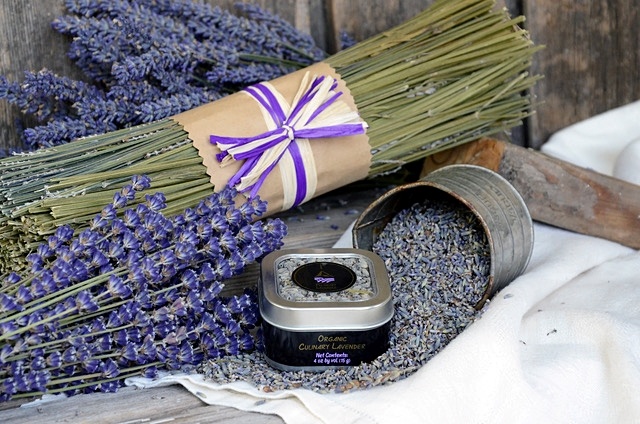
Strolling through the fields at Pelindaba Lavender Farm, visitors can easily channel the South of France. You can harvest your own lavender, learn about the distilling process and choose from more than 200 locally-made household, body-care, and culinary products. Here are Pelindaba’s 4 tips for how to cook with lavender – but not just any lavender:
Cooking with Lavender Tip 1: Culinary lavender is not the same as lavender for sachets and beauty products.
Most varieties of lavender can be used for cooking. A lot of it comes down to personal preferences. We use Lavandula x intermedia “Provence” for our recipes and culinary products. We prefer its flavor. Any variety of the angustifolia and x intermedia species can easily be used for culinary applications. What matters most is harvest time. Culinary grade lavender should be harvested early in the flowering season when just a handful of flowers have opened up on the flower head. Stated another way, lavender buds obtained later in the flowering season may have their culinary utility compromised as the paradoxically bitter essential oil builds up in the bud. While being laden with essential oil makes for wonderfully aromatic buds for other uses — sachets, crafts, home fragrance, etc, it can be quite unsuitable for culinary purposes. Inadequate understanding of the optimal time for harvesting culinary lavender has contributed to many poor culinary experiences. In other words, the “it tastes like soap” experience.
Cooking with Lavender Tip 2: Harvest the buds the right way at the right time.
Harvest lavender for culinary use when a few of the buds on a single stalk have bloomed. A mature lavender plant has roughly 500 flower stalks. On each stalk are dozens of buds. When a few have opened it’s a good time to cut the stalk. You can cut the stalk as long as you desire, just avoid cutting into the wood base of the plant.
Cooking with Lavender Tip 3: Using fresh versus dried lavender.
Although some recipes call for fresh lavender, we tend to use dried lavender flower buds in preparing the dish itself, reserving fresh flowers for garnish. We find the dried flower buds fully retain the lavender taste experience and are generally easier to handle. Drying means simply bundling some stalks together and hanging them to dry in a well-ventilated area for a few weeks. Then the buds are stripped from the stalks and used in any recipe.
Cooking with Lavender Tip 4: How to know whether or not you’re working with culinary lavender.
Squeeze a few buds between your fingers. If they have an exceptionally strong fragrance, use them for aromatic purposes. If, however, there is only a mild fragrance, the volume of essential oil in the buds is not large enough to negatively effect the flavor.
To learn more about lavender and to purchase culinary lavender to be shipped across the United States, visit the Pelindaba Lavender website where you can also get additional recipes. Visit, too! Celebrating their 20th year growing organic lavender and making lavender products, visitors can experience their newly redesigned educational exhibits, workshops, a lavender scavenger hunt around the grounds, lawn games, lavender treats including ice cream, u-pick cutting field and photo opportunities. Shop the store and nursery for items to take home. And in case you’re wondering (we were) where the name Pelindaba comes from, it’s a Zulu word that hearkens back to the owner-founder, Stephan Robins’ roots in South African. It can be translated as “place of great gatherings,” which blends their concept of gatherings of crops and people.
Products available from Pelindaba Lavender Farm, San Juan Island. Photo courtesy Pelindaba Lavender Farm.

Cooking With Lavender recipes are courtesy of Pelindaba Lavender Farm and Chef Tim Payne of Coho Restaurant, San Juan Islands.
Stuffed Baby Mushrooms with Lavender and Chevre
Ingredients:
24 Baby Bellas or Crimini Mushrooms, stems reserved
1 cup onions, chopped
1 clove garlic
6 oz. chevre (goat cheese)
1 tsp. Organic Culinary Lavender
Salt & Pepper to taste
Olive Oil
Method:
1. Preheat the oven to 375 degrees F.
2. Drizzle mushroom caps with olive oil and roast for 7 minutes. Liquid will pool in the caps. Drain it off.
3. Place 2 tablespoons of olive oil in a skillet and cook onions slowly to caramelize them until they have a deep, rich, brown color. Add the garlic and reserved stems and sauté until the stems are tender. Let cool slightly.
4. Place the chevre, onions, and lavender in a food processor. Pulse to combine. Season with salt and pepper to taste.
5. Place the filling in a piping bag and pipe onto the inside of the mushroom caps. The mushrooms can be refrigerated at this point and then cooked right before serving.
6. Roast for 15 minutes until the filling is cooked through and slightly golden brown.
Hungry for more? Learn how to make your own chevre.
Lavender Chantilly Cream
Use to top breakfast waffles, fresh berries, pound cake, ice cream, or your favorite dessert.
Ingredients:
1 cup heavy cream
1/4 cup powdered sugar
1 tsp Organic Culinary Lavender
1/2 vanilla bean
Method:
1. Slice the vanilla bean lengthwise. Bring the vanilla bean, culinary lavender, and heavy cream to a simmer in a small saucepan. Steep for 15-20 minutes.
2. Refrigerate overnight.
3. The next day, strain the lavender and vanilla.
4. Place in a large bowl and whisk with powdered sugar until soft peaks form.








0 Comments