





It can always be a little dicey to try foods you aren’t familiar with, that you can’t readily recognize, or whose name and ingredients you can’t pronounce. But fortunate are the brave souls who really dive into the cuisine of destinations they visit because they are truly eating like the locals, deepening their knowledge of, and connection to that place. Writer Edward Placidi is back from his latest adventure, this time exploring the Central Asia food scene, taking chances and reaping the rewards.
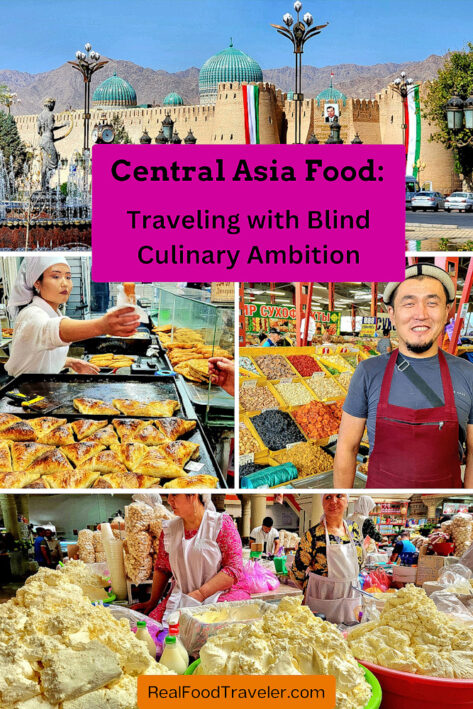
Save this article about the Central Asia food scene to Pinterest, to keep it handy. Clockwise from top: rebuilt ancient walls and fortress in Khujand; nuts, candy and dried fruit vendor; vendors selling Tajik cheese-like yogurt and Samsa vendor in Osh. Photos by Edward Placidi. Graphic by RealFoodTraveler.com.
Discovering the Central Asia Food Scene
I traveled blind during my recent jaunt in Central Asia, visiting Tajikistan and Kyrgyzstan. What have I actually ordered? Is it something I want to eat? I often asked myself these questions as I awaited meals to be served.
Language and the region’s Cyrillic alphabet were the obstacles in restaurants, and in general. With few exceptions, such as the front desk at most hotels, English speakers were rare. In Tajikistan the people speak a variation of Farsi, and in Kyrgyzstan a Turkic language. With menus in Cyrillic script, they were Greek to me.
It wasn’t all just fingers-crossed hoping. I tried various tactics, from Google Translate (using Russian which is spoken by many because of several centuries of first Czarist and then Soviet control) to pointing at the plates other diners were enjoying.
Eventually I turned it into a game ‒ a puzzle with mysterious components ‒ making it fun and adding another dimension to my travel adventure. Besides, in the end I was rarely disappointed; the worst curveball was the mixed vegetable plate I didn’t realize was all pickled – to the max – and overwhelming.
Thankfully, servers generally were very patient and tried to communicate, often pulling out their cell phones and opening a translator, as I did with mine. Yet, the results were usually limited to just a few bare details, such as “meat with vegetables.”
Luckily, sometimes menus had photos, invariably bad ones, but they at least provided some context. A few times I simply asked for a national dish I’d read about.
Looking back, dining was a highlight of the trip – the interaction with staff, the throw of the dice, the surprise element, and then enjoying the hot meal.

In Central Asia, Kyrgyz bread is served with nearly anything you order.
Hungry for more? Read about the melting pot cuisine of Oman.
The cuisine is not going to become the next foodie discovery, but dishes were hearty and filling, often satisfying, sometimes delicious. These are meat-eating lands, particularly beef, with horse an historic favorite.
Menus largely offer substantial stews and soups, grilled meats notably shish kebabs, accompanied by salads, and lots of bread. The region’s traditional staple ‒ round, seeded, flat loaves about the size of a dinner plate ‒ comes with almost everything you order.
Many if not most dishes are regional with each country often having its own variations – but for that matter, the dishes can vary from restaurant to restaurant and, I was told, from home to home.

Laghman, the National Dish, at Navat Restaurant in Bishkek.
An iconic dish of these lands is Laghman. Spaghetti-like but extra thick pasta is topped with a combination of beef or veal strips, bell peppers, radishes, potatoes and garlic that has been fried and then simmered. Navat Restaurant in the Kyrgyz capital of Bishkek serves the ‘Syai’ version swimming in a rich gravy – that was so much more savory and delectable than the typical laghman. A mutton version at a famed chaykhana (the legendary tea houses of Central Asia), Rokhat in Dushanbe, the Tajik capital, paled in comparison.
Bishbarmak is the kind of filling meal that sustained the traditionally nomadic people of Central Asia as they drove their animals across the vast steppes in search of green pastures. The Kyrgyz national dish usually features a regional favorite: horse meat (though it’s also prepared with beef or veal). Wide, flat noodles cooked in a meat broth are topped with boiled potatoes, onions and sliced meat.

Bishbarmak is a dish with horse meat served in Osh.
As a national dish, it’s a must try, but not likely a repeat order ‒ though Navat’s sister restaurant in Osh, Kyrgyzstan, really livened it up with slices of tender and tasty horse-meat sausage atop. Bishbarmak is not even craved by locals; it’s found on very few restaurant menus. While Western and international foods (pizza, burgers, wraps, smoothies, etc.) have become ubiquitous, still popular are the meat-filled samsa turnovers, dumplings, hearty beef-broth soups and kebabs that have long been the culinary foundation here.
Hungry for more? Read about the Taiwan Night Markets.
Ylyk-Ata Restaurant in Osh specializes in Shashlik, or shish kebab, an ancient favorite. What could be more basic and easy for the wandering herder than threading whatever meat you have on a stick and roasting it over an open fire? Skewers are usually marinated overnight with just lemon juice, salt and pepper, then preferably cooked over oak or linden wood ‒ or, if available, the favorite aromatic fuel: twigs from fruit trees or vines including grape, raspberry, apple, cherry and apricot.

Skewers of Beef Shashlik.
Shashlik is always served with a pile of white onions sliced paper thin, and often a cucumber and tomato salad –which is the vast region’s standard salad from Georgia and Armenia in the Caucasus to Uzbekistan and the other Stans. In Tajikistan and Kyrgyzstan, however, they often break the mold by tossing in julienned red peppers and red onion.
Manti, the popular oversize dumplings filled with ground beef and onions, vary from bland with clumpy, heavy dough to light and tasty. The best I had ‒ reminiscent of dim sum ‒ was in a tiny non-descript, nameless, back-alley eatery in Dushanbe where it was served with a fresh chives and yogurt dressing – along with typical accompaniments of cucumber and tomato salad, bread and black or green tea.
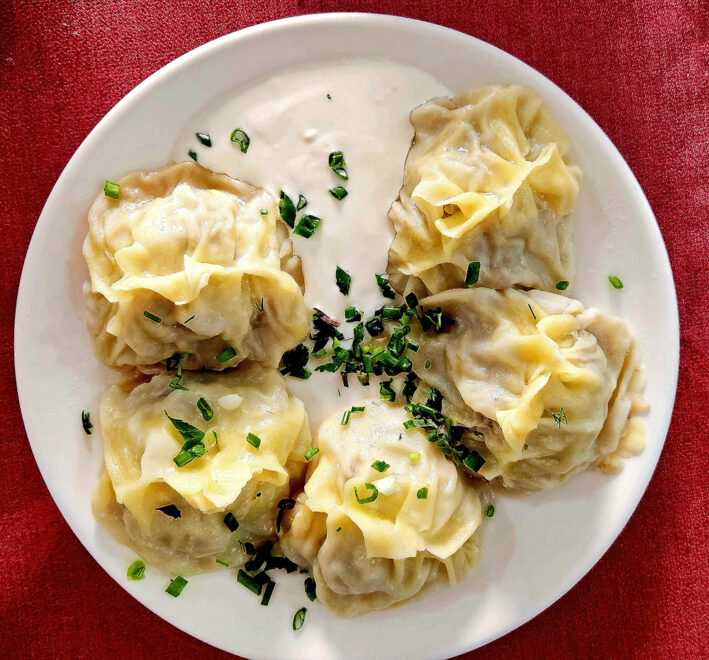
Manti dumplings with yogurt and chive dressing.
At another traditional chaykhana called Zaitun, in the ancient Silk Road city of Khujand, Tajikistan, I chowed down on crunchy and flavorful Archa, a tongue salad with fresh cucumber, pickled cucumber, tomatoes, green peas, greens and mayo, and succulent and savory Shar-shara, lamb ribs braised with tomatoes in an au jus plum sauce. Shar-shara was the tastiest dish of the trip.

Braised lamb ribs, Shar Shara, from Zaitun restaurant in Khujand.
With temperatures plummeting here in the colder months, soups are beloved with a variety on almost every menu. Generally they are prepared with the same ingredients just in different combinations: potatoes, carrots, garlic, sweet peppers, tomatoes, red pepper, anise, saffron, coriander, parsley and mint, with a choice of beef or lamb, sometimes chicken. But I also discovered tasty variations.
Hungry for more? Read about the spiced street food of Sri Lanka.
At a riverfront restaurant on the Syr Darya, one of the two great waterways of Central Asia, I had a beef feast – though I’ll never know the name of the restaurant or the dishes because communication was more difficult here than anywhere else on the trip. Taking in the colored lights of the buildings dotting the shoreline against a pitch-black sky studded with stars, I savored an earthy soup of rich beef broth, meatballs, vegetables and herbs, and a beef stir-fry with tomatoed-brown gravy, vegetables and sesame seeds.
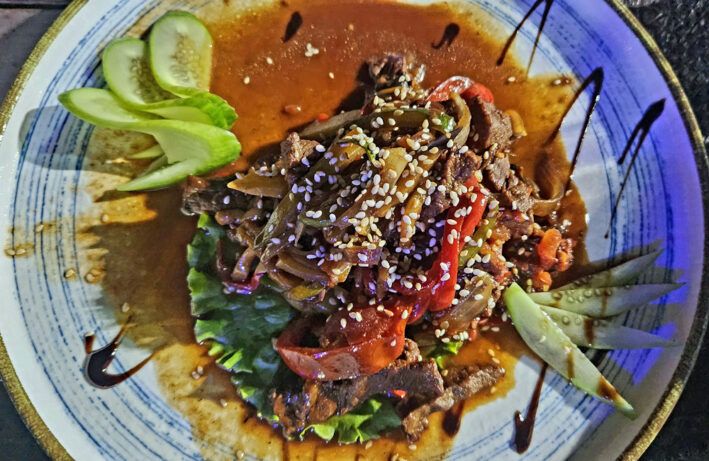
Beef Stir-fry from Riverside restaurant in Khujand.
The most enthrallingly enjoyable soup, however, was in Panjakent, Tajikistan, at Sardona (spelled phonetically from the name I was told for the restaurant): also a rich beef broth with savory meatballs but mixed with milk (cow’s milk is loved here especially a salted milk drink sold on street corners everywhere), plus the addition of scrambled eggs, carrots, onions and greens. I slurped it down as waiters repeatedly came by, laughing and joking (perhaps at my expense?) using gestures and shouted-out words to ask if I liked the food. What luck for a blind order!
Savory meat-filled turnovers cooked in ovens called samsa can be bought on streets everywhere – and then there’s the incomparable samsa of Novdoranak. The road-strip village, on a precipitous mountain road through a narrow gorge, does extraordinary business selling snacks and drinks to travelers heading south to the capital via the “Tunnel of Death” highway. They buy nuts, dried fruits, cheese balls, drinks chilled by an ice-cold stream pouring over the bottles and cans – and possibly the best samsa in central Asia: cooked in a deep, firewood-burning outdoor oven, the turnovers come out crispy, flaky, piping hot and scrumptious.

Samsa meat turnovers in wood fired oven in Tajik village of Novdoranak.
For once, I knew exactly what I was getting when I ordered my samsa. It was burning my mouth trying to eat it, but how tasty it was turned out to be the biggest culinary surprise of the trip.
-Story and photos by Edward Placidi







0 Comments