





Food tours are a great way to get to know a new destination. Not only are you tasting the iconic foods of the area, but you’re meeting the business owners and sightseeing along the way. Yvonne Michie Horn takes us along on a food tour that had her eating her way around Prague, starting with dessert first!

Tour participants gather at Pernickuv sen, a shop selling everything gingerbread.
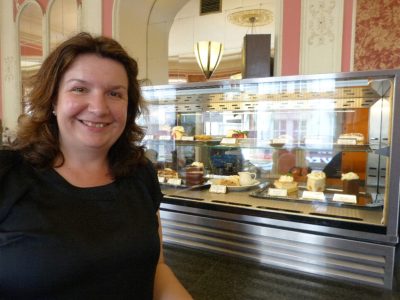
Eva Brejlova, our lovely tour guide.
Viewed from street side, Pernickuv sen is cute as a button, as might be expected of a shop with a name that translates to “Gingerbread Man’s Dream.” The shelves and counters are jam-packed with everything gingerbread; baked gingerbread cakes and cookies to carry home, cookie cutters by the dozens, ingredients for traditional Czech gingerbread recipes, honey, butter, nuts, spices, ornate gingerbread houses, aprons to tie on while mixing up gingerbread, and on it goes.
What better place to embark on a four-hour Eating Prague tour than Pernickuv sen? Especially to those who see no harm in eating one’s dessert first.
Eight of us gather around a table covered with, of course, a gingerbread-themed cloth; to await our guide for the afternoon, Eva Brejlova. A native of Prague, Eva introduces herself as a “noted home cook” and collector of traditional Czech recipes. She is into her third year of guiding visiting foodies on Eating Prague’s Traditional Czech Food Tour and tells us that slipping gingerbread into the oven has been a tradition in the Czech Republic for centuries. In the 16th century there was even a gingerbread guild!
Our first taste of Prague arrives in the form of three cookies on a paper doily: a crescent of buttery shortbread, a biscuit of chopped walnuts thumb-printed with plum jam, and a poppyseed-dense slice of biscotti. To sweeten the deal, a heart-shaped gingerbread cookie with “Eating Prague” scrolled in red icing scores each of our places around the table.
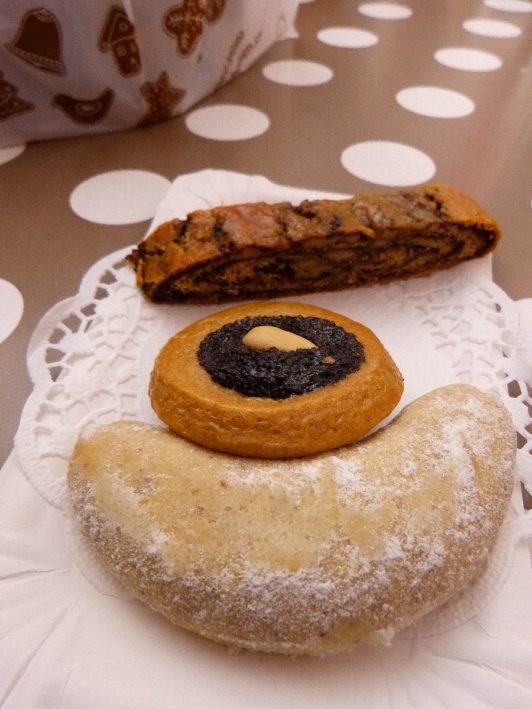
Eating Prague cookies to start off the tour – a great way to start!
With Eva leading the way, we set off into the cobblestone streets. Our first stop Palác Dlouhá, a revamped classic Art Deco building made luxurious housing. No need for residents to leave the premises in search of dining; its ground floor is now a gourmet arcade.
Sisters, acclaimed for their Czech version of the open-faced sandwich, the chlebicek, is located here. We step inside to ooh and aah over the array of art-gallery-worthy creations on display. Eva ushers us back into the arcade where we tuck into the platters of three different chlebicek. We sample delicately sliced ham piled with potato salad, pureed beetroot dolloped with goat cheese and topped with a candied walnut, a roulade of celery root garnished with a halved baby tomato and sprig of parsley; all slathered and arranged on squares of house-made white or rye bread.
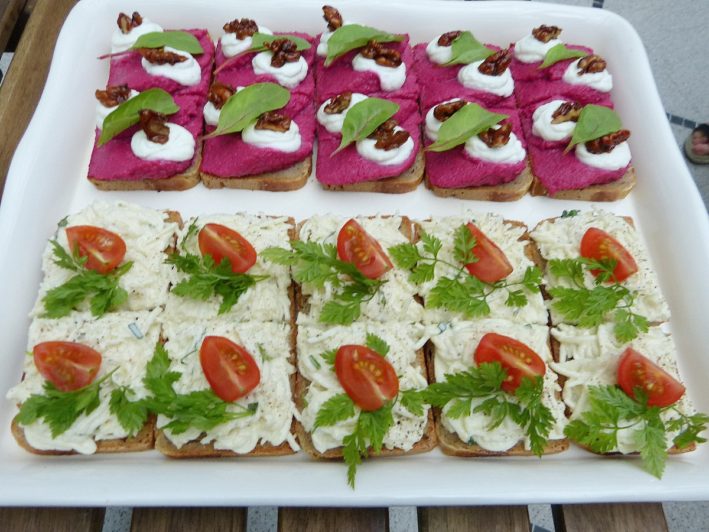
Beautiful, open-faced sandwiches.
Our tour has barely begun and I already regret munching my way through the cookies instead of saving them for later. We soon devour a tray carrying a selection from the locally sourced butcher shop, Nase Maso (Our Meats). On the tray, their thinly sliced ham and rare beef keeps company with two kinds of grilled and coin-cut sausages alongside slices of pickles and hearty bread swiped with mustard. Eva explained that “that’s the way these meats are meant to be eaten” and I agree wholeheartedly. Nase Maso also doubles as a take-out meatery with grilled or warmed items available for walk-in customers.

A tray of meats from Nase Maso.
Back on the street, we approach Jindřišská věž, or St. Henry’s Tower. Built in the 15th century and stretching to a height of 216 feet, it is the highest freestanding bell tower in Prague. Inside, a creaking lift takes us up to the two-story Restaurant Zvonice complete with the original wooden beams and ironworks that have supported the bell cast since 1518. Don’t worry, diners, the bell is no longer clanging away.
“Czech cuisine is centered on sauces and soups,” Eva tells us. “It can be said that if there’s one traditional Czech soup, it’s kulajda.” With that, steaming bowls arrive; a creamy soup incorporating potatoes and sauerkraut with mushrooms as its heart and soul. In this case, it’s chanterelles. “Mushroom gathering is practically a Czech national sport,” Eva notes. The great majority of the Czech population frequently heads into the woods during mushroom season, running April to November.
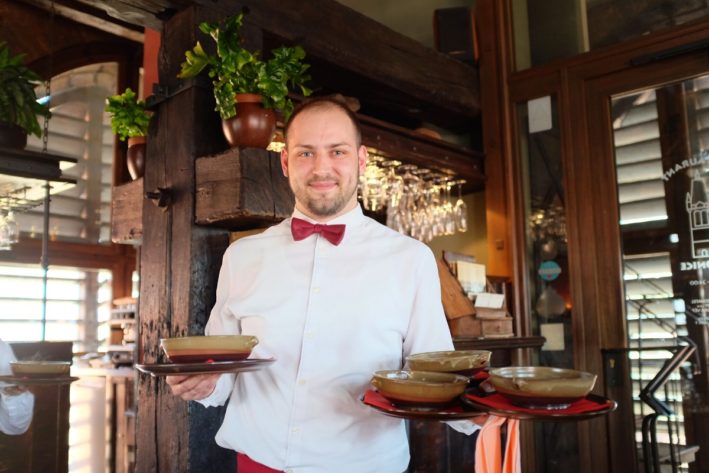
Zvonice – Waiter carries steaming bowls of kulajda to waiting Eating Prague participants.
Photo courtesy Eating Prague Tours.
On to Bistro Spejle (Sticks) where diners are encouraged to sit down and order a drink before returning to choose from an assortment of Czech-style tapas, each held together with a long toothpick-like stick. No matter what you decide on, the charge is 29 CZK (about $1.30) per item. Diners choose as many as they like, depositing the sticks in a holder supplied on each table. At the end of the meal, the number of sticks adds up to the bill.
Our group samples skewered slices of crisp-skinned, meltingly tender duck topped with a scattering of tiny onion rings. A mug of beer washes it down.
From the hip Bistro Spejle, we waddle our way to Café Louvre, where, since 1902, the likes of Franz Kafka stopped by for coffee, read free newspapers and, perhaps, challenged contemporaries to a game at one of the five billiard tables that remain in place today.
Perhaps he also dined on svíčková: a slice of larded and marinated beef floating in a puddle of root vegetable sauce enriched with heavy cream. Knediliky, a dumpling made from leftover bread, rests alongside. Large dollops of whipped cream and cranberry compote complete the dish.
As I sip from the glass of fine South Moravian wine provided, I contemplate how I can possibly make even a small dent in the svíčková. Mission miraculously accomplished, dessert appears in the form of another Czech icon: apple strudel. I do my best to dig in.
Eating Prague? I feel as if I have.
Four hour Eating Prague food tours, www.EatingEurope.com are scheduled Monday – Saturday, departing at 12:30 or 1:30 in the afternoon. Cost is 2159 CZK, 84 Euros, $99 US.
— Article and photos, unless otherwise noted, by Yvonne Michie Horn
Hungry for more? Here’s another article about another Czech pastry treat, Chimney Cakes.
Here’s another article by Yvonne, this time about her search for Cornish Pasties!
One more, here’s what a food tour is like in Hong Kong, quite different from this one in Prague.






0 Comments