









In destinations where oysters are a way of life, the people and places behind them take enormous pride (and care). Writer Chelle Koster Walton takes Real Food Travelers to New Smyrna Beach, Florida to discover various ways to really experience them from learning to eating.
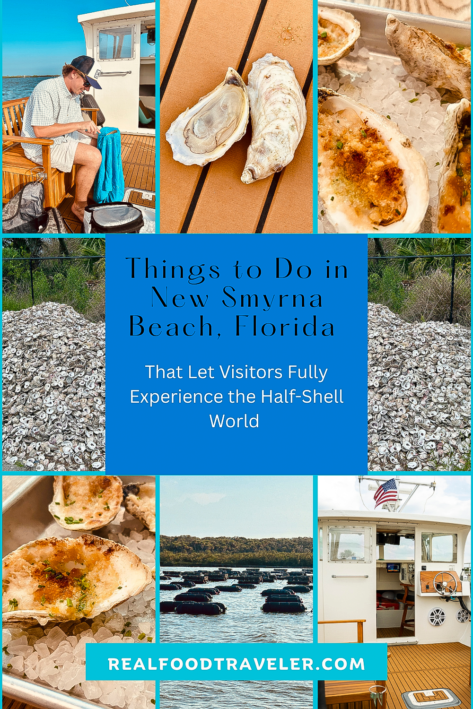
Save this article to Pinterest to help plan your visit to New Smyrna Beach, Fl. to experience oysters. Photos by Chelle Koster Walton. Graphic by RealFoodTraveler.com.
Things to Do to Fully Experience the Half-Shell World in New Smyrna Beach
With 2026’s dawning of a new boat tour around area oyster farms and the opening of The Local Pearl Oyster Shoppe by a James Beard semifinalist chef, the little-known world of oysters in New Smyrna Beach, Florida, just cracked wide open.
Thanks to the rare ecology and high salinity of the intracoastal Indian River’s Mosquito Lagoon, aquaculturists found the perfect milieu for raising oysters in the tastiest and most goodlooking and sustainable way. Abandoning the old, seagrass-damaging raking and tonging methods of harvesting oysters, they use mesh bags, pontoon cages, and tumblers that not only make operations more environmentally friendly, but craft an oyster that is esthetically and gastronomically next-level pleasing.
“When you put them through the tumbler to sort them, little bits of the shell chip off, which creates a thicker shell and meatier oyster,” says Ryan Norris, founder and owner of Indian River Oyster Company (IROC), the first in modern times to set up operations in Mosquito Lagoon. Back in the early half of the 20th century, he says, neighboring Port Orange was considered the oyster capital of the world, until the building of a bridge compromised the water quality and flow.
Hungry for more? Read Chelle’s article about the best places to eat in Key West, Florida.
OYSTER CULTURE
Oysters have always been the lifeblood of the New Smyrna Beach area just south of Daytona Beach, and now more than ever. As voracious water filterers, they keep the local estuary and fisheries healthy. Area raw bars serve up the oysters farmed by IROC and SharkBite Oysters, a newer operation so-named with the goal of switching focus from local waters’ reputation for shark attacks to oyster slurping.
Restaurants and raw bars also participate in the Shuck & Share program New Smyrna Beach’s nonprofit Marine Discovery Center (MDC) manages to replenish oyster beds for non-commercial use. Visitors can even volunteer to help “plant” and monitor the oysters. The center also opens its exhibits to the public free-of-charge and offers naturalist-guided kayak and pontoon boat tours of Indian River.
With its robust education and conservation mission, MDC works with local partners to stabilize shorelines and restore the oyster reefs that “paving paradise” steadily has been degrading. In the year 2025 alone, with the help of resident and visiting volunteers, MDC diverted 1.3 million pounds of oysters, otherwise headed for the landfill, to local waters. As a result, the estuary cultivated 1 million new oysters that year filtering 25 million gallons of water every day.
Because – fun fact: one 3- to 4-inch oyster can filter 50 gallons of water daily.
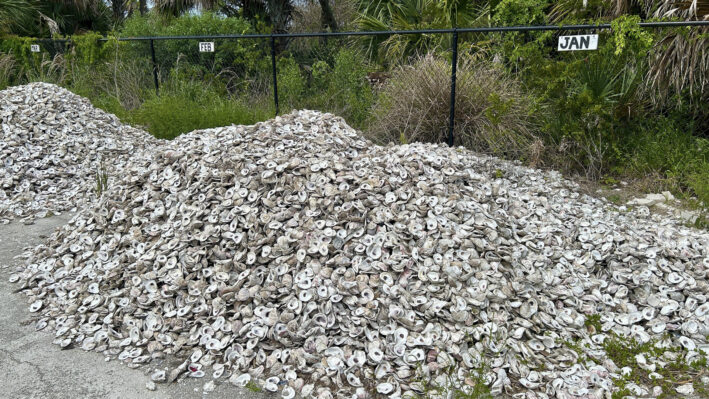
Empty oyster shells from Marine Discovery Center’s Shuck & Share initiative during their cleansing period.
CULTURED OYSTERS
Another fun fact: Oysters are packed with protein, vitamins C and B12, zinc, selenium, and iron. At only 10 calories per oyster, “you will burn more calories shucking them then you will by consuming them,” the folks at IROC like to say.
Not to mention they are plump, juicy, salty gifts to the tastebuds. Or, as Anthony Bourdain once called them: “food at its most primeval and glorious.”
Hungry for more? Read this review of “Tony” about Anthony Bourdain’s early career.
If you believe oyster farmers Norris from IROC and Sam Walsh from SharkBite, Indian River oysters rank as some of the best in the world.
“It’s the salinity of the meat, and they have a rich, smooth, buttery finish,” said Norris. The Eastern (Crassostrea virginica) variety of oyster farmed here is found from Maine to Texas, he says, but credits the distinctive flavor largely to the merroir of the lagoon itself, taking a little acclaim for himself, his farming and IROC’s processing methods.
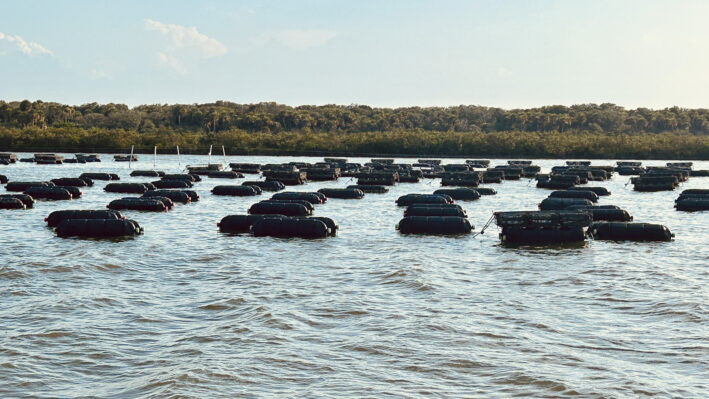
Oysters in the making at SharkBite Oyster farm.
“SharkBite Oysters are regularly ranked at the top with other premium oysters,” said Walsh. “Our consistent quality and briny but not overpowering flavor has made us a favorite from Key West to Chicago.” Differences in tidal effects and plankton diet subtly distinguish the flavor of product from the two farms, he said.
Both farms use mesh bags and cages on pontoons for growing the oyster larvae, a.k.a. spat, in the estuaries. The bags require flipping at least once a week, which, along with the tumbling builds the oyster’s muscle and meat and cultivates the shapely profile Indian River oysters display. SharkBite adheres to the theory that more frequent moving builds the oyster’s muscle even more, resulting in a nice, sweet flavor to complement the briny.
Walsh boasts they’re the perfect size and shape for a raw bar, thanks to special equipment SharkBite uses. He claims their rich, briny palate pairs perfectly with white wine or craft beer.
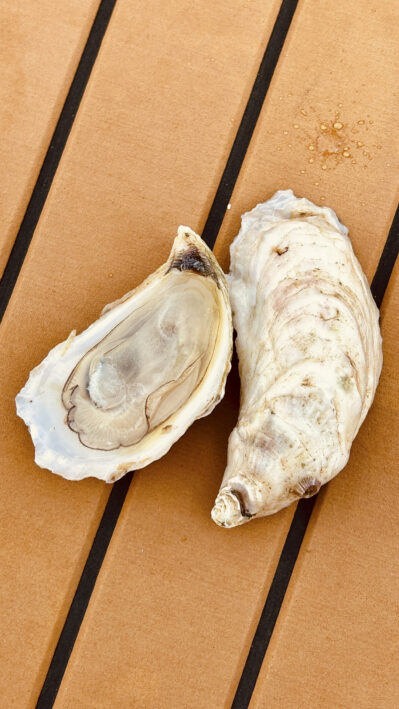
SharkBite’s oysters have a distinctive cupped shape.
“The SharkBites are by far the cleanest oysters and have the most delicious brininess to them,” said Chef Henry Salgado, owner of the Local Pearl and Spanish River Grill Tapas Bar in New Smyrna Beach, and a two-time James Beard semifinalist. “They are sweet with just a hint of truffle on the finish. We often offer a sample SharkBite for our guests who insist the cold-water, East Coast oysters are the only ones they will eat. And quite often many of them are very surprised and end up ordering the SharkBites.”
Chef Salgado is also a fan of IROC oysters and introduced them to the Nashville market through Local Pearl pop-ups while living there from 2020 to 2023, before SharkBite, which opened in 2022. “Now, New Smyrna Beach IROCs are quite popular in Nashville,” he said.
Hungry for more? Learn about nearby St. Augustine, Florida.
OYSTER CULTS
The world of oysters is cracking open far beyond New Smyrna Beach. Long considered a delicacy of the highest order (“like French kissing a mermaid,” novelist Tom Robbins once rhapsodized), in recent years they’ve sparked an avid following for connoisseur oyster tasters in restaurants that curate their menu with selections from around the U.S. and beyond.
Chef Salgado follows the sampling trend with different oyster du jour offerings chalked on Local Pearl’s board. He stocks SharkBite Oysters (“the best,” says the chalkboard) whenever possible and plans to exclusively spotlight them in his forthcoming seafood market. On the menu, he offers them raw with cucumber-fennel mignonette or “Malaga style” with fresh lime and black pepper, or charbroiled with garlic butter, cracker crumbs, and pecorino cheese.
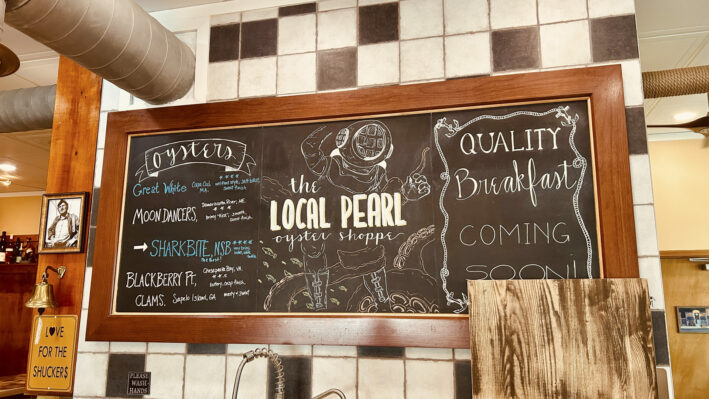
Oysters and other specials due jour at Local Pearl Oyster Shoppe which recently reopened in New Smyrna Beach after closing during the pandemic.
Local oyster lovers can order fresh from the briny in bulk through both SharkBite and IROC websites or buy from a number of local restaurants and seafood markets.
Both New Smyrna Beach farms deliver locally and use distributors to sell their products across Florida and the U.S. They have come in high demand and garnered critical praise. At Capa Restaurant, Four Seasons Orlando at Walt Disney World, IROC oysters were partially responsible, says Norris, for its four-year run of one-star Michelin ratings.
Local boat cruises, too, give folks the opportunity to taste the product as they tour the oyster farms. Captain Declan Rogers conducts a three-hour sunset cruise aboard the “Narwhal,” a restored vintage lobster/fishing boat from Maine by way of North Carolina.
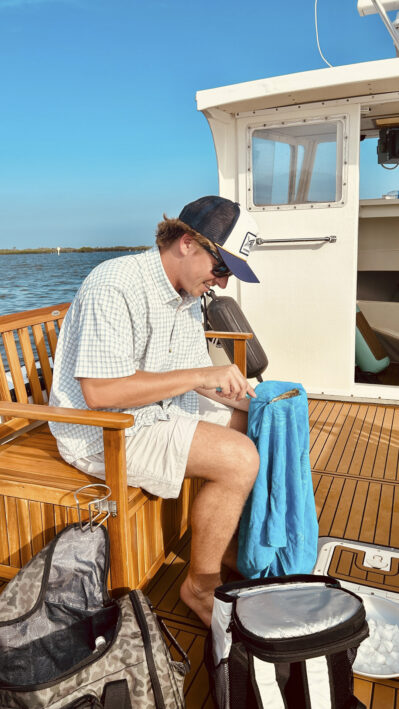
Capt. Declan Rogers hand-shucks oysters for guests aboard his oyster farm tours.
From the comfort of his handsome vessel, he narrates with spritzes of background information about oysters, oyster farming, local history, and the wildlife that swims or flies by in the mangroves. Along the way, he shucks fresh SharkBite oysters for all to taste.
An intimate affair, the tour accommodates up to six passengers, who are welcome to bring their own beverages aboard. He’s happy to hop in the water to demonstrate farming techniques at the oyster farm leases.
“It’s a relaxed tour, and I’ll focus it however my guests wish,” said Rogers. “This protected estuary has a lot going on between the wildlife and oyster farming.” The tour takes in both SharkBite and IROC farms on leases governed by the state of Florida.
IROC partners with Turtle Mound River Tours aboard a 24-passenger pontoon. Norris or one of his employees hops aboard to talk about oyster farming as tour operators pass around raw or grilled oysters for tasting. If you’re lucky, you will actually get to witness farmers at work on their oyster lease.
From learning at Marine Discovery Center about the oyster’s role in wetland ecology, to getting out on the water to experience firsthand the way oysters are cultivated, to ultimately slurping a crisp, chilled oyster fresh from its shell – New Smyrna Beach takes you on a journey from the oyster’s biological importance to its esteemed culinary couture.
For more information about visiting New Smyrna Beach, visit this website.
-Story and photos by Chelle Koster Walton
Use our Real Food Traveler Expedia affiliate link to make plans to visit New Smyrna Beach.
Please note, as is common practice in this industry, this was a hosted visit, however, all opinions are honest and based on the author’s opinion for the purpose of informing our readers.








0 Comments