






Skiers all over the world are looking ahead in their calendars to their favorite time of year – ski season – with trepidation. Like everything else due to the pandemic, ski season as we know it is in flux. Writer and Real Food Traveler Ski & Dive Editor, Yvette Cardozo shares the updates she’s heard about changing mountain resort ski season scene.

SilverStar’s village with its gondola in view. Photo by Amanda Wallace/SilverStar Mountain.
At this point mid-summer, resorts across North America are still trying to figure out what the next ski season will look like. And they’re using the “bike and hike” months as a massive trial run. Meanwhile, the border between Canada and the US remains closed to all but essential travel, though there are hopes it will reopen before the next ski season starts.
In the US, resorts heading for record years last season had their profits cut severely as they were forced to close in March – before spring break, and before spring skiing.
“Prior to the industry wide Covid shutdowns in March, we were on track for the fourth best season ever, expecting to finish up at 59.7 million skier visits,” said Kelly Pawlak, president and CEO of the National Ski Areas Association (NSAA).
“Instead, we wound up 14 percent down from the previous year. Missing the important spring break and full summer business will cost the industry over $2 billion and projections for winter at limited capacity… that’s another two to three billion.”
So yes, the industry is hurting.
But how will this translate on the slopes? What will limited capacity, social spacing and the rest mean for skiers?
Changes to the ski industry and mountain resorts
We heard from US and Canadian ski area representatives in two Zoom sessions and whatever finally happens, next winter your favorite resort won’t look like what you remember from the past.
Among the considerations: What’s a fair way of managing distribution of skiers and riders? What about season pass holders who paid in advance for a whole season? What about managing parking lots, shuttle buses, guest check-ins, ticket sales, dining, even bathrooms? There will be markers on the floor to space people out everywhere. One suggestion offered was adapters on door handles so people can open them with their elbows rather than touching with their hands. “People are ordering plexiglass by the boatload,” one representative added.
Resort people agree about the need for skiers and riders to plan ahead.
“This is not the year to roll out of bed and say, ‘Hey I’m gonna go to my favorite ski area today.’ Advance online tickets may be part of our new reality. We will encourage checking the resort website not only when planning your vacation but right before you head up (for a day trip) because information changes day by day,” Pawlak said.
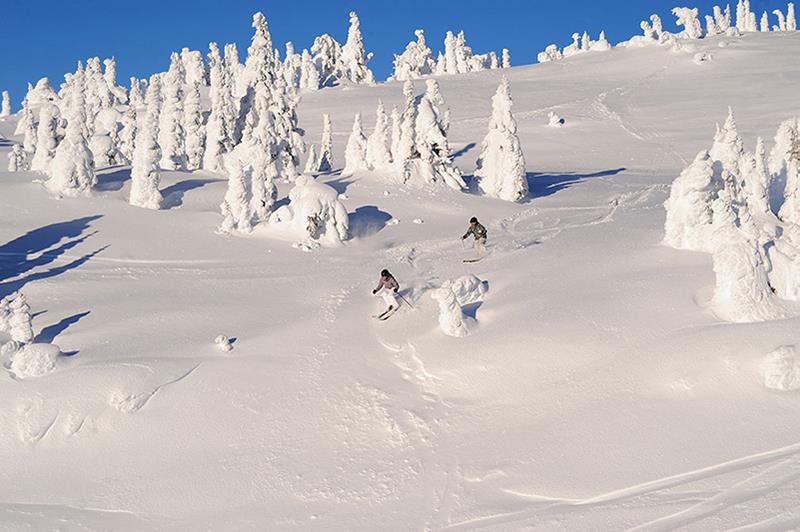
Skiing ‘snow ghost’ trees laden with so much snow, they hardly look like real trees. Photo by Big White Ski Resort.
Patricia Campbell, president of Vail Resorts Mountain Division which has 37 mountain resorts across 15 states and two countries, added, “We plan to be fully open even if demand is lower. Whether it’s one person or 100 on the mountain, they expect a full resort and that’s what we’re focused on. She continued, “Everybody’s so hungry for information and we’re living in a lot of ambiguity now and that will continue.”
The typical area, one rep said, is now looking at five different plans depending on how severe the restrictions are, or if they’re gone completely.
Rick Kahl, editor of Ski Area Management magazine, talked about experiences of resorts outside North America:
New Zealand, with early closed borders and stay at home orders, has so far successfully beat back the virus and is nearly back to business as usual. On the other hand, there’s South America where the virus is out of control in many areas.
“Almost all the areas in South America (where the season runs June – October) are closed. Las Leñas and Valle Nevado have already announced they’re closed for the season. Portillo says it’s closed indefinitely.”
Australia, Kahl added, is “in the middle, with limited capacity, social distancing and all the other usual mitigation measures.”
And, as an example of what North American resorts may do, Thredbo in Australia refunded all season passes because they knew they were going to be hit with 50 percent capacity limits. It was online-only advance reservations and they were sold out through August 30.
“In order to avoid having a complete revolt by their season pass holders, Thredbo gave pass holders a 40 to 70 percent discount on Day tickets.”
Kahl added that for North America, people will need assurances they are covered and if “things go south and they do commit in advance, they won’t be stuck having put out a lot of money and have no recourse for getting it back.”
Speaking about the reaction when orders came to close, Kahl said “Initially people were in a state of shock. They had just been asked to immediately halt all their operations, send all their guests and employees home. It’s really hard to shut a resort down on 24 hours’ notice.”
But, he added, as weeks went by, anxiety levels dropped and plans emerged. Many resorts in North America opened for a revised summer season that several called “a great dress rehearsal” for next winter. It involved limits to daily lift ticket totals, spaced tables in restaurants (and a lot of outdoor eating), social distancing in lift lines and restrictions on lifts, themselves.
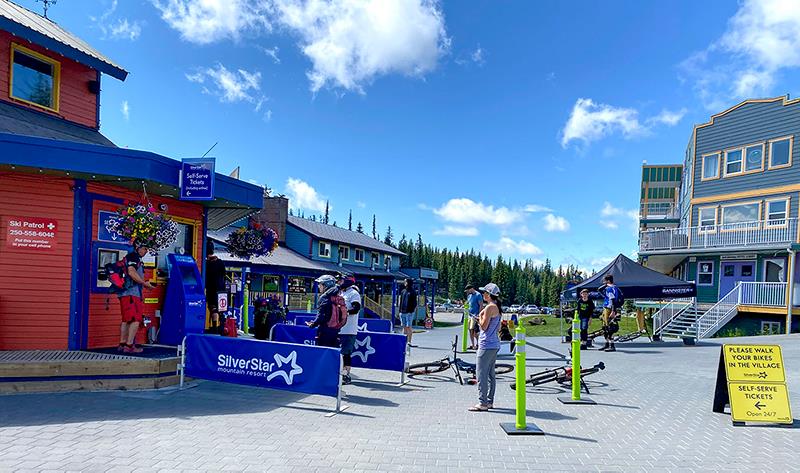
Cyclists standing socially distanced to lift up at SilverStar. Photo by SilverStar
How Air Canada is planning for a Covid-19 ski season
But, while final details for winter at resorts are still being determined, Air Canada has specific measures in place now. Tony Celio of Air Canada ran through a very specific list:
- Touch free check-ins, mandatory masks on board, hand sanitizing stations throughout the airports, health questions and temperature checks (top temp is 99.5F).
- In the boarding area, no lining up to board. Everyone stays seated until their group (ie 1, 2, 3) is called, then boarding is back to front, window to isle.
- On board, free packs containing hand sanitizer, wipes, mask, gloves, bottle of water, snack and headset is given to each passenger.
- Crews wear masks and gloves.
- Everything is sanitized between flights with hospital grade disinfectant and HEPA filters are being used for the cabin air.
Air Canada has this video on its website: https://youtu.be/CwGYeZDIkFo
Then upon arrival, baggage is being spaced out and people are being asked to have only one person per travel group approach the carousel.
What the Canadian mountain resorts are doing
As for Canadian resorts, they are not expecting massive crowds as they assume their international visitor counts will be down. And this has led to another problem.
“A lot of our staff is international. So now we’re trying to hire Canadians and looking for staff that’s more local,” SilverStar Mountain Resort representative Tamara Melanson said, adding that it’s been a tough hunt.
Pawlak of NSAA said the order to not allow international workers to come into the US until the end of 2020 is very concerning for US resorts.
“We don’t think American workers are going to be enough to fill the void. Fifty per cent of ski areas last year (even before the virus struck) said they couldn’t fill all of their positions.
“Our jobs are tough. When you think about a lift operator, that’s an eight or nine hour shift in the cold. And a lot of indoor jobs are similar to what people can get in their home towns. We’re going to try to get exceptions through Congress to get foreign workers for December.”
Back at SilverStar, Melanson said hotel totals this summer have been naturally spread out because there is a mandatory 24-hour gap between check out and the next check in so rooms can be deep cleaned.

Cyclists sitting socially distanced at SilverStar. Photo by SilverStar.
And she could speak to what they’re doing about lift lines, lifts and restaurants. Interestingly, this is the busiest year they’ve ever had for cyclists going up the mountain. “I think people just want to get out and do something.”
But still, they are limiting tickets to keep people spread and keeping people in a single stretched out line to board.
In summer, they have only the six-pack lift and gondola open. And for now, it’s one person (or group of friends) to a gondola and a max of two strangers to a lift. She figures seating on the resort’s quads and the six pack in winter will be similar.
Andre Quenneville, general manager of Mt. Norquay added that some resorts are experimenting with spraying lifts with disinfectant.
Jen Kyles of SkiCan which represents resorts across Canada said “People will need more patience,” adding that, for instance, they will need to make prior reservations for rentals which will then have timed entries to keep folks spaced. Many resorts, she said, are thinking of shifting dining into their conference facilities where the rooms are larger. And buffets will be gone.
Resorts like Mt. Norquay and Panorama Mountain Resort, not exactly known for crushing crowds, don’t expect to have problems with spacing on-slope.

Top of lift, Norquay. Photo by Mt. Norquay.
Meanwhile this summer, Banff has closed its main downtown corridor from June 1 to early September to provide more space for people on foot. Restaurants have 50% occupancy indoors but also have spaced dining on the street. And while masks are encouraged, they are not required, though that may change.
Quenneville said he feels confident his resort will be open for winter and expects the borders to be open by then. And Steve Paccagnan, CEO of Panorama, addressing shuttles from the Calgary airport, said they would be offering private travel for those who want it along with buses with “safe practices,” meaning spacing people out.
In the end, everyone agrees, it will be a lot of trial and error.
— Story by Yvette Cardozo
Hungry for more? Read about Yvette’s experience at Ski SilverStar Resort. And see what non-skiers can do at Sun Peaks resort.
Pin this article for reference as you plan your mountain resort getaways.








0 Comments