





The desire to meet the friendly locals and learn about their lifestyles motivated writer Donnie Sexton to visit Papua New Guinea. She returned with a fascinating account to share with Real Food Traveler readers.
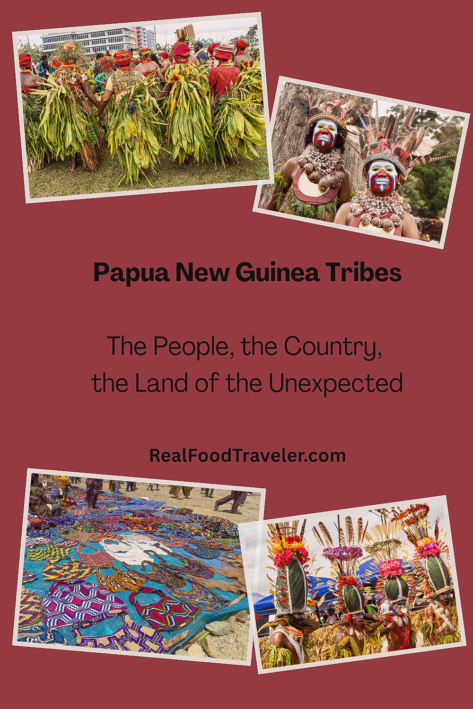
Save this article about Papua New Guinea tribal life to Pinterest. Photos by Donnie Sexton. Graphic by RealFoodTraveler.com.
Papua New Guinea Tribes – The People, the Country, the Land of the Unexpected
Curiosity motivated me to travel 28 hours from my home in the U.S. in Montana to Papua New Guinea. Admittedly, I knew very little about this island nation, only that most of the population was made up of hundreds of tribes. I imagined epic photography opportunities, and I wasn’t disappointed. Finding a tour operator was essential, knowing I wouldn’t try to navigate this island on my own. Indigo Safaris was my choice: reasonably priced, focused on indigenous people, and offering a chance to witness the renowned Mount Hagen sing-sing.
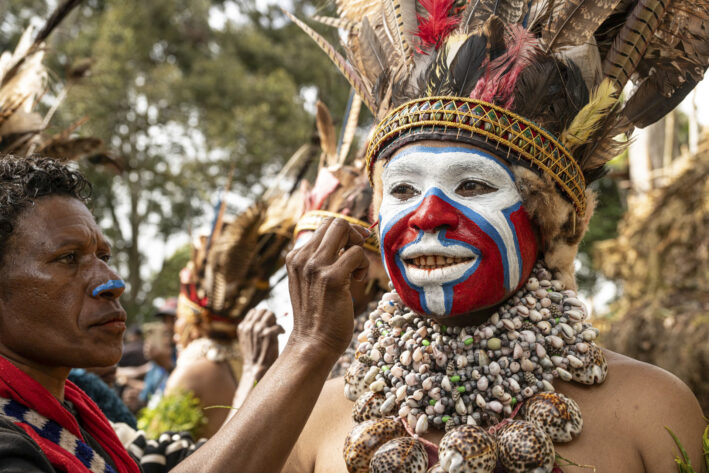
A woman from the Melpa tribe gets ready for the Mount Hagen sing-sing using the traditional bold face paint of red, white and blue. Photo by Donnie Sexton.
Papua New Guinea (PNG) is the second-largest island in the world, after Greenland, and the highest island in the world. Along the coast and outlying islands, a wealth of outdoor adventure exists, including scuba diving, fishing, boating, and kayaking. For those keen on hiking, PNG’s interior offers many options. With 897 species of birds, PNG is a birder’s utopia. For those focused on indigenous culture, it is best observed in the highlands, especially around the cities of Goroka and Mount Hagen.
PNG has a perceived reputation for being a dangerous country to visit. There are stories of cannibalism and tribal warfare, which seem to be something of their past. Locals are working hard to overcome this perception, knowing tourism is a huge boost to their economy. PNG is a unique patchwork of over 800 languages and many indigenous societies, most of which are open and welcoming to outside visitors. Their infectious smiles are often stained red by the betel nut they chew as a recreational stimulant. Betel nut refers to the fruit of the Areca palm tree. Although it is technically the “areca nut,” it is known as the betel nut because it is commonly wrapped in betel leaves.

The people of Papua New Guinea are generous, kindhearted, warm and willing to share their traditions with visitors. Photo by Donnie Sexton.
Everywhere throughout PNG, both men and women carry a bilum, a traditional handwoven bag. It’s made using a looping technique passed down through generations and is traditionally crafted from natural fibers. People wear it crossbody and use it to carry food, goods, belongings, and sometimes babies. The bilum is a colorful, useful souvenir that is easy to transport.
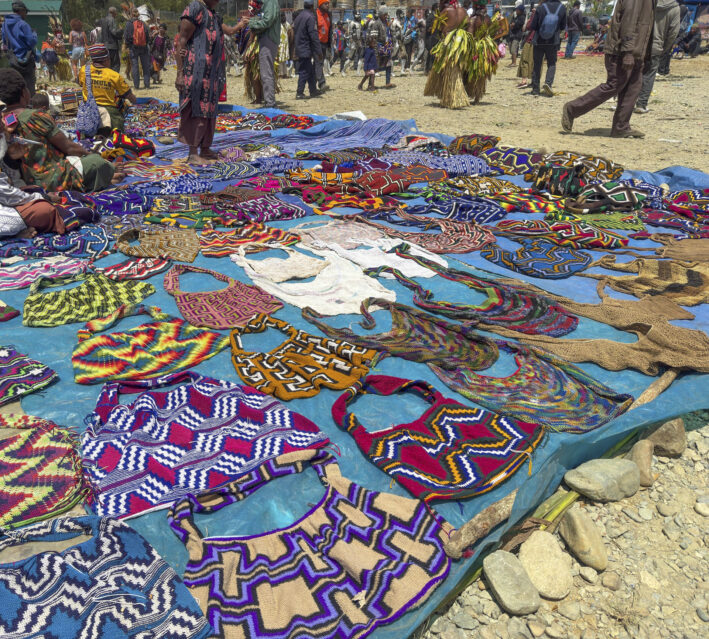
Handcrafted, colorful bilums are a practical and easy way to carry items including souvenirs. Purchasing them helps support the local women. Photo by Donnie Sexton.
Our exploration of PNG began with a flight from the capital, Port Moresby, to Goroka, where we stayed at the Klerht Cove Motel, a guesthouse run by congenial Dr. Boone and his family. Over breakfast, Dr. Boone shared with the group that Papua New Guinea is known as “The Land of the Unexpected.” To elaborate on this slogan, he brought out two black-and-white photos of a woman breastfeeding a piglet, leaving us all speechless.
Our first stop would be the local market, which proved to be a road map of what we would be consuming – watermelon, papaya, passion fruit, avocados, carrots, peanuts, and the staple of this island, sweet potatoes. So much of the shopping in PNG, whether it’s clothes, produce, car parts, or household goods, happens literally on the ground, sometimes laid out on plastic sheets or a cloth, or simply in the dirt. It leaves one with a new appreciation for grocery stores where items are displayed on stands or shelves.

Shopping in the local market in Goroka takes place on the ground, a typical way of buying foods and other local goods. Photo by Donnie Sexton.
Our first tribal encounter was with the Bena people, where we observed their Neheya Initiation for boys at puberty and young men, said to clear the mind and enlighten the heart and body. It starts with a nose-bleeding ritual, where sharp grass is forced up the nose to cause bleeding, and the tongue is cut to cause bleeding as well. Then they bend a piece of dried, smooth cane, 6-9 feet long, into a U shape and push it through the mouth and down the esophagus. The Bena are willing to share this ritual with the outside world to preserve their culture and history.
The Huli are an indigenous group living in the southern highlands. Men and women typically do not live together. Around age eight, the boys go to live with their father, who teaches them life skills. They learn self-sufficiency by living in the jungle for extended periods. Around age fourteen, provided they are virgins, they attend wig school under the guidance of a wig master for up to three years. They follow a strict diet and sleep with a headrest to prevent their hair from flattening. A wig specialist then cuts and shapes the hair into a unique Huli wigman headdress. Feathers from various birds, including the famed bird of paradise, adorn the wig. Once the boys graduate from wig school, they search for a wife. During celebrations, the Huli paint their faces with red and yellow clay, known as Ambua, setting them apart from other tribes.
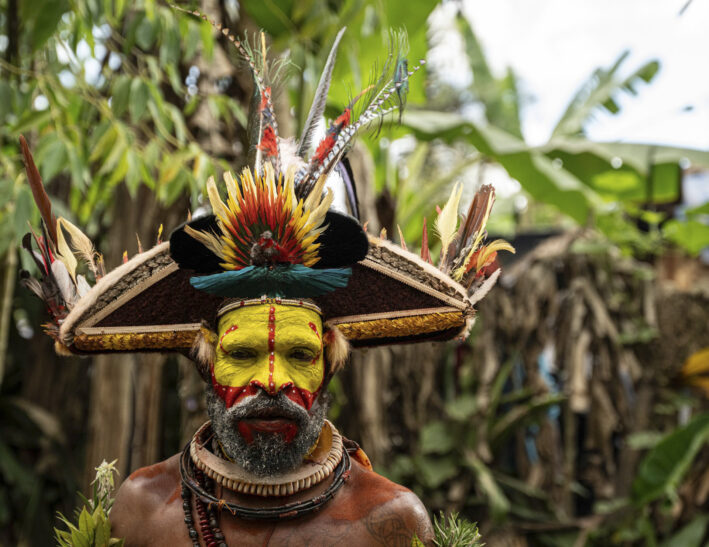
The Huli wigmen are known for the unique headdress crafted from their own hair and decorated with various bird feathers. Photo by Donnie Sexton.
The Asaro Mudmen can appear downright frightening, as they cover themselves with white clay, attach long bamboo claws, and don a ghostly mask made from dried clay, which can weigh as much as 22 pounds. As legend goes, the Asaro tribe ran into the Asaro River to escape from an enemy tribe. When they emerged from the river covered in mud and looking inhuman, the enemy ran off in fear. This led to a new battle costume to scare away adversaries. Today, the Asaro Mudmen re-enact the battleground for visitors and transform into mudmen during celebrations and festivals.

The Asaro Mudmen traditionally covered themselves in mud from the river, then used sharpened bamboo finger spikes and a mask made of heavy river clay to scare away their enemies. Photo by Donnie Sexton.
We observed the Asaro demonstrating the Moko Moko dance, which historically celebrated a victorious battle. The dance is a showcase of resilience and pride, creating a festive atmosphere where sex and alcohol come into play. The men wear a thick belt made from natural materials such as grasses, leaves, and seeds, with a protrusion representing a penis. Their dance movements are suggestive of sexual intercourse.
The Chimbu tribe is often nicknamed the “skeleton tribe” because their body paint resembles skeletons. According to folklore, when the Chimbu’s enemies saw them with their skeleton-like appearance, they feared they weren’t human and likely possessed supernatural powers. Their appearance became the power over their foes.
Hungry for more? Read Donnie’s article about the Hadzabe tribe of hunter-gatherers.
Every August, the city of Mount Hagen hosts a sing-sing, where close to 100 tribes and villages gather to celebrate their cultural heritage through dance, body adornments, chanting, drumming and music. The staging area is crammed with natives preparing for the event. With the help of a local guide, visitors can access the staging area to observe and photograph.
Getting ready is an art form that involves elaborate and distinct face and body painting. The paint is made from local dyes mixed with plant oil, pig fat, clay, and mud. Some cover themselves in white ash, and some in mud. Others, especially young men, are drenched in black motor oil. Elaborate headdresses range from the Huli wigmen to the Kalam tribe, where men wear a tall headdress crafted from thousands of emerald-green beetles. Each tribe’s regalia is made primarily from natural materials such as grasses, reeds, shells, feathers, flowers, pig tusks, and animal furs. A common sight is skirts made from cordyline leaves folded accordion-style and secured with a woven belt.
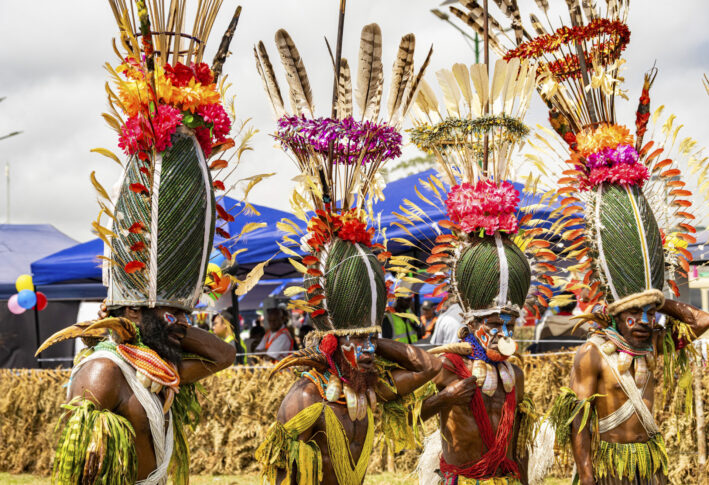
The Kalam are world-famous for their towering ceremonial headdresses, hand-stitched using thousands of iridescent emerald-green beetles and topped with plumes from a variety of birds. Photo by Donnie Sexton.
Around nine o’clock in the morning, the groups move into a huge grassy field and carve out a spot for their group where the singing, drumming, and dancing go on until early afternoon. Visitors are free to wander the grounds, check out the local goods and bilums for sale, or simply sit back and marvel at this incredible sea of humanity dazzling in glorious color.
Witnessing this spectacular showcase was the perfect way to finish my exploration of Papua New Guinea. PNG had easily proven to be not only “the land of the unexpected,” but astonishing, eye-popping, and sometimes unbelievable in its tribal ceremonies and rituals. I returned to Montana grateful for a home with running water, dependable electricity, and an indoor toilet, elements which many of these tribal villages lack, yet from my observations, their inhabitants seem so content with their lives.
-Story and photos by Donnie Sexton
TIP: Use our Real Food Traveler affiliate links to plan your visit using your favorite booking site.
Please note: This site uses an affiliate tool provided by the third-party provider Stay22. If you use certain affiliate links to make a booking or take advantage of an offer, the site may receive an affiliate commission from this third-party provider. To determine whether you have used any of the affiliate solutions, the third-party provider will use cookies to attribute commission. These cookies will be removed as soon as they have served this purpose.






0 Comments