











Real Food Traveler contributor Donnie Sexton returns from Tanzania with a glimpse into the life of the Hadzabe people, carrying ancient roles and skills into modern times.
Save this article about the Hadzabe people to Pinterest to keep it handy. Photos by Donnie Sexton. Graphic by RealFoodTraveler.com.
The Hadzabe People – Hunter-Gatherers from an Ancient Time
It sounded like a unique adventure joining the Hadzabe men and boys, armed with homemade bows and arrows, on a morning hunt. Wearing sandals made from old tires, they headed out on a sprint, leaving our small group struggling to keep up as we dodged spiny Acacia trees, rocky outcrops, and a myriad of tangled bushes. While we frequently lost sight of the hunters, we could hear them shouting in their unique “click” language. We continued downhill into a dry streambed full of rocks, then climbed back up again. I was out of breath, thinking this was an undertaking I could have done without.
Finally, one of the boys shot a squirrel. When we caught up to the group, they were hunkered down in the dirt, where an elder was building a tiny fire to roast the freshly caught rodent, hide and all. Once roasted and the singed hide pulled off, an elder with dirt-encrusted hands offered us a toothpick-sized sliver of breast meat, but I just couldn’t do it.
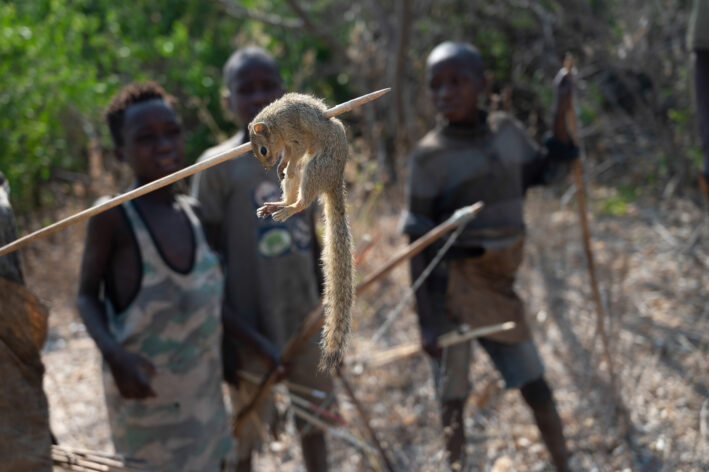
A squirrel marks a successful hunt by the Hadzabe boys.
Hungry for more? A tale of chicken feet and other Chinese delicacies.
VISITING THE HADZABE
On a few visits to Tanzania for safari excursions, I’ve been fortunate to see and photograph the Big Five (lion, leopard, elephant, rhinoceros, and cape buffalo). We’ve always made a stop at a Maasai village to see how the tribes live and enjoy their demonstrations of singing, dancing, and jumping. But it was a visit to the Hadzabe people that left me feeling like a time traveler who had landed in the Stone Age. The Hadzabe, or Hadza, are one of the world’s last true hunter-gatherer societies, with an estimated 1,300 remaining in the Lake Eyasi area of northern Tanzania. To visit the Hadza, we connected with a local guide who takes visitors to meet them. There was no road to reach their encampment, so our guide led us through dirt patches, dodging acacia trees until we reached a clearing where a small group of men came out to greet us and motioned for us to join the hunt.
LIFESTYLE OF THE HADZA
The Hadza are nomads with no fixed home, living in a family group of 20-30 people. They have an intimate knowledge of the land and its cycles, allowing them to migrate as needed to suitable hunting grounds where water, plants, berries, and tubers are available. Their dwellings are simple, with twigs and branches formed into a dome, then covered in grasses. When they move locations, their dwellings simply disintegrate back into the ground, leaving no trace.
The Hadza have no domesticated livestock, such as cattle or goats, nor do they grow or store their food. Each day for these people is simply a search for nutrition. For the men and boys, it’s a matter of hunting with homemade bows and arrows, sometimes with poisoned tips, derived from desert rose plants. The metal arrow tips come from bartering with another tribe in the area, the Datoga, noted for their metalworking. The Hadza hunt and eat a variety of animals, including impalas, dik-diks, kudus, baboons, monkeys, shrews, warthogs, bushpigs, and birds. For females in the group, their day consists of tending the children and searching for berries, baobab fruit, tubers, honey, and other edible plants.
Hungry for more? Exploring the food of Djibouti, Africa.
ON THE SEARCH FOR TUBERS
On a second journey to Tanzania, we once again visited the Hadza, but this time I knew that hunting with the men and boys was a no-go for me. Instead, I joined two women who headed into the bushes to dig for tubers. Using sticks to dig holes, they netted a handful of tubers, roughly the size and shape of a mango. Back at camp, one woman peeled off the outer husk-like layer of the tuber to reveal the fleshy skin. She pulled off strands, reminding me of string cheese, and offered each of us a piece. I was willing to give it a try, chewing and chewing to get a bit of moisture from the strand, but then spitting it out as the woman had done.
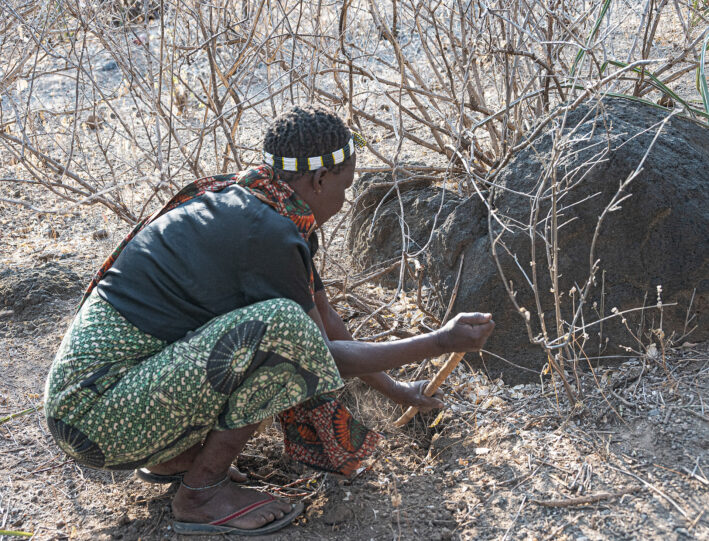
A Hadzabe woman digging for tubers with a stick.
ROASTED MONKEY
The men returned from another hunt, this time with a monkey. They gutted it out, handed the innards to a woman who took it to a rock to work it over, then the critter was thrown onto a substantial fire, hide, head, and all, roasted to a blackened state. Once again, we were offered bites of monkey, and our intrepid group of travelers politely refused.
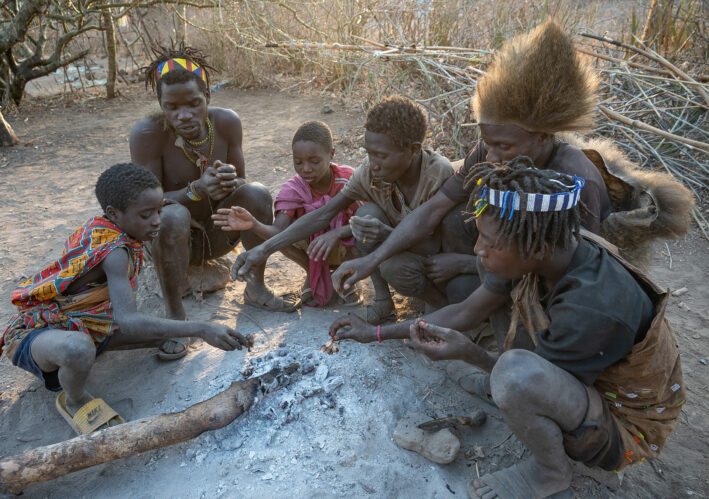
Men and boys from the Hadzabe tribe eating what they’ve hunted.
Hungry for more? Camel Trekking and Eating with the Bedouins in Egypt.
CLICKING LANGUAGE OF THE HADZA
The Hadza were keen on explaining to our group the various arrows they use for different species. Keep in mind that they speak with a clicking sound, along with animal sounds and wild gestures. With the help of our guide, we tried to imitate the sounds, which was not easy, and drew laughs from the Hadza men. We learned that the younger kids are learning Swahili, Tanzania’s native language. The Hadza wanted us to try shooting their bows and arrows, which was both challenging and entertaining for our group of six.
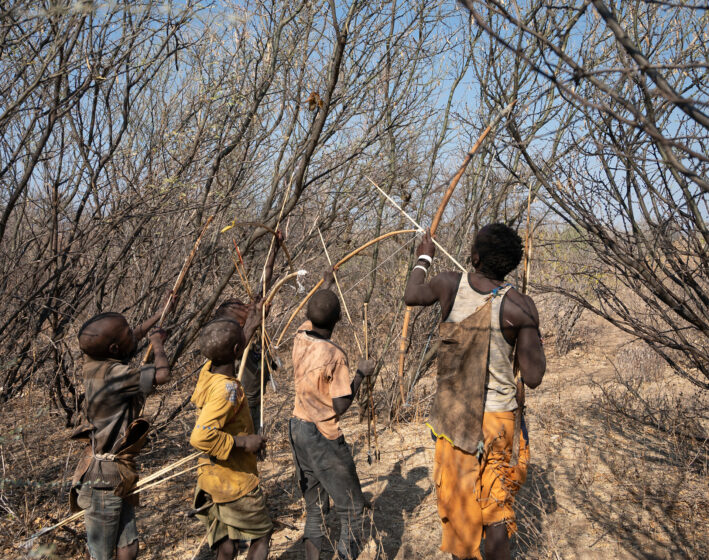
Boys hunting with bows and arrows.
ANCIENT CIVILIZATION
The Hadza are among the oldest peoples on Earth. Anthropologists believe they have existed for 50,000 years. Today, it is estimated that around 1,300 Hadzabe remain in the plains near the Serengeti in Tanzania. They are a society without chiefs; instead, there is a shared authority within their group. While I would label the Hadza “primitive,” in truth, they have a highly adaptive and knowledge-rich way of life, perfectly suited to their unique environment and ability to survive.
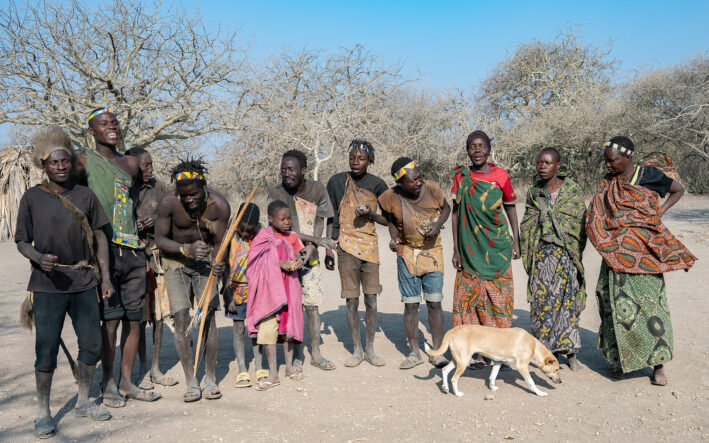
The Hadzabe people gathered to sing.
Dressed in animal skins and bits and pieces of Western clothing, the Hadza live, by all accounts, a very straightforward life. I took stock of our group, all wearing travel clothes, carrying cell phones and water bottles, and slathered in sunscreen. We were literally light-years apart in how we get by day to day with the Hadza. We lead lives consumed with material possessions and a never-ending thirst for activities and hobbies to keep us fulfilled.
HAPPY FOR OUR BOX LUNCHES
When we parted ways with the Hadza, we headed to a picnic spot with our box lunches, complete with a hard-boiled egg, apple, a piece of chicken, juice, carrot and celery sticks. A priority was using hand sanitizer before we ate. In the back of my mind, I kept seeing that roasted monkey and felt immensely grateful for how far we have evolved from the simple, primitive days of hunter-gatherers.
For anyone wishing to visit the Hadzabe people or opt for a Tanzania safari, I recommend reaching out to Yusuf Ngaina, owner of plainstopeak.com.
-Story and photos by Donnie Sexton









0 Comments