





Is it whimsy? Poetry? Remembrance? Art? A statement? Writer Betsa Marsh channels her inner child inside Swing House in Cincinnati, Ohio, to understand and experience the vision of the man who created it.

Save this article about Swing House to Pinterest. All images by Betsa Marsh. Graphic by RealFoodTraveler.com. Note image upper right: Artist Mark DeJong pauses with his home’s trademark swing. He crafted the seat from pine salvaged from the third-floor joists. A local industrial rope company wove the 30-foot natural fiber rope, and taught deJong how to tie the knots.
Hungry for more? While you visit, find out which authentic foods to have in Cincinnati.
Eager to see, I push the door open and rush one foot over the threshold. The world telescopes down to that wooden slab suspended in air, those vast, sinewy ropes.
It’s a swing, really a swing, a symbol of flight and freedom that a kid can propel on her own. The first place to run to on a playground. And yet – it’s here in a house.
I freeze before I step fully inside – angling my neck back and up, up, up, one floor, then two, finally three, all laced together by those mighty ropes. The proportions seem off, not playground friendly at all. Unnerving. Unbalanced. Indoors, not out.
Yet I take that fateful step inside and head straight for the launch pad, nestling in on the wooden seat, backing up my feet. The way a kid leans back into the void and flies up to the stars.
I’ve entered Swing House, a subversive little landmark in urban Cincinnati, Ohio. It reverberates with an essential push/pull conundrum, pulling you in with its playful familiarity, pushing you away with its outré strangeness. The only way to flow back and forth between the two planes is to hop on the swing and fly.
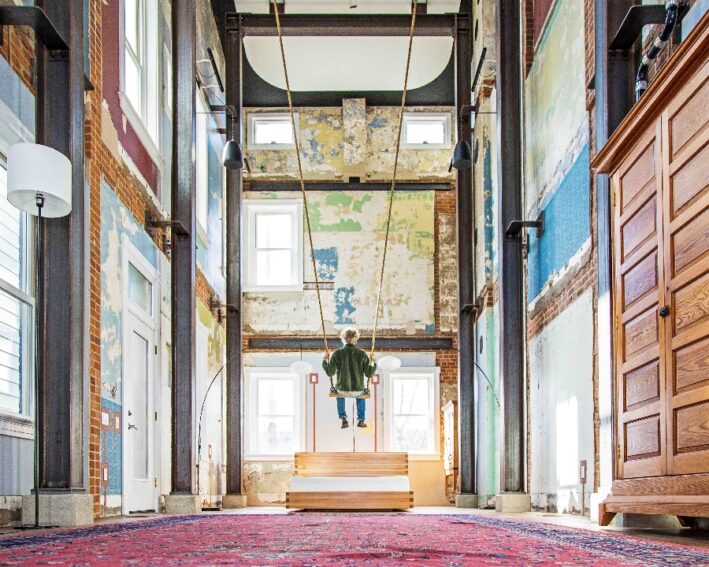
Artist and homecrafter Mark deJong rises on the trademark swing of his Swing House in Cincinnati. The deconstructed 1880 house is an art installation that works double time as an Airbnb. Hailey Bollinger photo.
From the outside, the blue brick Italianate looks much like its neighbors on short Avon Place, part of a blue-collar enclave since the first workers moved here in the 1880s.
It took the mind of Mark deJong to look beyond the prim Victorian façade to see the sturdy skeleton beneath, to reimagine telling the story of a house and people who made it home.
Of course, this could have become a living history house, revived with antiques and docents. But wouldn’t No. 1373 Avon Place be more interesting, the artist mused, as a fortified shell, revealing a pinch of one family’s wallpaper here, a patch of a bachelor’s paint? All bisected by a 30-foot rope swing.
DeJong bought the boarded-up building in 2010 on a one-block street he knew well. His mother’s ceramic studio had been in a warehouse on Avon since 1980, and he’d lived in the renovated top floor of her workspace since 2005.
Saving the house from the wrecking ball, deJong had his own form of controlled destruction in mind. He wanted to remove all the upper floors and interior walls, bracing the void with steel beams. As an art student at the University of Cincinnati, he’d biked the city’s oldest neighborhoods, exploring Victorian houses down on their luck. “They spoke to me,” he recalled, “about the story of the house.”
After 30 years of germination, deJong’s plans for the Swing House took three years of physical labor. A bit like Michelangelo, who chiseled away all the marble that wasn’t his statue of David, deJong pared back every element of the three-story building. Generations of furnishings and mementos were swept away or repurposed to create a towering stage set for his swing.
“The swing is a vehicle for contemplation,” deJong said. “The Swing House is about the past, revealing all the different layers that expose the aesthetic choices of the people who lived in the space.”
He opened the Swing House in 2017, then spotlighted it with an installation at Cincinnati’s Contemporary Art Center in 2018.
DeJong shares the Swing House with Airbnb guests. “The space as art is activated with the stay of one or two guests,” deJong wrote. After an overnight in August 2021, Cameron posted “It feels like a thoughtful letter from a friend…every corner offers inspiration.”
Visitors can swing toward the front door or toward the platform bed. Who doesn’t imagine that every B&B guest tries to leap off the swing and onto that bed?

The bed is tantalizingly close to the reach of the swing. For B&B guests, the windows in this open space have been soundproofed. And deJong provides everyone with an eyemask.
Was that part of deJong’s 30-year plan, from his first thought of deconstructing a heritage home? “If your dreams don’t scare you,” he cautions, “they’re not big enough.”
Curious Cincinnatians also pop in for a free monthly open house, and are invited to swing, too. “This house is part of Cincinnati,” deJong said, “and I want to give it to the city.”
Lest deJong start to sound too earnest, it takes just one lap around the Swing House to fall for the artist’s sense of whimsy. A house painter once lived here – ho hum. If any of us had found these old, dried-up paint cans, we’d fly them to the dumpster. It took deJong to create a panel of lids, aswirl with kaleidoscopic hues.

DeJong found more than 100 cans of paint in the basement. He curated some of the most kaleidoscopic lids.
And maybe my favorite? During deconstruction, a stuffed Kermit the Frog fell free from his ceiling prison. Because his bug eyes made him top-heavy, Kermit landed on his little green head, and that is how he remains in the basement gallery.

A plush Kermit the Frog plummeted from the ceiling during the Swing House deconstruction. Because the toy’s eyes make it top heavy, it landed on its green head, and deJong displays it that way in the basement gallery.
Down a spiral metal staircase, the gallery runs videos chronicling the hard work of deconstruction, with steel girders floating in from above. All under the keen eye of an engineer who helped deJong stabilize and strengthen the core of this venerable family home.
Most of these narrow houses in the hard-working neighborhood of Camp Washington were built without the services of an architect. But their sheer survival, and the Swing House’s elegant skeleton, attest to the care and skill of the men who built them.
But what does it all mean? As with so much of modern art, the question might be beside the point. It celebrates craft and family, invoking the generations who lived within its walls. People who might thoroughly enjoy kicking their heels up on the swing and breezing through their own spectral homestead.
When you go to Swing House
DeJong hosts a free open house at The Swing House from 12-4pm the second Saturday of each month. The house is near the revitalized Over-the-Rhine heritage district and the American Sign Museum.
Airbnb handles the rentals for the house, 1373 Avon Place. The starting price is $189 per night.
Be sure to pop in next door to see deJong’s Stair House, another Italianate home that will spotlight a beautiful wooden staircase. “While The Swing House is about the past,” deJong said, “the Stair House will be about the future. It will be a blank slate, plastered white with free-standing stairs.”
–Story and photos, except where noted, by Betsa Marsh
Hungry for more? Discover more things you must see in Cincinnati with this book.








0 Comments