





Eating the authentic foods of a region is one thing (a really good thing). But having the opportunity to learn how to cook those foods, learning about the ingredients and techniques, working side-by-side with chefs or homecooks? Well, that takes culinary travels to a whole new, very fortunate level. Writer Ed Placidi got to do just that and shares the experience of a cooking class in Cambodia. Ed gives RealFoodTraveler.com readers the authentic recipe, here.

Participants in a cooking class in Cambodia.
Cambodia’s Rich, Fragrant National Curry Is All About Technique
While Cambodia is known today for eclectic street food, from grilled snakes to fried bugs, traditional Khmer cuisine, one of the world’s oldest, is notable for its delicate seasoning and layers of textures and flavors, without the blast of fiery chili common elsewhere in the region. To learn more about the venerable Cambodian kitchen, a cooking class – featuring preparation of the rich, fragrant national curry dish of Fish Amok – in a farming village outside the booming tourist hub of Seam Reap (home to Angkor Wat), was among the most fulfilling, and tastiest, experiences of my travels in this welcoming country.
It felt like I was back in school, being reprimanded by my teacher. “Pound harder” with the mortar. “Less pressure, more angle” with the chopping knife. They were serious and dogmatic, and they didn’t relent. If the dish was going to come out perfectly, the proper techniques had to be followed. They whipped me into shape quickly, and the final result was of course heavenly flavors.
A tuk tuk picked me up at my hotel for the 20-minute ramble through back streets and market areas out into the countryside, down rust-colored dirt lanes to a small farming village and an outdoor kitchen set amid gardens. The class and adjacent Sojourn Hotel, a small luxury property removed from the bustle and glitz of Seam Reap, are affiliated with an NGO that assists the local community, providing rice and vegetables to villagers along with English classes and training to help local youths gets jobs in Seam Reap’s hotels, restaurants and tour operations. So taking the class, more than learning basics of Cambodian cuisine, was also participation in a worthwhile cause.
We – myself and two English couples were the students that day – were greeted by the class leader, glib Soyheap, a poised and elegant young lady who had worked her way up through the NGO program. We began with a leisurely walk in the village gardens to see many ingredients of the Cambodian kitchen growing, interspersed with a primer on the difficulties of life in a poor village and a visit to a family’s compound of tin-roof huts where several generations live together (married daughters each have their own family house in the compound). It was an intimate sensory overload as Soyheap broke off leaves and rubbed then between her fingers to release the scent.
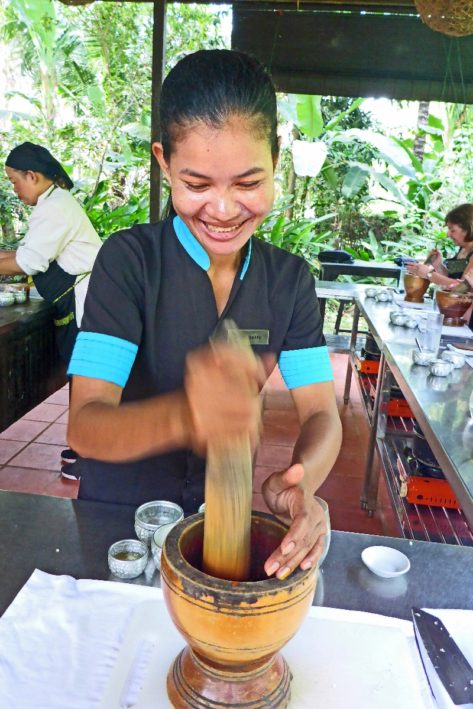
Soyheap demonstrating her mortar technique.
When we returned to the outdoor kitchen, waiting for us was gracious Vone, the chef at the Sojourn Hotel whose giant smile was contagious, spreading an aura of good cheer over the class. We gathered around baskets filled with the ingredients to be used that morning including many we had seen on our walk: fresh turmeric, pungent Asian basil, coriander-like saw leaf, intensely fragrant kaffir lime (leaves are used for tea, salads, curry paste, etc.), delicate gallenga (like ginger but much milder), unique-to-Cambodia ngor leaves, shallots, chili, salt and pepper, fish paste, garlic and stock powder.
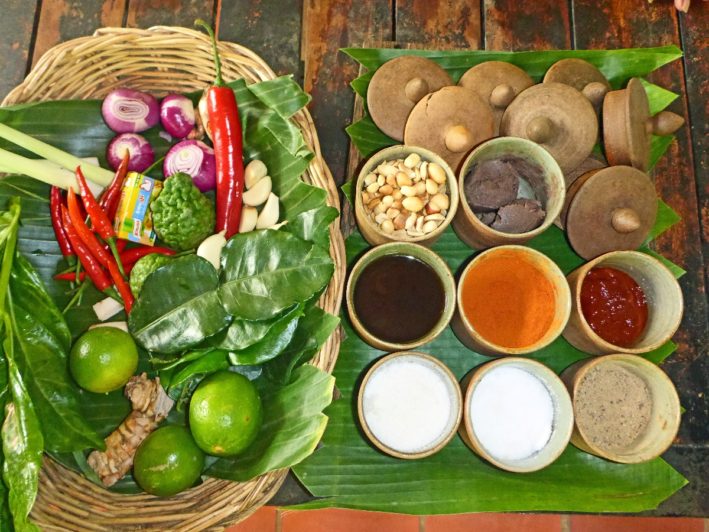
The day’s ingredients for the cooking class.
Cooking Class in Cambodia: Fish Amok We made this main course first; the national staple is arguably Cambodia’s most popular dish. Minutes of intense chopping reduced lemon grass, gallenga and kaffir lime leaves to virtual powder – with Soyheap and Vone hard-pressing their techniques of the knife angle and pressure to apply. Once fine enough, we dropped the mixture into a large wooden mortar, added rough chopped shallots and garlic, and then the pounding began. At one point Soyheap took my pestle from me and showed me how hard to pound. She laughed when I told her I didn’t want to break the mortar, but she monitored me closely until I had pounded the mix to the appropriate smooth paste.
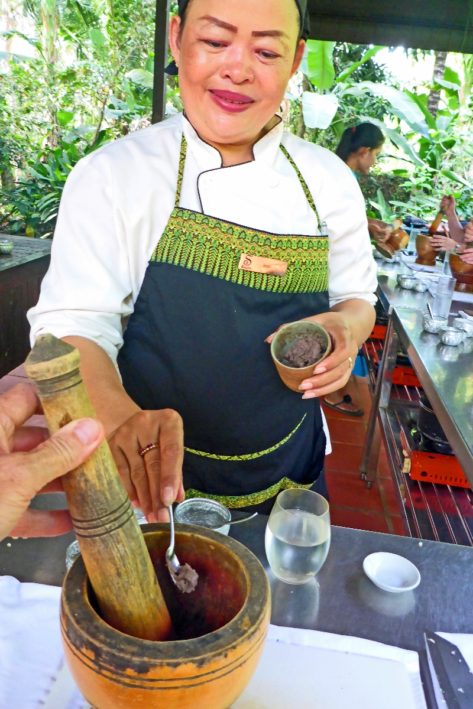
Vone added fish paste to the Fish Amok.
Next we sautéed the paste in vegetable oil and added a series of ingredients, cooking the evolving curry for a few minutes with each addition: first fish from Cambodia’s Tonle Sap Lake, Southeast Asia’s largest, cut into bite-size pieces, followed by roughly chopped ngor leaves and a bouillon cube, fish paste, a ramekin of coconut cream and one of water, and finally salt, sugar, black pepper and a dash of chili.
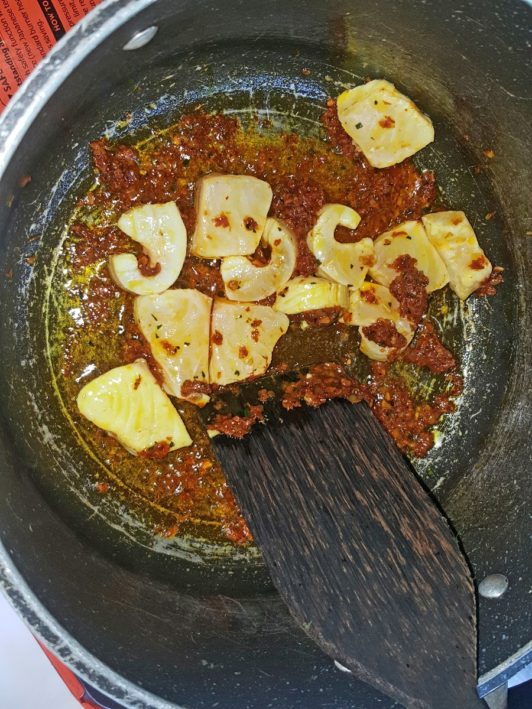
Cooking Fish Amok.
Cooking Class in Cambodia: Khmer Green Mango Salad Another national favorite, on menus throughout the country, preparation began by shaving a green mango (the peel removed first) with a string peeler, producing long, slender strips. Like with Fish Amok, in the Khymer style each ingredient for the salad was mixed in well before adding the next ingredient: First was cooked chicken cut into bite-size pieces, then shredded carrots, julienned tomatoes, basil, and saw leaf. We spooned the mixture onto a dish with a stylized banana leaf cut into an 8-point star, and topped it with a well-blended dressing of roasted peanuts, minced garlic and shallots, vegetable oil, and palm sugar.

The ingredients for Khmer Green Mango Salad.
Cooking Class in Cambodia: Banana with Palm Sugar and Grated Coconut This popular Cambodian sweet is very easy to prepare. We cooked sticky palm sugar for about 5 minutes, stirring continuously, then added a half ramekin of coconut cream and turned off the heat, continuing to stir for a few minutes. With the fire back on, we added shredded coconut and three typical Cambodian bananas – only about three inches long, slim and sweet as candy – and the other half ramekin of coconut cream, stirring on and on until thickened, about five minutes.
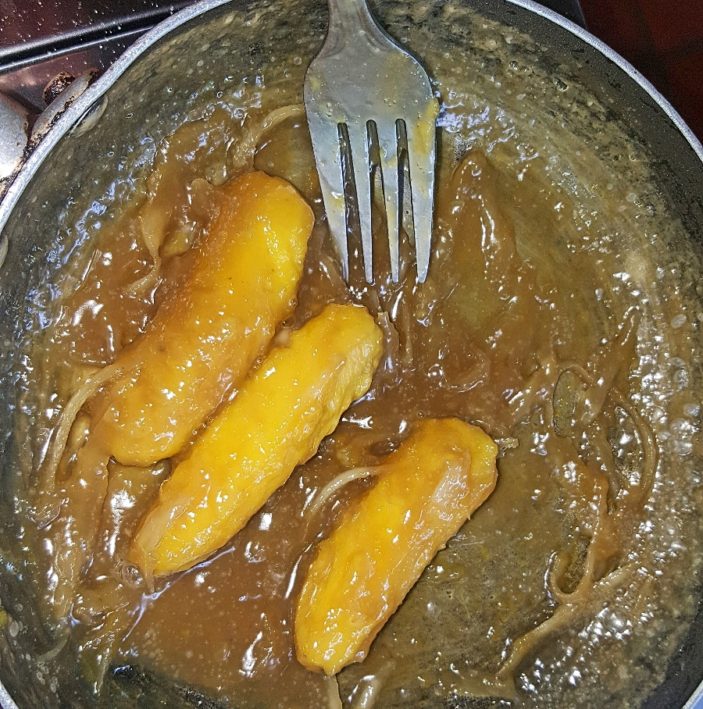
Cooking bananas with palm sugar and grated coconut.
Time for Lunch: Shaping with forks, Vone enhanced the presentation of our salads and had us carry them to a dining table in the garden. A few minutes later, after beer and wine were served, our Fish Amok arrived in a stunning presentation: served in a banana leaf folded into a bowl, with a round, flat-topped mound of rice garnished with herbs. Our eyes widened with the first bite: a delicious burst of flavor, an array of them, that mingled perfectly with the sticky rice. The harmonious dish widened that big smile of Vone’s when she saw how much we enjoyed the food. I had eaten Chicken Amok – exactly the same except chicken instead of fish – in an upscale restaurant in the capital, Phnom Penh, that paled in comparison to this. Sophisticated and professionally executed, it was on an ethereal level.

Fish Amok, finished and ready to enjoy.
The Green Mango Salad was a party in the mouth of crunch and a bombardment of flavors, from the sweet and sour of the green mango to the perfume of the basil and saw leaf to the intensity of the garlic and peanuts.

Khmer Green Mango Salad, plated.
Banana with Palm Sugar was several intense, sweet flavors that exploded on your palette, but almost too sweet, so served with kaffir lime and the more you squeezed on the more it cut the sweetness.
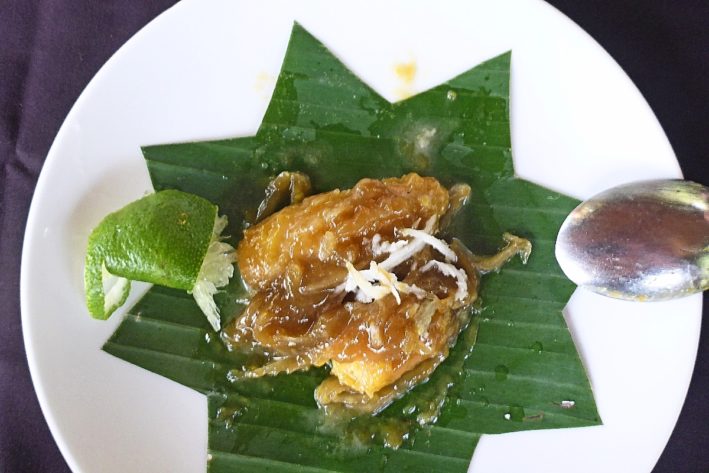
Banana with palm sugar and grated coconut in a cooking class in Cambodia.
All in all, the excellent class had everything: You learned basics of the Cambodian kitchen, your senses were fired with the introduction to and working with new ingredients, you were taught basic Cambodian cooking techniques, you created favorite national dishes, and then enjoyed a sumptuous lunch. And then they send you home with a well-executed booklet that is a primer on Cambodian cuisine with a number of recipes including those we prepared. — Story and photos by Edward Placidi
Hungry for more? Enjoy this article by Ed Placidi about an ancient way of making wine that’s still around today.







0 Comments