






Experiencing the cuisine of Paris, France is an essential part of any visit. Our Europe Editor Irvina Lew recently visited her beloved Paris and took her culinary delights to a new level by attending a cooking class at La Cuisine Paris. Here, she tells Real Food Travel readers what it’s really like to attend the school.

Save this article to Pinterest to help you plan your La Cuisine Paris experience. Photos by Irvina Lew except Eiffel Tower which is courtesy of Canva.com. Graphic by RealFoodTraveler.com.
La Cuisine Paris: A Parisian Cooking School Experience
In Paris, this spring, I relished bistro, brasserie, and café meals; some Thai and Japanese fare; and a few fine-dining feasts. Food is such a priority for me, that when I’m traveling, I try to enhance my familiarity with the local culinary culture by participating in a food or market tour and/or a cooking class. On this recent Foray in France, I enrolled in a Market Tour and Cooking Class offered by La Cuisine Paris.

The author outside of La Cuisine Paris where she took a cooking class.
Jane Bertch, an American who settled in Paris, founded the cooking school, and describes the challenge in her newly released book: The French Ingredient: Making a Life in Paris One Lesson at a Time. Her new memoir shares details about its launch and lots of intriguing insider secrets about Paris. Currently, nine bi-lingual chefs teach about 60 students daily, mostly in English, although there are French language sessions. Each attendee chooses from a calendar of events that includes specialty sessions: how to make baguettes or bistro lunches; croissants, or breakfast pastries; crèpes or macarons. One class focuses on advanced classic sauces; another is devoted to technique.
Mine was scheduled for a late-April Saturday morning, so I taxied to the Metro Station at Place Maubert, across from Marché Maubert, one of the popular Left Bank markets near lively Boulevard Saint Germain, in the 5th arrondissement, not far from where I had lived as a student at The Sorbonne. I arrived early enough to sip cappuccino at a café within viewing distance of our meeting place, in the tiny triangular garden, and, at 9:25am. joined the small group who appeared to be waiting. Within minutes, Adriane, a young representative from La Cuisine Paris presented herself and escorted us to our rendezvous with Chef Cyril Denis, at the front of the thrice weekly marché.

Chef Cyril Denis, at the marché.
From Chef Cyril’s brief introduction, we learned that the Parisian private chef and sake enthusiast had spent some childhood years in New Jersey, (where he learned impeccable English), and that he was a former journalist, educator, and TV chef. He asked each of us to introduce ourselves. From what I deduced, we were nine Americans: three female friends, a mom and daughter, a couple, and another solo female. (We connected and I learned that she is a West Coast accountant who visits Paris bi-annually and always schedules a cooking class).
Chef explained that we would vote for the ingredients for the entrée (appetizer) and plat, (main dish) to be prepared for our four-course luncheon menu and handed market bags with La Cuisine Paris logos to people willing to carry some of the purchases. He proceeded to show us prospective ingredients at his favorite produce, beef, poultry, and seafood stalls. (It was obvious from the start that Cyril’s passion for the finest ingredients determined his choice of the best purveyors among the 45 at the market).
Afterwards, we voted almost unanimously to start lunch with Coquilles Saint Jacques (scallops from Brittany in their shells) which, happily, were still in season, and continue with Magret de Canard, (duck breasts from an esteemed purveyor in south-western France) for the main course. Cyril also purchased potatoes for the Gratin Dauphinois, beautiful white mushrooms, some whole garlic bulbs, fresh herbs, and tightly tipped green asparagus for the Asperges Vertes Sautées.
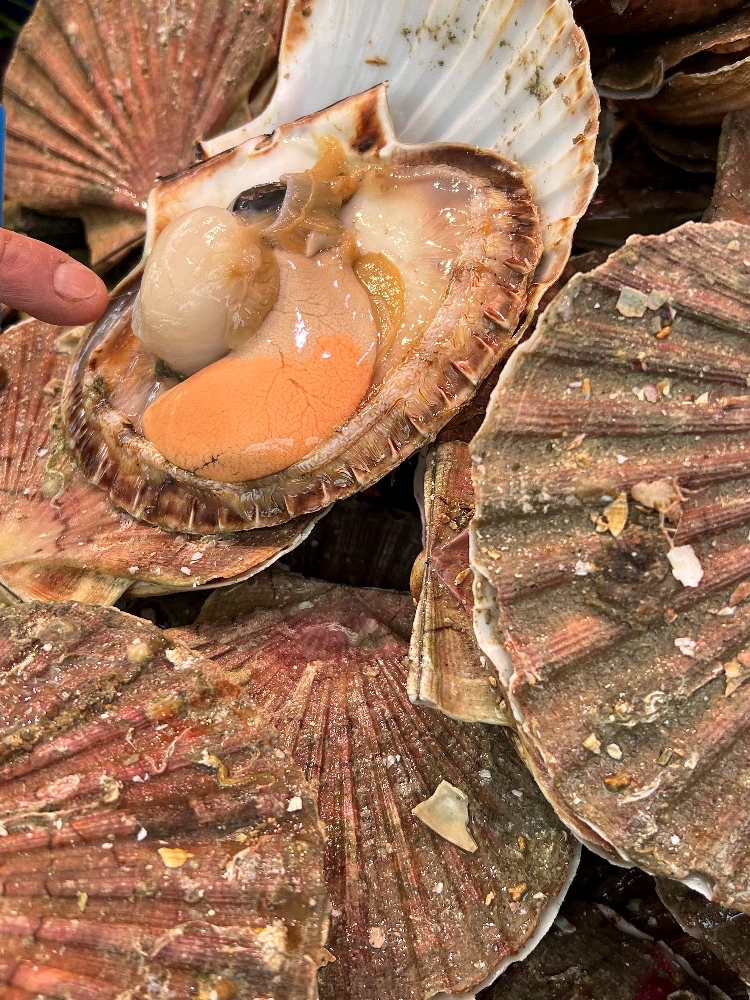
Coquilles Saint Jacques were in season when we were there.
For the cheese course, he led us inside the Fromagerie Laurent Dubois to buy fromage (cheese) in one of the top three cheese shops in France and to La Parisenne, the most distinctive, artisanal boulangerie/patisserie at the market, for baguettes. I don’t recall mention of dessert, which was predetermined, and a surprise.

A variety of cheese from the local Fromagerie.
With shopping completed, we walked to the cooking school via a scenic stroll down narrow streets and across two small bridges connected to the ancient Ile Saint Louis — an island in the Seine River with close-up views of Notre Dame on the adjacent Ile de la Cité — to 80 Quai de l’Hôtel de Ville where La Cuisine Paris is near Paris je t’aime, the Tourist Office of Paris, within the gorgeous 14th century City Hall. I strolled slower than most and with Adriane, who was tasked with “bringing up the rear” and didn’t seem to mind that I stopped to take pictures along the picturesque route. By the time we arrived, the rest of the group had finished their coffee and someone announced that class was ready to begin.
We mounted the circular stairs to the kitchen, where we were provided aprons. Chef asked us to wash our hands and, he insisted, rewash them whenever we touched a phone; I had to redo mine, repeatedly. In the center of the kitchen, the long stainless-steel table was set up with individual workstations with a cutting board, sharp knife, small, triangular potato peeler, and strategically placed bowls for scraps and all for each item for the mise en place.
In clear and precise terms, Cyril educated us about the importance of a sharp knife and demonstrated how to properly hold it, and how to peel and slice a potato, a mushroom, and a garlic. He also taught us how to excavate the “germ,” the thick white or green (depending on the age of the garlic) stem in the center of the clove, which can be bitter. I never knew this was a thing; I usually cut the end, smash the clove, discard the shell, and dice in a style that tries to replicate Jacques Pépin’s method.
Chef also showed us where to break the asparagus, how to open and extract the fresh scallop from the shell, and how to safely use the mandolin to slice potatoes. Then, he demonstrated how to meticulously clean one’s workstation and, in long sweeps, showed us how to wipe the entire surface. He insisted this was mandatory before starting any next task.
Once all the ingredients for the mise en place were ready in their individual bowls, we took turns following his directions. Someone tossed the mushrooms in the sauté pan (they were the base for the scallops which Chef sliced); someone else poured the whole milk into the butter and flour roux for the béchamel topping; others stirred or grated the nutmeg.
Chef showed us how to toss each slice of potato into the heated cream and butter mixture to be sure that each one is well-drenched, BEFORE placing it in the gratin dish. It probably starts the cooking process, too. It’s been decades since I served a Gratin Dauphinois, but I’m sure I used to pile the potatoes into the buttered baking dish and pour the cream and butter mixture over the slices. That day, I learned how to prevent the potato slices from sticking together.
After Cyril showed us how to diagonally cut one asparagus, others completed the task; I stirred them in the sauté pan with the lardons (the tiny, square pieces of bacon fat) for the Asperges Vertes Sautées, while Chef cut a circle of Japanese-made parchment paper to fit the pan, snipped off the paper tip and placed it above the veggies, so that some of the steam could escape while the asparagus tenderizes.
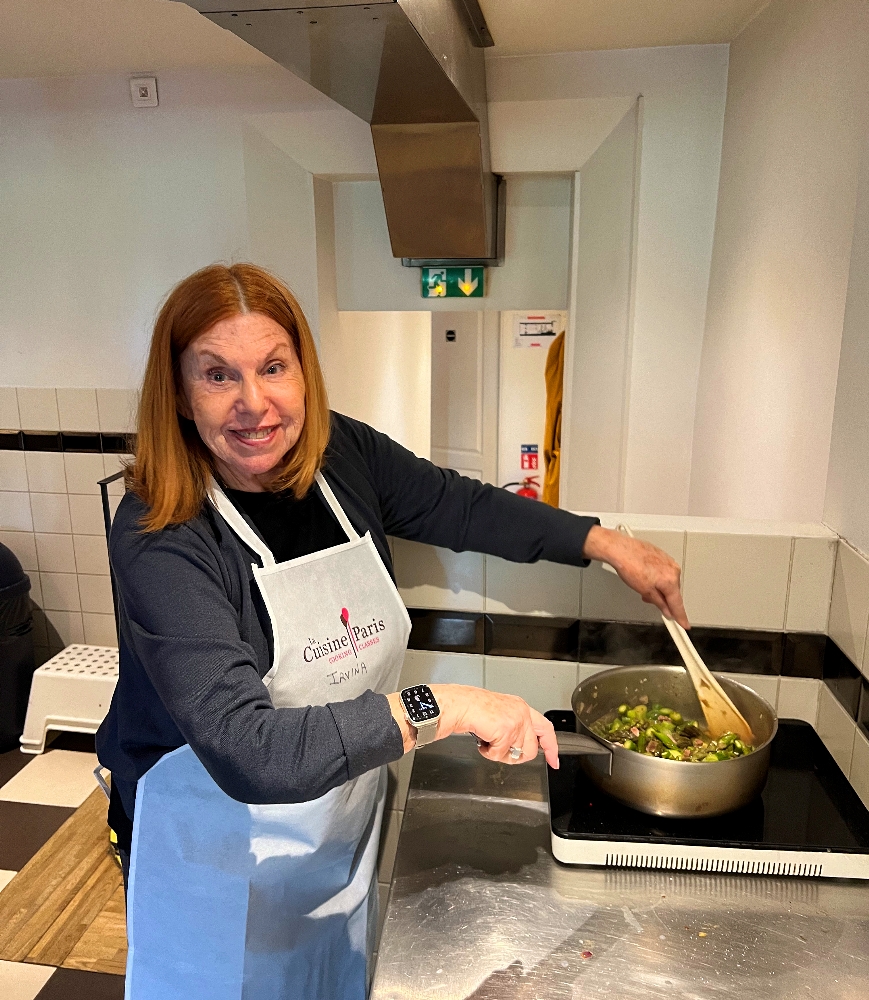
The author performing the assigned cooking class task of stirring asparagus at La Cuisine Paris.
For the individual Soufflés au Grand Marnier, he showed us how to carefully butter one ramekin and dunk it into a dish filled with lots of sugar until it was completely coated; then, he tossed out the excess sugar. (Now that I know that trick, my little molten chocolate cakes will always come out of the ramekin easily!) We each prepared our own ramekin, but chef whipped the egg whites to the perfectly stiff texture necessary for the dish; then, he flaunted the whisk upside down to prove it’s stiffness. I took a picture!

Chef Cyril of La Cusine Paris shows how whipped egg whites should look when properly done.
Hungry for more? Here’s a recipe for Molten Chocolate Cake.
With ramekins in the oven, he set about showing us how to score the fat on the first of four thick duck breasts (which served the ten of us, generously). He cooked them fat-side-own in an open pan and poured off some excess fat. After ten minutes in the pan, he illustrated a technique that I will certainly adopt. He took the pan off the stove to rest and wrapped it entirely within a huge sheet of aluminum foil; that way, the protein continues to cook to its perfectly pink doneness! Then, while the duck was resting, he removed and served the bubbly scallops. Before long, he sliced the duck and put the pommes dauphinoise and the asparagus on the counter to plate.
We dined at a long table in an adjacent windowed dining room overlooking the tree-shaded street bordering the Seine. First, we ate the appetizer: the bubbly bechamel atop sliced scallops and mushrooms served in the shell. Then, we each received a plate with sliced, pink, duck breasts, topped with pepper sauce, some asparagus, and potatoes au gratin.

The Coquille St. Jacques was our starter during our cooking class in Paris.
Next, we were served small plates with slices of Fougerus and Le Volcanique cheese with fresh bread. And, finally, the pièce de resistance, an absolutely perfect soufflé, in which was poured some Grand Marnier. Cyril seemed to have effortlessly perfected the seamless timing and the resulting meal was better than at most restaurants.

Right out of the oven, our Soufflés au Grand Marnier.
Hungry for more? Read about Paris and more in these articles by Irvina Lew.
In four hours, I admired market-fresh ingredients, walked through one historic neighborhood to another, picked up some solid new cooking techniques, enjoyed a marvelous lunch and made a new friend. At home, we each received the printed menu with recipes:
Saint Jacques Normande with Béchamel
Gratin Dauphinois
Sauce au Poivre Vert
Asperges Vertes Sautées
Magret de Canard
Soufflé au Grand Marnier
To learn more about La Cuisine Paris cooking school, visit their website.
-Story and photos by Irvina Lew, Europe Editor, Real Food Traveler
Please note: Real Food Traveler has partnered with Trivago and Expedia to help our readers plan their trips. Doing so will not change your search functions, pricing or any other experience with the site but it may provide a small commission which helps support this site.
Also, this article contains a link to Amazon.com. RealFoodTraveler.com is a participant in the Amazon Services LLC Associates Program, an affiliate advertising program designed to provide a means for sites to earn a small amount of advertising fees by linking to Amazon.com while providing convenience for the reader. This in no way affects the prices of any products you may purchase in conjunction with this link.

Keep this article handy by pinning it to Pinterest. Photo courtesy of Canva.com. Graphic by RealFoodTraveler.com.






0 Comments