





With a little trust in her navigation system and a mission to find the best pasties in Cornwall, England, writer Yvonne Michie Horn found a hand-held treasure with a fascinating history.

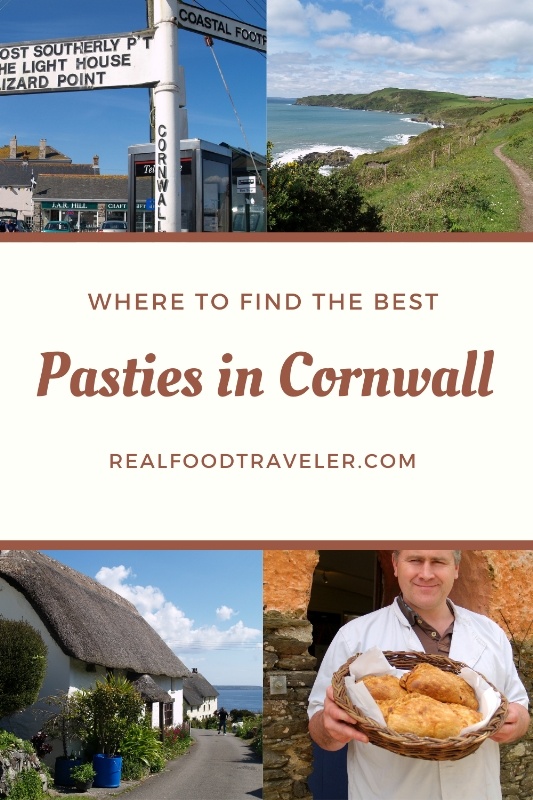
Cornwall pasties can be found down winding roads with thatched roof cottages, like these.
Without the patient GPS lady at my side – “Please make a U-turn at the earliest opportunity” – I’d probably still be wandering Cornwall’s tangled ribbon of world-class, narrow lanes looking for what is purported to be Cornwall’s best pasties.
During my ten-day tour of Cornwall, I’d had plentiful opportunities to try a pasty (say “pass-tee”), the county’s national dish. Shops selling them are even more ubiquitous than McDonald’s elsewhere in the world. But I was searching for an authentic pasty, one identical to those Cornish tin miners carried with them to tide them over while working in the depths of the earth, warming them up on an improvised oven – a shovel set over a candle. Not that I intended to do that.
While perusing pasty shop windows and counters, I noted varieties of fillings. Chocolate and banana – lunch fare for a tin miner? Don’t think so. Undoubtedly such fillings were created to please the emmets. Emmet, derived from an old English world for ant, is the descriptive word used by the Cornish to describe the hordes of tourists who arrive mid-June through September to swarm about its postcard-perfect villages, beaches and countryside, munching pasties as they go.
“Pasties aren’t street food,” a local told me. “Pasties to us are, ‘What shall we have for dinner? Well, let’s go pick up some pasties.’ Chocolate and banana? Never. Sausage and apple, Stilton cheese and leek? Not authentic, but good.”
That same local told me where to find Cornwall’s best, most authentic pasties. Which was why I’d put myself in the hands of the patient GPS lady, trusting her to take me to a pasty shop with a Helston address somewhere on a knob of Cornwall known as the Lizard Peninsula.
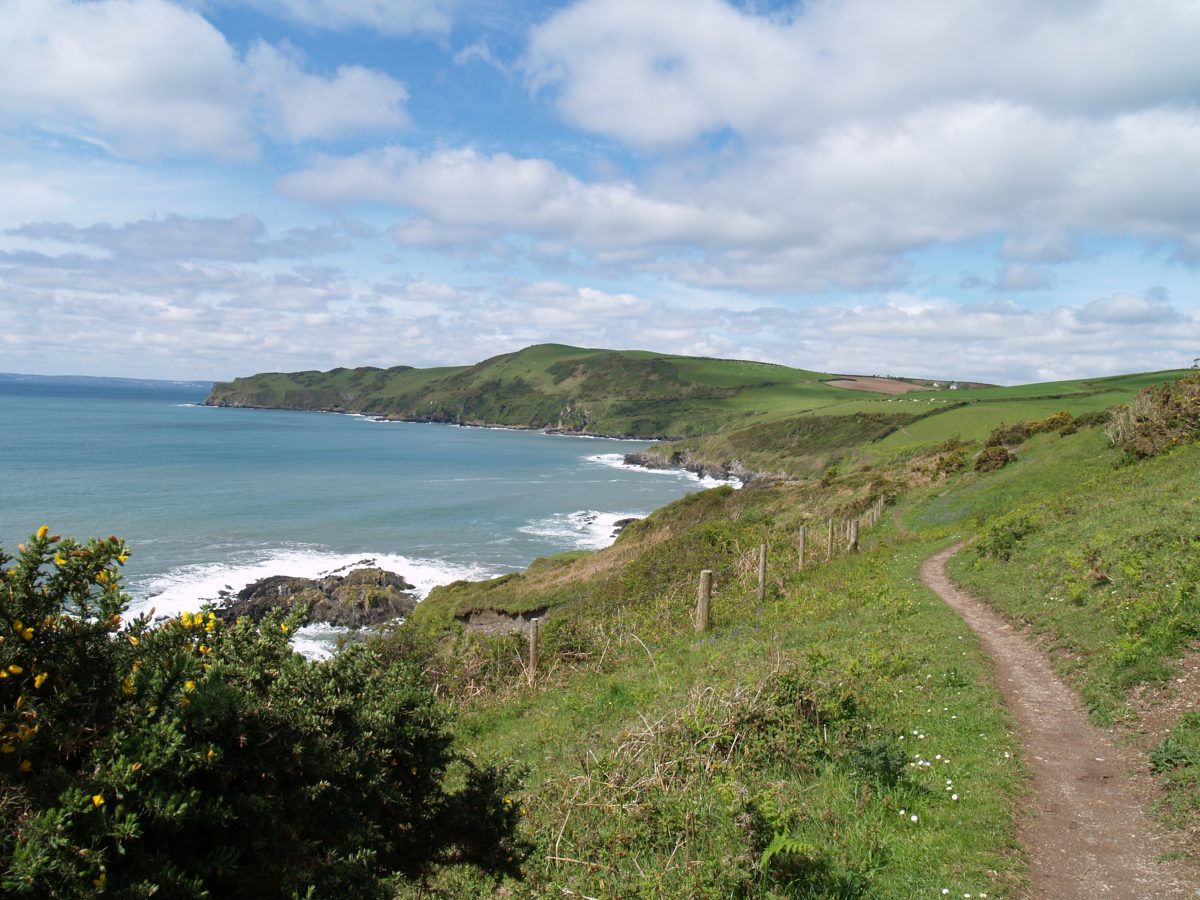
The lovely edge of Lizard Peninsula along the Cornwall coast.
In 2011, the recipe for an authentic Cornish pasty was awarded Protected Geographical Indication (PGI) status. Such status ensures that only products genuinely originating in a certain region are allowed to be identified as such in commerce. Not only Cornish pasty ingredients were specified but also its shape, a round of pastry folded into a “D” and crimped on the rounded edge. Crimping was important to a tin miner, giving an edge to hold on and later discard, ensuring that dirty fingers, undoubtedly including traces of arsenic, would stay clear of the mouth.
Size, according to PGI, is traditionally somewhere between six and eight inches. But that has not stopped an oversized version. Regatta week, an annual summertime event, includes a giant pasty paraded from the town of Polruan to neighboring Fowey. On St. Piran’s Day, the March 5 holiday named after the patron saint of miners, an enormous pasty is marched from the town of Polruan to neighboring Fowery’s ground of the Cornish Pirates rugby team, where it is passed over the goal posts – presumably not drop kicked.

David Gear proudly shows off a basket of pasties.
The GPS lady appeared to be taking me into the nowhere of the Lizard. As she instructed me to turn into a farm yard, she announced that we’d arrived.
Puzzled, I hailed a man driving out of the farm yard on a little red tractor. “Is this is where I get Cornwall’s best pasties?” I asked. “Second best,” he corrected, as he put the tractor in gear. “First best are Mother’s. You’ll find the second best over there, my son-in-law’s,” pointing to a little shop I’d failed to see.
From its out-of-the-way location, son-in-law David Gear of Gear Family Farms turns out some 1500 pasties a day with most shipped unbaked and frozen to Whole Foods’ markets in London. The rest, straight from the oven, are handed over the counter to a steady stream of customers – authentic pasties filled with traditional ingredients all organically grown on the farm.
The recipe includes diced onion, potato and “swede” (turnip) seasoned with salt and pepper. “Meat can be added,” the second-best pasty maker in Cornwall told me. “It was traditionally stuck in to make use of a bit that had gone a tad bad.” Gear offers a non-vegetarian pasty, assuring “tad bad” is not the case of the thinly-sliced steak he uses.
A bench just outside the shop door invites immediate seating for those who can’t wait to dig into Cornwall’s second best. As I unwrapped mine, I thought of the worlds’ largest Cornish pasty made in August 2010, measuring 15 feet, weighing 1,900 pounds and containing 1.75 million calories.
While teeny in comparison, a Gear Family Farms’ pasty is incredibly filling. I rewrapped a sizeable portion to warm up and eat later on – but only if I could find myself a shovel and candle.
— Story and photos by Yvonne Michie Horn
Hungry for more? For another article about pasties, go here.
Keep this article handy by pinning it to Pinterest.






0 Comments