






Sometimes the best laid plans go awry when traveling. But how can you blame nature standing in the way of nature?! Writer Betsa Marsh shares her experience braving wild winds when trying to see miraculous sites in the sky in Death Valley, an International Dark Sky Park.
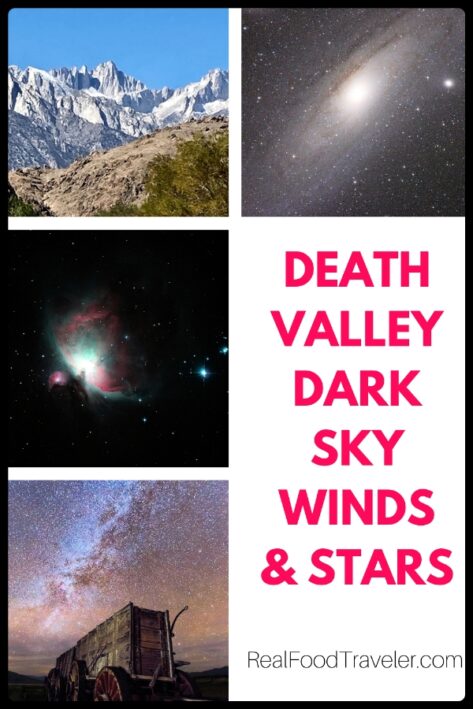
Save this article about stargazing in Death Valley to Pinterest to help you plan your trip. Photos counter-clockwise: The Andromeda Galaxy, seen from Death Valley by David Blanchette. Mount Whitney by Betsa Marsh. The Milky Way above the Harmony Borax Works in Death Valley National Park. Photo by NPS/W. Kessler.
Suddenly, a Death Valley Sirocco Steals Our Stars
We’re clambering over sand dunes and down to salt flats, the lowest point in North America. Hiking out to the desiccated ruins of a 20 mule team wagon and borax mine and diving into the spring-fed pool at an oasis inn.
All seems on plan at Death Valley National Park, home of superlatives: the lowest, driest and hottest place in America. After a morning hike in rising temps, surely we’ve earned our frozen cocktails by the pool.
Kids splash, adults stroke through the clear water that bubbles away at a heavenly 83 degrees. We’ll take a break before the evening’s main event, stargazing out in the desert, celebrating Death Valley’s honor as the world’s largest International Dark Sky Park. The International Dark-Sky Association, which awards Dark Sky Park status, has further crowned Death Valley with its highest darkness rating, the Gold Tier.

The Pleiades, an open-star cluster in the constellation Taurus, blazes over Death Valley National Park. About 444 light years away, it is among the nearest star clusters to Earth. David Blanchette photo.
Suddenly, the desert has other plans. Palm fronds and dates fly into my Caribbean Bushwacker, dust funnels into my husband’s icy margarita. Annoying, but surely a momentary squall. But by the time we clean out our drinks and head inside, umbrellas are sailing into the pool and we’re in a full Lawrence of Arabia moment.
Then, even more surprisingly, it starts to rain. First one set of drops on the little terrace outside our door, so we race out to stand in it—we’ve been told Death Valley averages less than two inches a year. Then we have another sand tornado, followed by a second sprinkling in America’s driest place.
“When it rains, I tell people to appreciate it,” said Matthew Lamar, Lead Astronomy Ranger at Death Valley. “It’s pretty rare.”
Our 70 mph winds are pretty unusual, too, according to Lamar, kicking up a couple of times a year from October to May. We’re just that lucky.
We now have rain-in-Death-Valley bragging rights as the Inn’s electricity snaps off for the rest of the day, but what we don’t have are memories of the Milky Way over Death Valley salt flats. “The problem was the wind and sand,” said Kent Taylor, the expedition leader with Orbridge tour company who had to shut down our stargazing. “It was a tough call, but we couldn’t risk people getting sand in their eyes.”
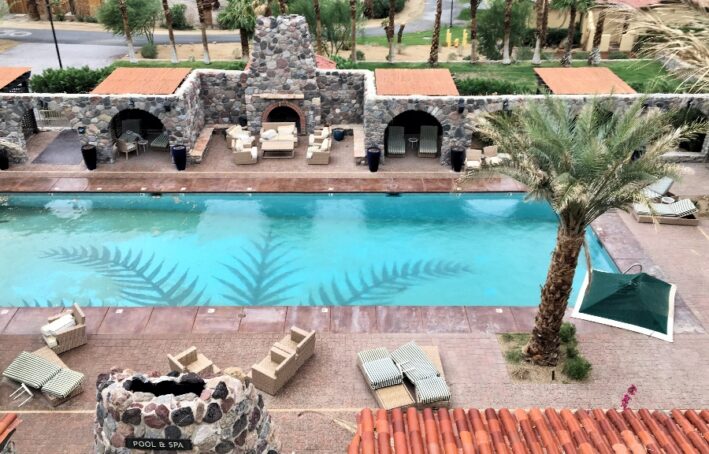
After the storm: Winds of 70 mph tumbled furniture and blew sand into the gorgeous spring-fed waters of the pool at the Inn at Death Valley. David Medkeff photo.
Hungry for more? Read about the Death Valley Superbloom.
On a calm night at Death Valley, stargazers would head for the Devils Golf Course on the salt flats for a program by Dave Blanchette, a keen amateur astronomer and vice president of the Las Vegas Astronomical Society. He mounts his camera to a telescope so it’s much easier for newbies to spot Jupiter and Saturn, planets we might have seen on a quarter-moon night in October.
Blanchette takes one-minute photos, which show objects in the sky much brighter and frequently in color. “You can rarely see these with the naked eye,” he said, ticking off such deep-space quarry as nebula, galaxies and globular clusters that can mass 100,000 stars together.
Blanchette’s groups have permission from the Inn at Death Valley to set up on the 10th tee of the golf course, away from the resort’s lights. Although he can see light pollution from San Bernadino and Los Angeles in Death Valley “if you know where to look,” the park has worked hard to earn International Dark Sky Park status. Park staff inventoried every light in the park, according to Lamar, angling some downward, replacing others and eliminating a few altogether. They also teach visitors about the night sky in a series of ranger programs that runs from November through mid-April.
The brightest dark spot on the Death Valley calendar is the Dark Sky Festival each winter. “Scientists from NASA show how similar Death Valley is to Mars and Europa, [one of Jupiter’s moons], and hold telescope events,” said Lamar. The Las Vegas Astronomical Society often participates, along with the NASA spinoff SETI Institute, the Search for Extraterrestrial Intelligence.
“About 80 percent of Americans can’t see the Milky Way where they live,” Lamar said. “They want to experience it. And some people [at the festival] have been into stargazing and astrophotography for a long time. They’re at different points in their relationships to the night sky, but it’s a fulfilling experience for all of them.”
For our little dusty group of travelers, however, there will be no bonding with the Milky Way tonight. But the next day, as we head toward Mammoth Lakes, we discover our reward. Last night’s fierce winds sand-blasted the skies, giving us a crystalline view of Mount Whitney, the highest peak in the continental U.S. Snow sugars the Sierra Nevadas, and Whitney stands tallest in the glitter. We shall grumble no more about palm fronds in our pool drinks.
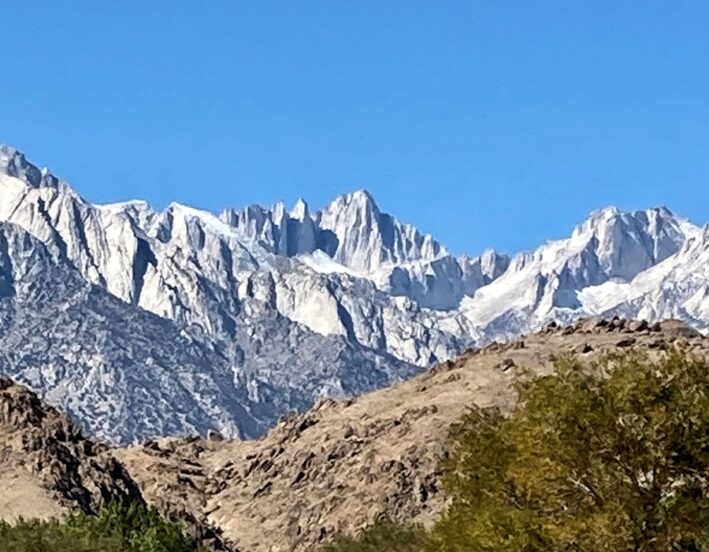
A sudden sandstorm cleared the skies for a crystalline view of Mount Whitney, center, the highest peak in the continental U.S. Betsa Marsh photo.
Death Valley National Park Ranger Matthew Lamar and astronomer David Blanchette have some tips for the best stargazing.
- Come during the new moon, when the moon isn’t visible and you’ll see more stars. But if you do visit during full moon, you can shoot the moon rising over the mountains, against sand dunes, or the old buildings and mule cart at Harmony Borax Works.
- Head for a hill such as Dantes View, at 5,000 feet, for the best views. At lower points, heat can distort the image. “If the stars twinkle,” Blanchette said, “that’s heat shimmering in the atmosphere.”
- Mesquite Flat Sand Dunes has unobstructed views to a wide expanse of sky.
- The salt flats of Badwater Basin are an other-worldly experience, great for the foreground of a night shot. “One of my best memories of Death Valley is a full moon rising over Badwater Basin,” said Lamar, “with the moon being reflected off the salt.”

The Milky Way stretches above the Harmony Borax Works in Death Valley National Park. NPS/W. Kessler photo.
When You Go
At 3.3 million acres, Death Valley is the largest national park in the continental U.S. Badwater Basin is 282 feet below sea level, the lowest point in North America.
For more information about night sky ranger programs and the annual Dark Sky Festival, visit Death Valley National Park, www.nps.gov/deva/index.htm
The International Dark-Sky Association has designated Dark Sky Parks around the world at www.darksky.org/
-Story by Betsa Marsh
To help you plan your trip, visit Expedia to get started. RealFoodTraveler.com is an affiliate member of Expedia.com and may receive a small commission on travel booked through the site.








0 Comments