






Whether a trip to the city of Fez, Morocco, is on your bucket list, or not yet on your radar, this article by writer Katy Koontz will give you a real feel, and taste, of what you’re in for.

Save this article about exploring the city of Fez in Morocco to Pinterest to help you plan your trip. Photos by Katy Koontz. Graphic by RealFoodTraveler.com.
When you hear that the new section of the city you’re visiting was founded in 1276, you know you’re about to upend your ideas about what “new” and “old” mean. Whatever I initially expected from Fez, the spiritual and cultural capital of Morocco and the oldest of the country’s four imperial cities, the reality was infinitely richer and more intriguing than I imagined.
To be fair, the area called “New Fez” (Fes el-Jdid) is hardly the newest section of the city. That designation belongs to the modern, urban Ville Nouvelle. You could easily lift Ville Nouvelle off of the African continent and plunk it down somewhere in Europe and no one would notice anything out of place. That’s because the French developed this section of the city when they controlled Morocco from 1912 to 1956 (which explains why the name of the city is often spelled in its French form, Fès).

An overlook of the Moroccan city and its ancient medina of Fez, the first UNESCO World Heritage Site in the country.
In contrast, Fes el-Jdid was founded in 1276, while “Old Fez” (Fes el-Bali) was established sometime between 789 and 808—back when the Vikings began raiding England and Charlemagne was battling the Saxons in Europe. Both Fes el-Jdid and Fes el-Bali are included in the city’s medina—an ancient walled area that’s one of the largest car-free urban zones in the world. In 1981, it was classified as Morocco’s first UNESCO World Heritage Site.
In granting the special designation, UNESCO noted: “This architecture is characterized by construction techniques and decoration developed over a period of more than ten centuries, and where local knowledge and skills are interwoven with diverse outside inspiration (Andalousian, Oriental and African). The Medina of Fez is considered as one of the most extensive and best conserved historic towns of the Arab-Muslim world. The unpaved urban space conserves the majority of its original functions and attribute. It not only represents an outstanding architectural, archaeological and urban heritage, but also transmits a lifestyle, skills and a culture that persist and are renewed despite the diverse effects of the evolving modern societies.”
Hungry for more? See what it’s like to go to Rick’s Cafe Casablanca.
Exploring the City of Fez
It’s said more than 9,000 alleys are among these narrow, maze-like passageways, although anyone trying to get an accurate count would doubtlessly end up utterly confused as some turn into dead ends and others loop back around on one another in an endless tangle. It’s so much better to spend your time taking in the sights rather than taking a tally.
Those sights include souks (markets), mosques, museums, madrasas (Islamic schools), cafes, fondouks (a kind of medieval hostel for merchants), mosaic fountains, riads (traditional Moroccan homes converted into guesthouses; our hotel—Riad Fes—was a former palace), and many other splendid surprises.
Our explorations began with a quick look at Fes el-Jdid. We peered through the gates of the 195-acre Royal Palace (still used by the Moroccan king) and saw the nearby mellah, or Jewish Quarter. While there isn’t a significant Jewish population living there now, at one time the city was home to the largest and one of the oldest Jewish communities in Morocco.
Our guide Radouane el-Aouan (who suggested we call him Rad for short) pointed out that you can always tell when you’re in the mellah of a Moroccan city because you see exterior balconies and windows on the houses, whereas traditional Arab homes sport such features only on interior courtyards hidden from the street.
Rad soon ushered us into the incredibly narrow and twisty-turny streets of the medina to see the souks. The shops are often quite tiny—sometimes closet-size—and sell household goods as well as a wide variety of the traditional artisan creations Fez is known for, like metalwork, ceramics, leather goods, and Berber rugs. While the narrow passageways meant we didn’t have to worry about dodging any cars in the medina, Rad warned us to watch out for donkeys transporting merchants’ goods.
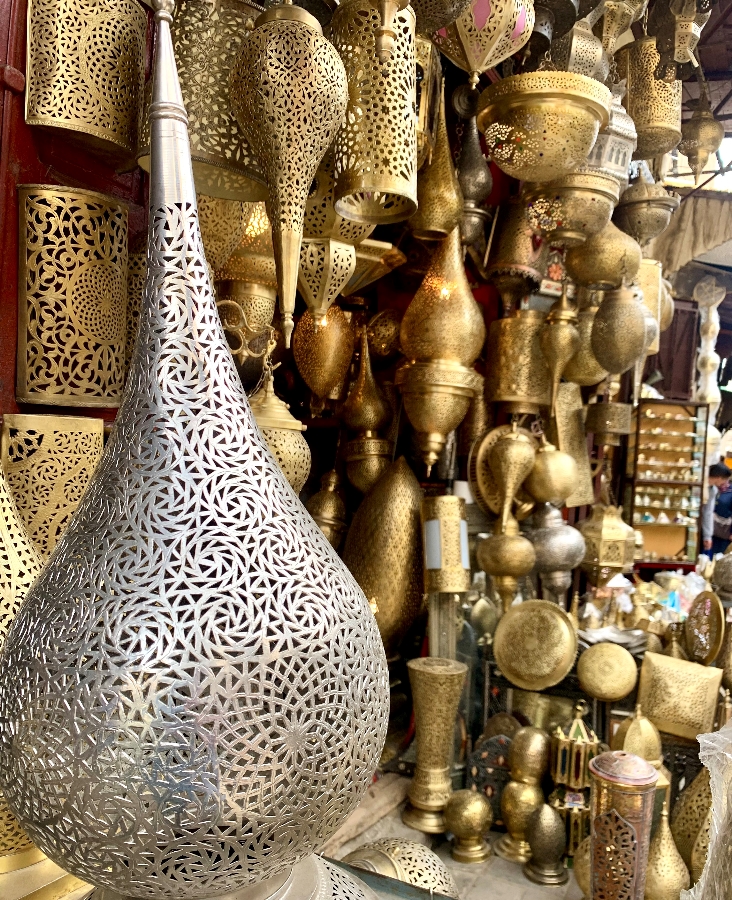
One of the many souks selling filigree brass lanterns and other fine metalwork in the ancient medina in Fez.
Savory and sweet treats in the city of Fez
Many souks sell food, including dates, spices, fresh mint and other herbs, eggs, olives, meats, and various sweets. Rad helped us try a few, starting with chebakia—cookies made from fried strips of dough soaked in honey and sprinkled with sesame seeds. Chebakia are especially popular during Ramadan, he explained, a holy month during which Muslims fast from food and water during daylight hours. Another popular sweet is briouat, a triangular-shaped puff pastry filled with almond or peanut paste. They’re fried and then coated with honey. These were definitely my favorite sweet treat of the trip!

A merchant in the Fez medina is surrounded by tubs of khlea, preserved meat. Below the counter are briouat, a puff pastry filled with almond or peanut paste and coated in honey.
I also loved the ma’akouda, potato balls made with traditional Moroccan spices and dipped in egg before being deep fried. They’re often eaten as a filling in sandwiches, but we just popped them right in our mouths.
I passed on the snail soup, cooked in large vats of peppery broth and served in their shells. I also passed on trying camel, although you can actually get camel burgers in Fez. After seeing severed camel’s heads hanging in the markets (advertising the meat for sale at that stall), I just couldn’t bring myself to be quite that adventurous. (I’m not even going to mention the stalls serving steamed sheep’s head.)
Hungry for more? Read about other places to travel in Morocco.
An incredibly tasty treat is pastilla, a type of sweet-and-savory meat pie dusted with icing sugar and cinnamon. Traditionally it was made with pigeon, but today shredded chicken is the most common filling. Eggs, onions, shaved almonds, spices, and a little sugar are added to the meat, which is surrounded by a flaky pastry called warqa (similar to phyllo dough). In addition to buying it as street food, you can find this dish in almost every restaurant, as well. I’m almost embarrassed to say how often I ate it while I was in Morocco.

Pastilla, a sweet and savory, flaky meat pie, is iconic to Fez, Morocco.
Rad made sure we got to try bissara, a soup made from pureed fava beans that he explained is popular with locals to have for breakfast, especially in winter. He showed us how to add a spoonful of olive oil to the bowl and then sprinkle some paprika and cumin on top. Moroccans usually eat this soup with chunks of bread. Bissara originated in the northern Moroccan city of Chefchaouen (known as the blue city), but now you’ll find it all over Morocco.

Fava bean soup is served with various accompaniments.
We also tried jben, a traditional Moroccan creamy goat cheese, and leben, fermented milk, usually from goats, that has a sweet and tangy taste similar to kefir.
Another market staple we saw in stalls all over the medina is khlea, preserved meat. It’s typically made from strips of beef or lamb that are marinated in garlic, coriander, and cumin and then dried in the sun. The meat is then cooked in a mixture of water, oil, and tallow and sold in plastic tubs filled with more tallow. Considered a delicacy, it originated in Fez and Rad explained that it’s considered part of the city’s heritage.
More Fez travel sights
In between markets, we passed several mosques and schools and even the world’s oldest library, al-Qaraouiyine, linked to a university established in 859. Scholars and scientists from all over the world come here to view its ancient manuscripts. Although we were not permitted inside the library or the mosques, we were allowed into the lovely courtyard of al-Attarine madrasa—an Islamic school built in 1323 and named for the perfume and spice markets that surround it. The courtyard contains an impressive display of mosaic tile (called zelij) in colorful geometric designs, intricately carved plasterwork (some with calligraphed verses from the Koran), fine marble columns and capitals, and carved cedarwood doors and ceilings. In the center of the courtyard stands a modest but beautiful marble fountain.
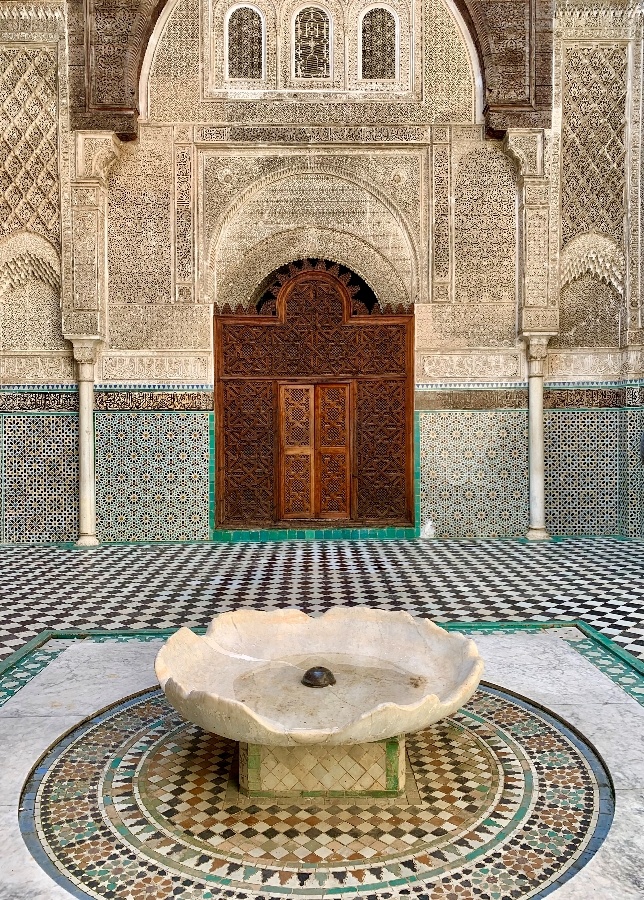
The courtyard of an Islamic school built in 1323 known as al-Attarine madrasa in Fez, Morocco.
Finally, Rad guided us to the leather goods souk. Here, we had a look at Chaouwara Tannery, the city’s largest, which has operated since medieval times. Workers cure the hides (usually from cattle, but also from sheep, goats, and camels) by soaking them for several days in vats filled with a pungent mixture of cow urine, lime, water, and pigeon poop. (The smell is so strong that the tanneries typically give visitors sprigs of fresh mint to hold under their noses.) Then the hides go into vats of dye before workers lay them out in the sun to dry.

The Chaouwara Tannery, the largest tannery in Fez, with its many vats for both curing and dying leather hides. This tannery has existed since the Middle Ages.
As we made our way through the passageways back to our hotel at the end of the day, I was grateful we had Rad to lead the way. Otherwise, I’d probably still be wandering the maze-like medina months later, completely lost—although on second thought, that might not be such a bad fate after all!
For more information, visit the Moroccan National Tourism Office. For professionally certified and licensed guiding services, look for Radouane el-Aouan on Facebook and Instagram (@radmorocco).
–-Story and photos by Katy Koontz
Hungry for more? See what it’s like to cook with the locals in Morocco.






0 Comments