





Here at RealFoodTraveler.com, we believe that taking a cooking class in a destination you’re visiting is one of the best ways to learn what the locals eat. It’s also a great way to discover local ingredients, tried-and-true cooking methods, and meet the locals. Best of all, you get to enjoy the fruits of your culinary labor at the end! Writer Debi Lander shows us what it was like to attend a cooking class in Morocco.

Save this article about attending a Moroccan Cooking Class to inspire you to learn to cook like the locals, with the locals. Photos by Debi Lander. Graphic by RealFoodTraveler.com.
Hungry for more? Learn about taking a cooking class in Cambodia.
Morocco fulfills travelers’ desires with reams of history, cultural diversity, exotic adventure, and fabulous food. While touring the country in the northwestern corner of Africa, I attended a cooking class in Marrakech. I hoped the hands-on lesson would teach me to make a tagine.
Moroccan Cooking Class: Tagines
Tagines top the list as the most popular meal in Morocco, though the term is confusing. The word tagine refers to both the Berber cookware, a conical-shaped, two-piece earthenware clay pot, and the stew-like entree.
The clever design of the tagine allows the covered pot to trap steam in the dome. It condenses and drips back down. You end up with a moist and succulent dish. Everything cooks evenly, the contents tenderize and caramelize, and the natural flavors burst forth.

The tagine rests on the burner, over a metal diffuser. A spoon allows some steam to escape.
The credit for the tagine’s origin goes to Harun al Rashid, a ruler of the Islamic empire in the late 8th century. Interestingly, the tagine was described in stories from the 9th-century collection 1001 Arabian Nights.
However, some food historians argue that the tagine’s presence goes back even further to the Roman Empire. The Romans used portable ovens similar in shape to the tagine. (The ancient Roman Empire extended into what is now Morocco at Volubilis. I toured this scenic UNESCO World Heritage Site and highly recommend it.)
Hungry for more? Make the national dish of Grenada.
What it’s Like to Attend a Cooking Class in Morocco
We met our instructor, a lovely young woman named Kautar, in the old medina (walled city) market of Marrakech. Despite a torrential downpour, we picked out vegetables, fruits, and herbs amongst jostling umbrellas. We also purchased chicken from the butcher (where live chickens roamed in cages at the rear). Our soggy procession continued to the home of Kautar’s aunt, Khmisa, who would assist.
First, we sat at a long table and learned the proper method to make and pour sweet mint tea. Kautar steeped green tea leaves with a generous handful of spearmint leaves. She then served it in traditional small glass cups. Pouring tea becomes an art; the higher you raise the pot, the better. Tea is also a sign of hospitality and is presented to guests upon arrival. We also nibbled on some cookies. (Moroccans often eat cookies before a meal, with fruit served at the end.)

We learned the proper way to make and serve tea from our hosts.
My group then went to workstations around a large table in the partially covered courtyard. We attempted to use the proper techniques as demonstrated, though we didn’t always get them right! My first job was to chop parsley, and auntie was very demanding that it be super fine. The group worked together: chatting, cutting, and peeling zucchini, carrots, turnips, potatoes, beans, and cauliflower. We were fascinated with a little bird who flew in to get out of the rain.

The ingredients we were going to use for our Moroccan cooking class were laid out for us.
Moroccan cuisine calls for spices, and the blend named Ras El Hanout, meaning “top of the shop,” comes from Morocco. It’s a vibrant, earthly spice mixture, and each family maintains its own recipe. Think garam masala in India. Common choices include cardamom, cumin, clove, cinnamon, nutmeg, mace, allspice, dry ginger, chili peppers, coriander seed, peppercorn, sweet and hot paprika, fenugreek, and dry turmeric.

The spices we used were laid out in bowls.
We would make two tagines, one a vegetarian entrée and the other lemon chicken. The chicken tagine recipe called for ½ teaspoon of Ras El Hanout, plus additional ginger, cumin, turmeric, and saffron stems. We crushed all the spices together and added preserved lemon slices, grated onions, garlic, and parsley. The mixture then went into the bottom of the oiled tagine, and the chicken pieces were arranged on top.

My group at their workstations.
Khmisa added about half a cup of water around the edges and covered the tagine, which was then placed on a metal diffuser. It simmered gently over a gas stovetop for 30 minutes, then a spoon was inserted between the lid and bowl to let some of the steam out. Cooking continued with Khmisa turning the chicken pieces and testing for doneness. When the meat easily pulled from the bone, it was removed and rested under foil. The sauce in the tagine was reduced by turning the heat up to high.
When ready to serve, the chicken pieces were placed back and topped with olives, additional preserved lemon strips, and the lid. Tagines are served at the table with a show of bravado as the dome is lifted.
To make the eggplant starter (Zaalouk), my travel buddy was asked to grill about a pound of eggplant directly on a gas range burner. When charred, it was taken off the burner and placed in a brown paper bag. The charred peel was removed when cooled, and the remaining pulp was mashed.
The next step surprised me: we grated tomatoes to make the sauce! This method works well but leave out the skin. Spices and olive oil were then added to the mashed eggplant.
Zaalouk can be served hot or cold with bread. I found it exceptionally yummy, and the recipe will be added to my repertoire.
We also prepared Brioutes, a triangular appetizer that reminded me of spanakopita, but with mixed vegetables as the filling. These puffed pastries were fabulous, and we were very impressed with ourselves for working with the filo dough!!

Triangular briouates were a delicious accompaniment to our tagine.
Of course, when everything was cooked, we sat and enjoyed the scrumptious feast. This class was not only fun but proved to be a terrific way to learn about Moroccan cooking.
Now I will try to replicate the Moroccan meal, as I purchased a beautiful blue and white ceramic tagine in Fes that I carefully carried home.
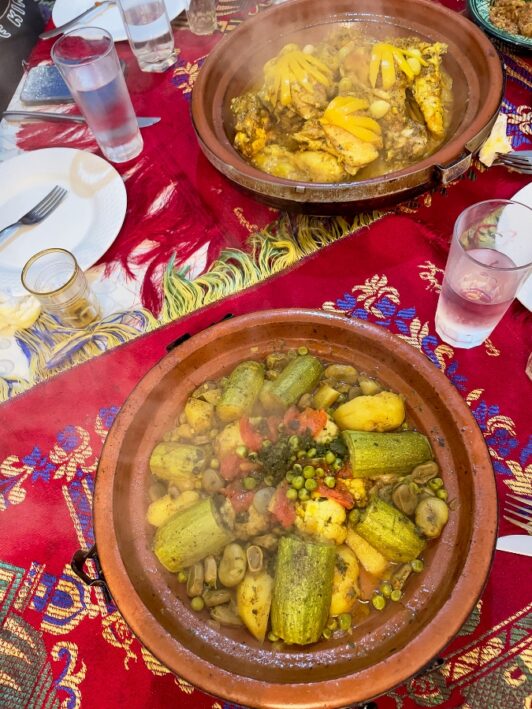
The food we made in our Moroccan cooking class is served.
To learn more about Khmisa Marrakech Cooking, visit their Instagram page. Or, visit their website.
Please note: RealFoodTraveler.com is a participant in the Amazon Services LLC Associates Program, an affiliate advertising program designed to provide a means for sites to earn a small amount of advertising fees by linking to Amazon.com while providing convenience for the reader. This in no way effects the prices of any products you may purchase in conjunction with this link.






0 Comments