





Much maligned, Malört is the stuff of legends. Writer, and cocktail specialist, Carrie Dow returns with the story behind the Chicago icon, Jeppson’s Malört.

A bottle of Jeppson’s Malört, courtesy CH Distillery.
Jeppson’s Malört: Chicago’s prodigal spirit returns
For Medicinal Purposes Only
The year was 1932, the height of US Prohibition banning the manufacture and sale of alcoholic beverages. During this time, a Swedish immigrant named Carl Jeppson sold his homemade concoction brännvin door to door in his adopted city of Chicago. A traditional Scandinavian spirit made from potatoes or grain and wood cellulose, brännvin was used as relief for upset tummies. Jeppson called his spirit Malört after the Swedish term for wormwood and his main source of flavor. Two Chicago police officers approached Jeppson wanting to know what exactly he was selling. Instead of explaining, he offered them a taste of his elixir. Coughing and gagging, the cops said his liquid was so foul that no one in their right mind would drink it recreationally and therefore must be medicine. With local law enforcement’s blessing, Jeppson continued selling his “medicinal” spirit long after Prohibition ended in 1934.
Dan Janes, Marketing Director for CH Distillery in Chicago, laughed when I told him that story.
“Whether that exact scenario went down, I don’t know. Basically the gist of how he skirted federal regulation was by selling it as a cure-all,” he said.
For 85 years, Jeppson’s Malört has had a special grip on the people of Chicago. Its “medicinal” qualities made it a favorite of older denizens who kept a bottle hidden in cupboards and only sipped after meals. Older relatives passed this ritual to their children and grandchildren, when they were old enough of course. Then in the mid-2000s something changed. Chicago bartenders discovered the spirit and began stashing bottles under their bars where they would celebrate with a nip after a long shift or offer shots to unsuspecting tourists and those turning 21. With the advent of social media, #malortface became a popular hashtag and a trend was born.
Sweet Home, Chicago
What many Chicagoans didn’t know was that production of Malört moved to Florida when the spirit’s original distillery closed in the 1980s. However, 90% of the spirit’s consumption continued to be from Cook County, IL. It was owned at the time by Chicago Attorney George Brode who purchased the recipe from Jeppson in the 1960s. Brode hired Patricia Gabelick as his secretary in 1966 and she took over the business when Brode’s health failed before inheriting the company when he died in 1999. Wanting to retire, Gabelick remembered a phone call from CH Distillery’s founder Tremaine Atkinson asking to collaborate. Instead she offered to sell him the company. He was thrilled to return Malört to its Chicago roots at his Pilsen neighborhood facility.
“I love Malört for the same reasons I love Chicago,” Atkinson said. “It’s bold, strong, and unapologetically itself.” Given the spirit’s reputation, I had to ask why.
“I think many Chicagoans, I like to call them Malört enthusiasts, take pride in it,” said Janes. Janes also said that Malört’s popularity increased demand for the product outside of Chicago. He expected CH to make 300,000-plus bottles this year and they already distribute in neighboring states.
#malortface
So what does Malört taste like? Well, another Chicago myth stated the reason for Malört’s, shall we say, intensity was because Jeppson used to own a smoke shop and smoked so much it ruined his taste buds. Supposedly Malört was the only thing he could taste. Comedian and former The Daily Show contributor John Hodgman described Malört as tasting like “pencil shavings and heartbreak.” Gabelick, despite running the company the last 30 years, refused to drink it.
A different view of Malört comes from renowned distiller and Chicago native Sonat Birnecker, co-founder and co-owner of Koval.
“Some people like it, some people hate it. Some people like hating it,” she laughed. “I grew up going to Europe all the time so those types of spirits are not strange for me. I think those bitter, herbal spirits are fabulous. They’re just a different taste that people are not used to. It’s become sort of a fun thing for Chicago, but it’s very entrenched in the European tradition of bitter spirits.”
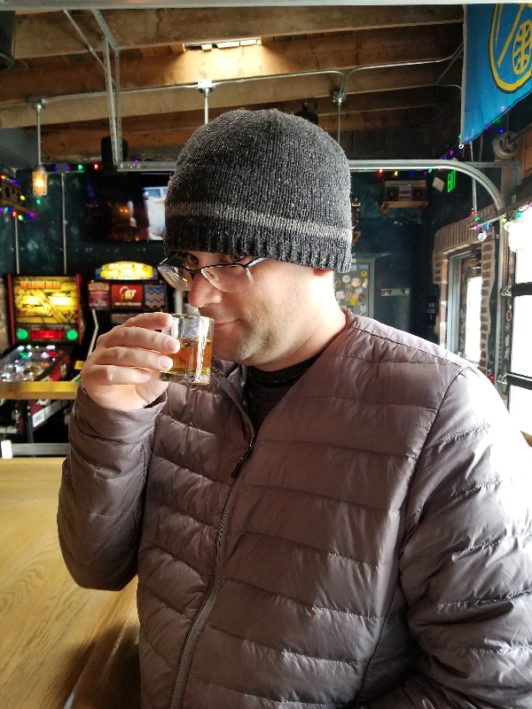
Carrie’s brother, Chad, about to drink Malört. Will he get #MalortFace? Photo by Carrie Dow.
Today Chicago, tomorrow the world
After sampling Jeppson’s Malört at Denver dive bar Occidental, I would say the spirit had a woodsy, bark-like flavor that was different, but not revolting. It reminded me of taking a deep inhale while hiking through a dense forest on a hot summer day. However, the spirit continued to linger and that’s where things took a turn. After passing the gullet, the flavor evolved into something akin to soapy, dirty dishwater (my bartender said to her it was nail polish remover) and that taste did NOT…GO…AWAY. An hour later I could still taste it. Many people have claimed to taste grapefruit, however, Atkinson insisted that no other flavorings besides wormwood, which he gets from a single source in Switzerland, were used. Atkinson even kept Jeppson’s labels, which show Chicago’s original three-star flag. The city added a fourth star to the flag after the 1933 World’s Fair, but Jeppson never changed his.
While today’s bartenders have attempted to make palatable cocktails from Malört, the traditional way Chicagoans drink it is a Chicago Handshake, a shot of Malört chased with an Old Style beer. However, the bar at the Kimpton Hotel Monaco Chicago serves a Malört cocktail called “The Wanderer” made with bourbon, Malört, Italian vermouth, and bitters.
To get the full Jeppson’s Malört experience head to the Windy City and belly up to a bar like Nisei Lounge in Wrigglyville, Saint Lou’s Assembly in West Lake, or Roger’s Park Social. Another fun way to try it is to see if your neighborhood dive bar has it, which will immediately earn you mad respect from any bartender. Only when all else fails should you order a bottle online and try it at home. That’s because inflicting Malört on unsuspecting friends and family may cause them not to like you anymore. Or maybe that’s a good thing?
To learn more about Jeppson’s Malört, visit their website, here.
— Story by Carrie Dow
Hungry for more? Listen to this podcast about a couple that retired and then went into the distilled spirits business. Colorado’s spirits scene has exploded. Find out why and where you need to go to check it out. See how this magazine got its start in Colorado.
Pin it so you don’t forget it!

Please note, RealFoodTraveler.com is a participant in the Amazon Services LLC Associates Program, an affiliate advertising program designed to provide a means for sites to earn a small amount of advertising fees by linking to Amazon.com while providing convenience for the reader.






0 Comments