






The beloved oyster holds a place of honor in Louisiana, what with the plentiful waters that yield them, to the restaurants that revel in them. Suzanne Corbett, Real Food Traveler’s Food History Editor, tells about the Louisiana Oyster Trail, encouraging us to follow along so that we can enjoy one special aspect of local cuisine.
Save this article to Pinterest to help you plan your journey along the Louisiana Oyster Trail. Graphic by RealFoodTraveler.com.
The world is your oyster when you travel throughout Louisiana. A place where oysters are enjoyed dockside as a half shell snack to elevated creations defining Louisiana Creole haute cuisine. Each worthy of praise, along with countless others, celebrated and served along the Louisiana Oyster Trail. An elenctic mix of eateries from shuck shacks to fancy white table restaurants that meander throughout Jefferson Parrish.
Oysters, both plentiful and affordable, are as much a part of Louisiana culinary culture as the crawfish. Over seventy percent of oysters harvested in the US are from the gulf with the majority coming from Louisiana waters. Waters that make a difference. In essence its terroir.
Just as terroir effects the flavor of the wine, the same is true for oysters. Louisiana’s gulf coast waters are warm and brackish, which yield large, tender, and mild flavored oysters. Oysters that are wild harvested and those that are farm raised.
While wild harvested oysters appear on the market the most popular varieties are those commercially bottom-farmed and dredged or raised in cages. These oysters are plump with a creamier texture making them a favorite chefs can bake, charbroil or place on raw bars.
To sample the difference consider traveling the Louisiana Oyster Trail where nearly twenty restaurants dot the path that stretches to Lake Pontchartrain and the Mississippi River to the gulf. Each restaurant is marked with a three-foot oyster sculpture designating an official trail stop. Stand out cities along the trail include Metairie, Gretna, Grand Isle and of course, New Orleans, whose northwestern section of the city is within Jefferson Parrish.
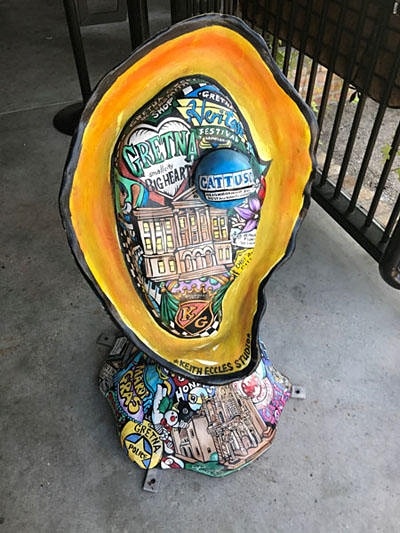
See one of these and you’re in the right spot along the Louisiana Oyster Trail. Photo by Suzanne Corbett.
Restaurants to watch for along the New Orleans Oyster Trail are Acme Oyster House and The Galley Seafood Restaurant, both in Metairie, Perino’s Boiling Pot Restaurant in Harvey, and Restaurant des Familles in Crown Point.
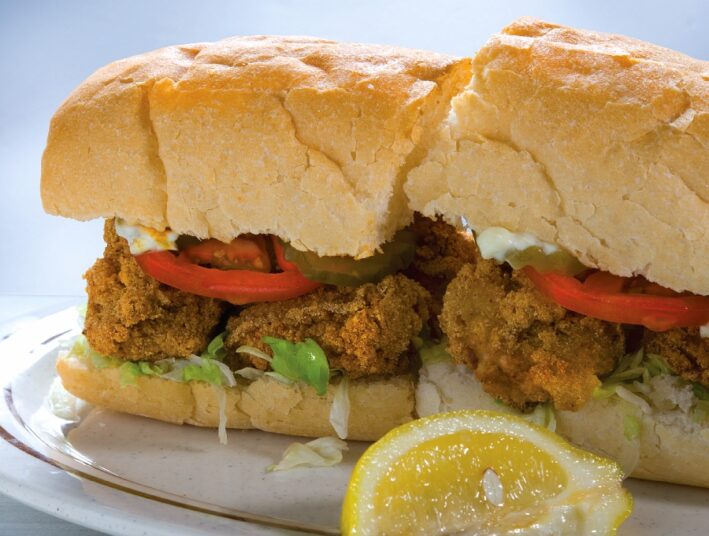
An Oyster Po Boy from Acme Oyster House. Photo courtesy Acme Oyster House.
Oyster connoisseurs such as James Beard winning Best Chef of the South, Ryan Prewitt promotes enjoying oysters on the half shell. To taste the subtle differences in flavor, Prewitt says, “Raw, on the half shell is the most exciting way to eat an oyster.”
Speaking for myself, oysters on the half shell are a delicacy I love. However, slurping an oyster off the shell with or without a splash of Tabasco isn’t for everyone. And that’s OK because there are options. Consider chargrilled oysters, a Louisiana original recipe credited to Drago’s, dating to the early 1960s. A simple recipe that chargrills oysters on the half shell in seasoned butter, and are finished with parmesan. Heaven on the half shell that were first grilled at Drago’s first location in Metairie.
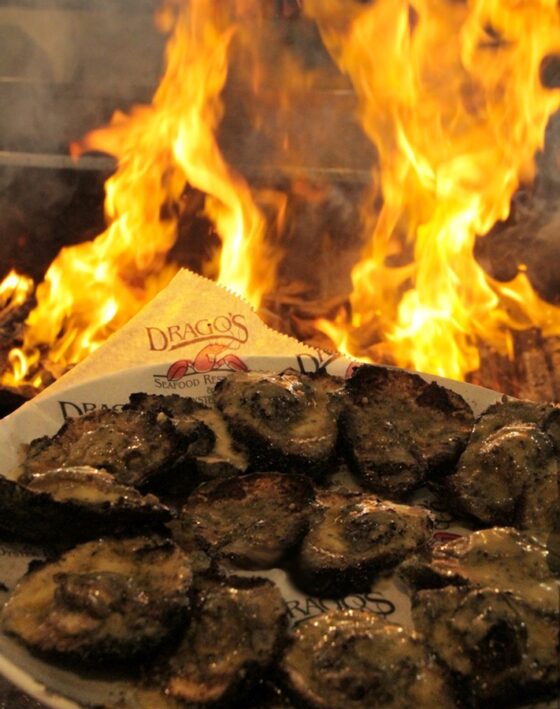
Oysters from Drago’s are a must on the Louisiana Oyster Trail. Photo courtesy Drago’s.
Anyone who goes to Louisiana to indulge in oysters must include the French Quarter. Technically not part of Jefferson Parrish’s Oyster Trail, The French Quarter is home to NOLA’s most hallowed eateries where oysters rule. Places such as Desire Oyster Bar where the oyster po-boys are served delightfully overstuffed. Galatoire’s where Oysters en brochette is sauced with meunière butter (a brown butter, parsley, and lemon sauce). Then, the mecca for all oyster lovers, Antoine’s, the birthplace Oyster Rockefeller.
Hungry for more? Find out how to plan for the famous Galatoire’s Friday Lunch.
Established by Antoine Alciatore in 1840, Antoine’s defines New Orleanian fine dining and haute French Creole cuisine. Antoine’s became renown for culinary creativity, which began in 1899 when Antoine’s son Jules invented Oyster Rockefeller. Rick Blount, fifth-generation proprietor, and great grandson of Jules recounted how his great grandfather developed its signature dish:
“My great grandfather was a chef and was playing with the class Bourguignonne Sauce, the classic butter garlic parley sauce used for escargot. He started integrating the normal stuff he had in the kitchen into the sauce – parsley, green onions, and celery. Not spinach. Spinach isn’t in the recipe. Jules discovered all those vegetables tighten the sauce, which he spooned over escargot before they were baked. During an escargot shortage Jules was inspired to use the sauce on oysters on the half shell and bake them like the escargot. It caught on.”
Jules dubbed it Oyster Rockefeller originally as a joke because it was decadently rich as Rockefeller. The name stuck. Not to the amusement of Rockefeller, who according to family history reports, when Winthrop Rockefeller dined at Antione’s he said his grandfather, John D. Rockefeller, was incensed anyone would name a food after him.

Oysters Rockefeller from Antoine’s, in New Orleans. Photo courtesy Antoine’s.
Antoine’s menu today offers several styles of baked oysters, including Oysters Bienville topped with a mélange of shrimp, bacon and wine and Thermidor, laced with bacon and tomato sauce. These along with its venerated Rockefeller are served during lunch or dinner.
Hungry for more? Here’s the recipe for Antoine’s Restaurant’s Oysters Rockefeller.
When ordering the Rockefeller look for your postcard, which are usually delivered with each order. Antoine’s chefs kept a count on how many orders of Rockefeller have been made since that first plate was baked and served by Jules. The official tally card sports a vintage photograph of Jules tableside with your order number. To date that number is nearly five million.
To learn more about travel in Louisiana, visit this website.
-Suzanne Corbett, Real Food Traveler Food History Editor
Hungry for more? Read our collection of articles about New Orleans.







0 Comments