





Savor this article by Real Food Traveler contributors, travel guides Thomas Bjerkan and Paula Pinho, to help you plan your visit to Málaga, Spain.

Save this article to Pinterest to help you plan your visit to Malaga, Spain. Photos by Thomas Bjerkan. Graphic by RealFoodTraveler.com.
A Taste of Málaga: Tapas, Taverns, and the Unexpected Joy of Slow Travel in Southern Spain
If you arrive in Málaga expecting to power through a checklist of museums, monuments, and “top ten” attractions, I’d like to suggest a different approach. This city — and much of southern Spain — is best appreciated at a pace that allows for lingering. Here, meals spill into long conversations, drinks are enjoyed without a glance at the clock, and entire afternoons can be spent people-watching from a shaded plaza.
As full-time residents of Málaga, we have learned that the essence of this region isn’t found only in guidebooks. It lives in the clink of glasses in a crowded tavern, in the scent of wood smoke curling from a village restaurant, and in the quiet moments when you simply sit still and take in your surroundings.
This isn’t a whirlwind itinerary. It’s a collection of flavors, places, and small rituals that have become part of our everyday life — and which, we believe, capture what makes Málaga such a joy to experience.
Hungry for more? Editor’s Pick: 12 Favorite Foods in Mallorca
Visit Málaga, Spain: Strolling into the Heart of the City
The historic center of Málaga is a place made for wandering. Narrow, stone-paved streets weave between pastel façades and wrought-iron balconies. The air carries the scent of roasted almonds from street vendors, and above it all, church bells chime at unhurried intervals.
Calle Larios, the grand pedestrian avenue, feels like the city’s living room. By day, it’s a sunlit walkway lined with polished marble and elegant shopfronts. By evening, locals drift down it for the paseo — that unhurried, social stroll that seems to suspend time.
But for us, the city’s real charm unfolds when you step away from the main streets and slip into one of its traditional taverns. One of our favorites is Café de Chinitas, a place where the patterned tiles, dark wood, and soft hum of conversation make you feel instantly at home.
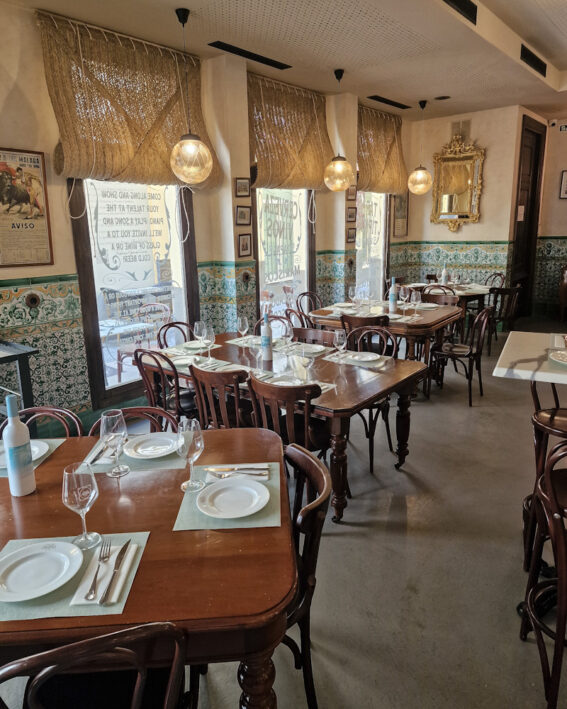
Café de Chinitas offers a great atmosphere for dining.
On our last visit, we ordered their menu del día tapas offer: five small plates and two drinks for just 20 euros. The table quickly became a colorful mosaic of flavors:
- Boquerones en vinagre – white anchovies cured in vinegar, dressed with extra virgin olive oil, the acidity balanced by a delicate saltiness.
- Ensaladilla rusa – a creamy potato salad enhanced with peas, carrots, and the sweet, briny bite of local white shrimp.
- Ensaladilla malagueña – a distinctly local twist, featuring potatoes, juicy orange segments, salt cod, and a scattering of plump green olives from nearby groves.
- Croquetas de jamón – golden-fried bites with a crisp shell and a silky béchamel interior, studded with savory cured ham.
- Albóndigas – tender meatballs simmered in a slow-cooked tomato sauce.
- Torreznos – thick strips of pork belly fried until shatteringly crisp, with just enough fat to melt on your tongue.
It was one of those meals where you promise yourself you’ll save room for later… and then somehow every plate ends up clean.
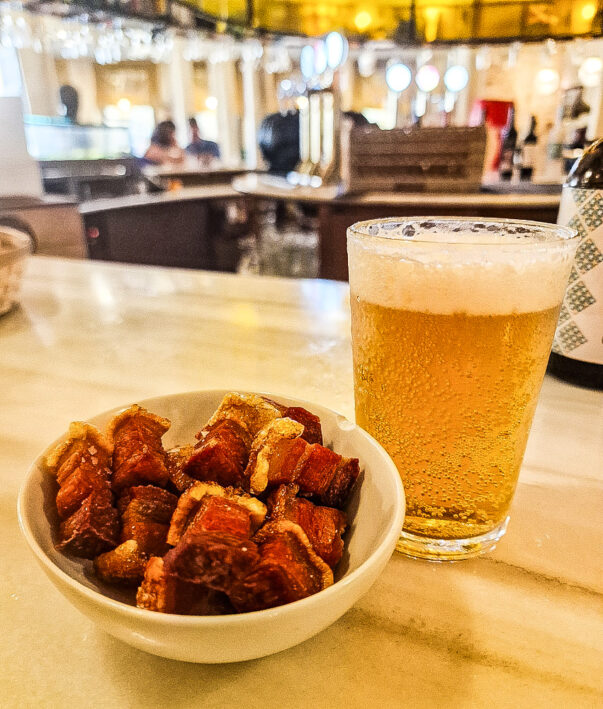
Addictive Torreznos are an addictive tapa, along with a cold beer.
Hungry for more? Best pintxos in Spain’s Basque country.
Vermouth and the Pleasure of Doing Nothing in a Hurry
A few blocks away, Vermutería La Clásica offers another kind of Málaga magic. The specialty here is vermouth, served directly from the barrel. It arrives in your glass the color of deep amber, fragrant with herbs and spices.
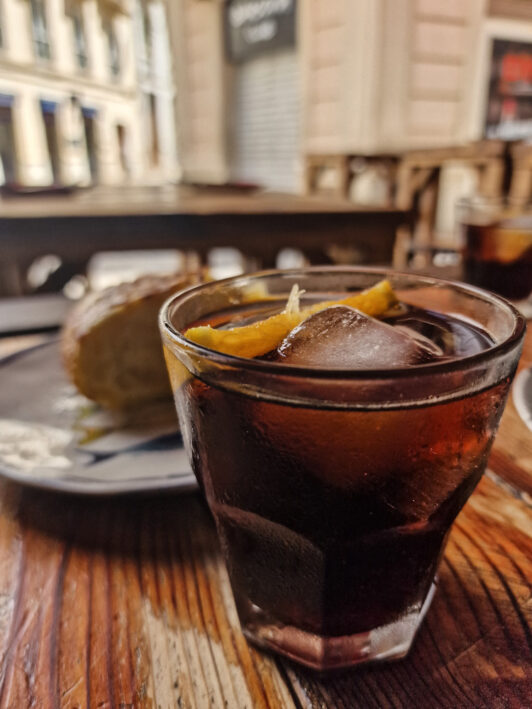
No visit to Malaga, Spain is complete without the local vermouth like this one from Vermutería La Clásica.
We paired ours with ajoblanco, a chilled almond-and-garlic soup with a texture like liquid silk. Here, it’s served simply — no grapes or garnish — letting the purity of the flavors speak for themselves. Alongside came generous slices of Spanish tortilla (thick potato omelet) and chorizo a la sidra, the sausage gently simmered in cider until the meat is infused with sweetness and spice.

Ajoblanco soup at Vermutería La Clásica.
The pace in places like this is blissfully slow. Some guests stop in for a single drink before heading home. Others settle in for hours, chatting while the sunlight shifts across the cobblestones outside. We stayed long enough to watch the day slide into evening, that perfect golden hour when Málaga seems to glow from within.
Hungry for more? Here’s a recipe for Ajo Blanco Soup from Mexico.
East to Vélez-Málaga: Everyday Life in the Axarquía
Just twenty minutes east of the city, the atmosphere shifts. Vélez-Málaga isn’t a tourist showpiece but a lived-in Andalusian town, with whitewashed houses climbing the hills and everyday life playing out in its squares.
In Plaza de la Constitución, life moves at a human pace. Children weave between café tables. Neighbors exchange greetings across the street. The bells from the local church keep their own steady rhythm.
Here, we discovered La Sastrería Asador, a restaurant where the kitchen leans into tradition while using the deep, smoky flavors of a wood-fired oven. The house steak tartar is rich and perfectly balanced, the seasoning precise without overpowering the meat. Anything that comes out of the oven — from roast vegetables to slow-cooked lamb — carries that unmistakable kiss of wood smoke.
We lingered over our meal, sipping wine and deciding that we’d come back soon. That’s the beauty of living nearby — nothing needs to be rushed.
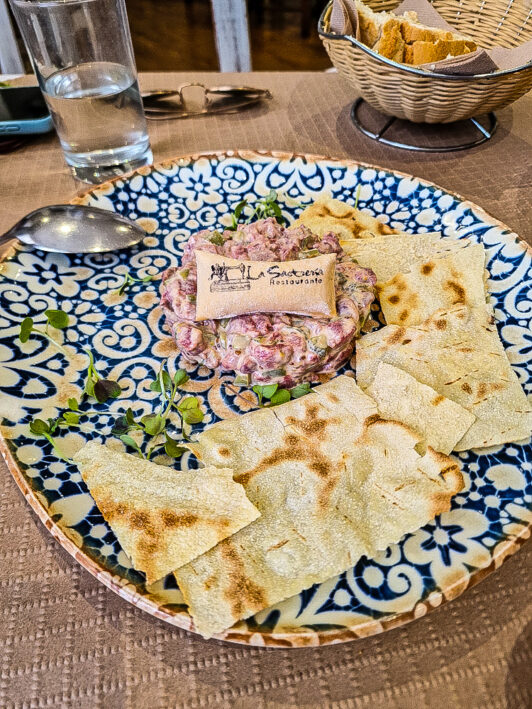
The house steak tartar served at La Sastrería Asador.
Hungry for more? The Saffron Festival in La Mancha.
Visit Málaga: From the Sea
From land, Málaga’s port is lively — a mix of restaurants, palm-lined promenades, and bobbing sailboats. But the view changes entirely once you’re on the water.
We took a small boat out from the marina and watched the city open up before us: the Alcazaba fortress perched on its hill, the cathedral’s single tower reaching above the rooftops, and, to our surprise, the modern lines of the AC Hotel’s rooftop terrace. From up there, you see the port spread out below you; from the boat, you see the whole city framed by the surrounding mountains.
The air smelled faintly of salt, the sun was warm but not harsh, and for a few quiet moments, it felt like Málaga belonged entirely to us.
The Everyday Joys of Slow Travel
We could make a long list of more restaurants to try or villages worth visiting. But one of the lessons Málaga has taught us is that you don’t have to see everything to feel you’ve truly experienced it.
Sometimes “exploring” means sitting at an outdoor table with no agenda except to sip coffee or vermouth and watch the life of the square unfold. Sometimes it’s walking to Café de Chinitas simply because you woke up thinking about torreznos.
Slow travel here isn’t about doing less — it’s about noticing more. It’s the murmur of conversation in a packed tavern, the scent of orange blossoms in spring, the warm evening air on your skin as you cross Plaza de la Merced at dusk.
Practical Pointers for Your Own Málaga Experience
- Mind the schedule – Lunch is usually 1:30–3:30pm, dinner after 8:30pm. Show up in between and you may find the kitchen closed.
- Look for menus del día – Many spots offer fixed-price lunches with several small plates and drinks. Great for sampling different dishes without overspending.
- Vermouth hour – Late morning or early afternoon is prime time for a glass from the barrel.
- Short day trips from Málaga count – Towns like Vélez-Málaga are easy half-day excursions that reveal a quieter side of Andalusian life.
- Walk it off – The historic center is compact and rewards slow exploration. The details you notice on foot are worth the extra steps.

The authors, Thomas and Paula, enjoying their time in Malaga, Spain.
Why We’ll Never Tire of Málaga
Living here has shown us that Málaga is like a conversation you can step into at any point — and it’s never quite the same twice. We’ve met strangers who became friends over shared plates of tapas, stumbled into festivals we didn’t know were happening, and found that the city still surprises us even after years of calling it home.
Whether you’re here for a quick weekend or a long stay, Málaga has a way of pulling you into its rhythm. The trick is to let it. Order what’s local. Accept that the food will arrive when it’s ready. Watch the world go by without feeling the need to move on too quickly.
Because here, the joy isn’t just in the taste — it’s in taking the time to truly savor it.
-Story and photos by Thomas Bjerkan and Paula Pinho.
Thomas and Paula are the co-creators of TourCostadelSol.com, a curated guide to the best tours, villages, and hidden corners of Spain’s southern coast. Thomas, originally from Denmark, and Paula, from Brazil, are a couple based in Málaga with a shared love for slow travel, local food, and uncovering the cultural soul of Andalusia.
Hungry for more? Get to know the food of Valencia, Spain.






0 Comments