






With glorious scenery outside and enjoyable experiences inside, writer Betsa Marsh tells Real Food Traveler readers what it’s like to travel aboard the new Rocky Mountaineer train trip route through the Rocky Mountains, from Colorado to Utah.

Save this article about the Rocky Mountaineer Train route to Pinterest to help plan your trip. Images clockwise: Red sandstone of Burns Canyon; vineyards of Palisade, CO (courtesy Rocky Mountaineer); swoops of petrified red sandstone of Ruby Canyon near Utah border; and aspens and cottonwood along the Fraser River.
Hungry for more? Learn about winter adventures in Southern Utah.
What to Expect from the New Rocky Mountaineer Route Through the Rockies
A quivering curtain of aspens leans in on the right as a wall of raw rock squeezes in on the left. Suddenly, I’m morphing down into a drone, zooming through Colorado’s Gore Canyon with a bald eagle’s point of view.
Of course, this drone is bulkier than most, materialized by the Rocky Mountaineer excursion train rumbling from Denver, Colorado to Moab, Utah. Carloads of passengers want to experience both the West’s natural glory and the sheer bravado of blasting railroad lines through the Rockies.
That triumph of dynamite and determination is a keystone of the Rocky Mountaineer company. It began rail excursions through Western Canada in 1990, and its glorious run from Vancouver to Banff is one harrowing twist after another. With tracks perched on the edge of thousand-foot drops, passengers with vertigo need not apply.
So it seemed natural when Rocky Mountaineer followed the Rocky Mountains south across the U.S. border in 2021. They chose the Denver to Moab track of the Union Pacific, creating a two-day journey through landscapes of peaks, buttes, rivers and desert. With a chance to see bald eagles, pronghorn and the Colorado state animal, Rocky Mountain bighorn sheep, from the rails. Sure enough, on our first morning, we spot two white bighorn rumps gamboling up a scrubby hillock.
This is pampered wildlife spotting, with giant windows, comfy seats and an open bar. Time to sip your Woodford Reserve as you scan miles of crimson sandstone for moose and bear.
Each of the world’s excursion trains is different, so here are some Rocky Mountaineer hallmarks along its new Rockies to the Red Rocks route.
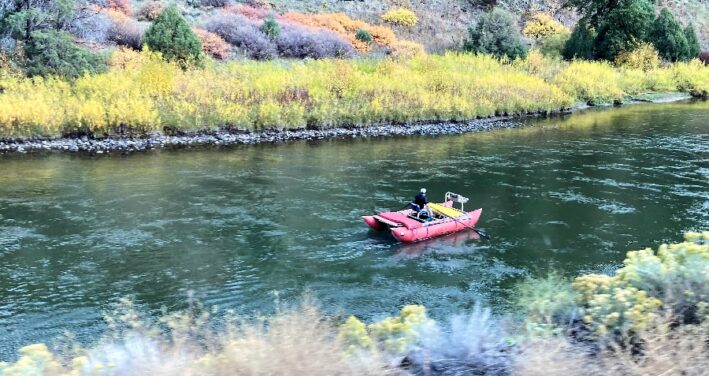
A raft drifts down the Colorado River near Burns Canyon.
Hungry for more? See what awaits you at Colorado’s Broadmoor Hotel.
Fueled for the Rails Aboard the Rocky Mountaineer
Can the Rocky Mountaineer be vying with the Orient Express in CPM: calories per mile? Each meal is white–linen service at our seats, with in-between snacks in the lounge car. The next nosh is always on the horizon.
The Rocky Mountaineer borrows a trick of distraction from the Orient Express. On a day trip from London, the Orient Express crew welcomed us on board and couldn’t wait to service a lavish cream tea. As the train lumbered slowly pass the gritty working part of the capital, all dust bins and scrap yards, our minds were focused instead on teapots and jam jars.
The Rocky Mountaineer welcomes its guests on a siding far from Denver’s elegant Union Station, and needs to inch past the city’s industrial outback before it can pick up steam and find the scenery. Cue the waffles, frittatas and yogurt parfait.
Chef Seth Dunham wrangled the groceries on our trip, pulling little miracles from the ovens of a minute galley kitchen. He’s not afraid of big proteins, sending out such lunch entrees as pork loin roasted with rosemary and Durango honey. And coriander-crusted Coho salmon, a marvel of flake to fork.
Dunham handled complaints deftly: “The cold butter won’t melt on my waffle,” one man bellowed when the chef asked for feedback. Next morning, the chef checked in and the bellow back on butter temperature was “Perfect.”
Then, a mini-rebellion arose against turkey sausage. Next time, it’s chef’s crispy bacon all round.

Chef Seth Dunham’s farm-fresh scrambled egg cazuela calls for a breakfast salute to the colors of the Mexican flag. Crumbled cotija, corn tortilla chips and roasted hatch chilis bring the flavor and the color pop.
Hungry for more? Read about the three railroaders who built Florida.
Rocky Mountain Train Trips Bring a Friendly Cast and Crew
Each of the Rocky Mountaineer’s five guest cars has its own dedicated team that caters to passengers’ tastes, temperatures, and of course, drink requests. A train manager roams freely throughout, telling tales of the route’s natural and human history, as well as the exploits of the people who blasted through these black, red and green rocks to forge a railway.
Our train manager, Chris Woods, and his staff were also quick to field quirky questions. What Colorado’s state bird? The Lark Bunting, a chunky sparrow who forages in the prairie. How big are the observation windows? 4 1/2 x 6 feet.
The topic of windows might be a sore point for some Rocky Mountaineer veterans who’ve reveled in panoramic views in Canada. In the more expensive Gold Leaf service, the all-glass view is unobstructed up and over the car.
In the American Southwest, however, Rocky Mountaineer can only offer Silver Leaf Plus service, with windows up the shoulders of the cars to a metal roof. The reason is simple arithmetic.
The Rockies to the Red Rocks route cuts through 42 numbered tunnels. The longest is the Moffat, a masterwork of its time that burrowed six miles through solid mountain to cross the Continental Divide.
“The Canadian observation cars, with 360-degree views, are six inches too tall for the Moffat,” a crewmember told us with chagrin.
I’ve ridden in both Rocky Mountaineer cars, and I tried to figure out how much I missed that extra glass over my head. It would’ve been a luxury, yes, but I could catch nearly every mountain top from my seat. Or I could simply pop up and hang out on the open-air platform between cars and take in all the mountain views and alpine air I could handle.
There is one consolation for going through the 1928 Moffat Tunnel. The crew encourages us to smooch a partner sometime during the 12-minute roll inside this Western tunnel of love.
Time is Elastic on Rocky Mountaineer Train Trips
Yes, train travel gave us modern times zones, but even mighty trains like the Rocky Mountaineer can’t truly control their schedules. About 50 miles out of Denver, we pull to a siding and wait for an east-bound freight train to roll through Moffat Tunnel. On these rented Union Pacific rails, freight comes first, Amtrak second, and the Rocky Mountaineer third.
Even after the working freight train flies by, our engineer doesn’t fire up the Mountaineer. We need to wait 20 minutes for giant fans to clear diesel fumes from the tunnel.
So we relax and listen to the chamber music drifting down upon us. One woman knits a scarf, another works a crossword. Lots turn to drink-– bring on the Auspicion Cabernet 2019 from Napa, or maybe a tumbler of Bulleit. Two velvet walls of green spruces and yellow aspens, their leaves shimmying in the breeze, model patience.
Really, the entire Rocky Mountaineer experience is about relaxing and absorbing the world as it presents itself. Most of the passengers are retirees who’ve long since packed up their watches and briefcases. They’d much rather take a meeting with the Holstein cattle and bald eagles just beyond their windows.
When You Go on the Rocky Mountaineer Route
Learn more about the Rocky Mountaineer train trips on their website. Please note, passengers are required to wear masks unless eating or drinking.
–Story and photos, except where noted, by Betsa Marsh








0 Comments