






One of the ways to truly experience the culture of Bolivia is by attending a cholita fight. Writer Donnie Sexton attended an event and tells us about the history of them, a behind-the-scenes glimpse, and what to expect when we go.

Save this article to Pinterest to plan your own visit to see the fighting cholitas. Photo by Donnie Sexton. Graphic by RealFoodTraveler.com.
Hungry for more? Read Donnie’s article “Chicken Feet and Other Chinese Delicacies.”
The Fighting Cholitas of Bolivia
I felt like I had just entered a carnival fun house, awash in color and bedazzled by white lights. Dead center was a wrestling ring, where Dasyi and Rosita, cholitas luchadoras, were going at it. Daysi was hanging on the top rope and pounced down on Rosita with a body slam. They tussled on the plywood floor for a few minutes, then stood up and proceeded to pull each other’s braids. The referee separated the women, then he kicked Daysi in the side of the head, sending her into the ropes. The announcer was yelling a play-by-play in Spanish. On either side of the ring were bleachers packed with shouting, jeering fans. No question, I was in for an evening of rambunctious entertainment.
The word “cholita” is derived from the Spanish word “cholo,” which was historically a derogatory term for Bolivian women of mixed indigenous and Spanish Heritage, most of whom were from Aymara and Quechua cultures. In 2005, the first indigenous president, Evo Morales, was elected, opening the door for cholitas to emerge from the shadows and start to reclaim their rightful place in Bolivia.
Distinctive Clothing of Cholitas
Throughout Bolivia, cholitas are recognized for their distinctive clothing, including pollera skirts, shawls, and borsalinos (bowler hats). The position of the hat indicates a woman’s marital status. If worn straight, they are married; if tilted to the side, they are single. The skirts are colorful, pleated affairs worn with many petticoats underneath, giving women the look of having huge, swaying bottoms. I’m told this is an attractive feature for men, indicating the woman is likely to do well with bearing children.
The Start of Cholita Wrestling
Cholita wrestling got its start in the early 2000s in Bolivia, when Juan Morales, a promoter of men’s wrestling, introduced women wrestlers to revive declining interest in the sport. The women first performed in traditional wrestling attire, but the crowds weren’t overly impressed. But later, when they entered the ring in their pollera skirts and sporting long braids, interest grew tenfold.
The skirts add a distinctive element of excitement to the matches, flying every which way like a never-ending cyclone. Fortunately, when all is exposed, the wrestlers wear an undergarment, akin to athletic shorts, to cover their privates.
Exploring La Paz
I had been on a 12-day overland journey through Bolivia, which ended in La Paz, the country’s administrative capital, sitting at a whopping 12,000 feet above sea level. We had a full day exploring the city, with the anticipated highlight being a seat at the Fighting Cholitas performance in the evening. Our local guide led us to Calle Apolinar Jaén, a picturesque historic street in La Paz. I happened upon the doorway of a wrestling venue and struck up a conversation with Yolanda la Amorosa, a fighting cholita. There was no show at that location because it was undergoing significant repairs.
For 25 years, she has stepped into the ring, following in her father’s footsteps. Now her eldest daughter is following her lead. Her skill in the ring comes from a combination of gymnastics, swimming, and Jiu-Jitsu. One concern she shared is the lack of government healthcare. “The government thinks we’re clowns,” she tells me.
As the sun set, we headed to the city of El Alto, adjacent to La Paz, taking one of the 10 cable cars that serve La Paz. We then boarded a minibus and worked our way through snarled traffic to Cholet B&B Havana, an unlikely location for the wrestling matches, with rooms for rent above the venue.
Rowdiness in the Ring
For the next hour, I watched in amazement as Dasyi and Rosita put on a mind-blowing show, complete with body slams, flips, chokeholds, flying kicks, somersaults, and leaps from the second-floor railing onto the opponent. Sometimes the women launched out into the audience, landing on surprised spectators. The ref played into the theatrics, holding one wrestler so her opponent could land a few good punches. More than once, the women turned on the ref, giving him a swift kick or slap upside his head.
After Dasyi and Rosita finished, took a bow, and left the stage, out came Maria, wearing a face mask, and Benita, launching a second electrifying match. Out of nowhere, an empty beer can was launched at Benita, striking her face. Appearing upset, the woman dove into the audience and pulled out a random guy, who became part of the show. He entered the ring, trying to act as a mediator to the ruckus. I was told there was a storyline to all the shenanigans, a “good” versus “evil” plot, with good always winning. But not understanding Spanish, I couldn’t discern which of the fighters represented good and which one was evil. Without doubt, the entertainment factor for these matches was off the charts.
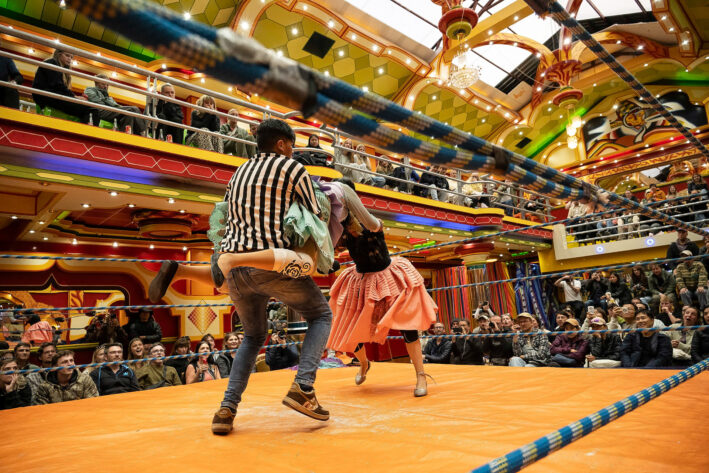
The referees get very involved in the battles between the Cholitas.
Interviewing the Fearless Fighters
Later, with the help of my guide, who translated, I interviewed the four cholitas. They ranged in age from 18 to 40. All had day jobs, and three of them had kids. They weren’t wrestling for the money, which pays between $12 and $15 per match. Instead, it had become their passion to showcase their athletic abilities while entertaining the crowds. They spoke of a sense of triumph and pride, earning respect and admiration for who they are.

A group of fighting Cholitas pose for a photo.
A Story of Women’s Empowerment
The fighting cholitas are a remarkable example of women’s empowerment. This wasn’t about the fight in the ring, but about the battle each of them had won in the real world, regaining their rightful heritage as indigenous people through sheer physical strength and determination. Today, cholitas play a pivotal role in business, sports, politics, and activism. They have set the stage for future generations of women to prosper in Bolivia.
For anyone with La Paz, Bolivia, on their travel radar and hoping to see the fighting cholitas, I recommend getting in touch with a local travel agency or finding a local guide to make all the arrangements for you. The shows take place in a few locations in both La Paz and El Alto, most days of the week, but finding the venues in a city of two million can be tricky.
-Story and photos by Donnie Sexton
Hungry for more? Read about a journey in Roatan, Honduras.








0 Comments