






There’s an area tying together Colorado and New Mexico that has a wonderful mysticism to it – the San Luis Valley. Rich in agriculture, open skies, landmarks and things to do, it’s a much-loved, yet not overly visited area. Here, Jimmy McDonough, Real Food Traveler’s Eco-friendly Food, Travel and Adventure Editor shows us around and tells us about the little miracles of the area, the “milagros.”
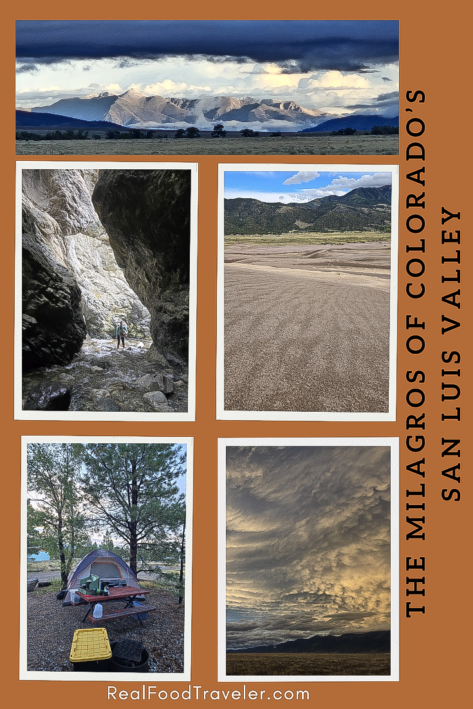
Save this article about the San Luis Valley of Colorado to Pinterest to help you plan your visit. Graphic by RealFoodTraveler.com.
The Milagros of Colorado’s San Luis Valley
Since childhood, I have been drawn to and through the San Luis Valley. It has been the perfect place for outdoor adventuring and as a scenic shortcut to honeymoon in Taos and Santa Fe. I have brought my children here, too, to enjoy nature’s beauty. On a recent visit, the Valley’s many unlikely, often improbable, characteristics struck me as many little miracles – or, as said in the second language of the region, Milagros.
The Spanish mark runs deep here, reflected in the names of many places in the Valley. The headwaters of the Rio Grande river are in the valley’s mountain ranges named by early Spanish explorers: San Juan, Sangre de Cristo, San Luis. Today’s culture blends Mexican, Indigenous, Spanish, and Anglo heritages and history.
Almost as large as the state of New Jersey, the San Luis Valley in south central Colorado spills into northern New Mexico. A vast, open plain, flat as a flapjack for great stretches, it is tempting to hit the pedal and speed through to points beyond. Let me share with you the San Luis Valley I have experienced, in hopes you slow down long enough to find your own Milagros.
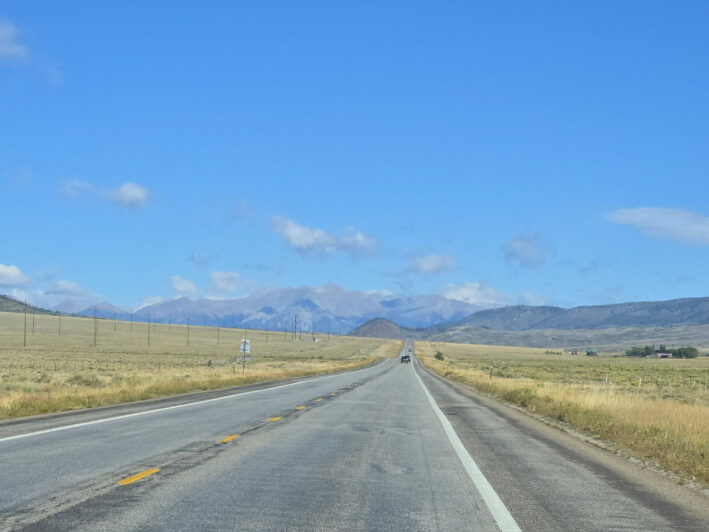
Don’t race through the San Luis Valley. There’s a lot to see and experience there.
Great Sand Dunes National Park
Approaching North America’s tallest sand dunes, hundreds of miles from any ocean shoreline, is startling. Sprawling at the foot of a wall of 14,000-foot peaks (the Sangre de Cristo range), the dunes beckon you to climb and explore. Entranced, every visitor loses their inhibitions in the dune field – laughing, rolling, jumping in the sand. It is a joyful space. And if you time it just right in the spring and very earliest summer days, a wonderful seasonal stream (Medano Creek) turns the dune flats into a delightful beach experience complete with gentle waves that delight adults and children alike. Bordered by untamed wilderness, the dunes are full of surprises; on one visit with my children, we watched a large black bear run effortlessly across the sand. One of nature’s Milagros, I never tire of this place and yearn to return each time the dunes fade in my rear-view mirror.

A glimpse of the Great Sand Dunes National Park in the San Luis Valley.
Zapata Falls
Just down the road a bit from the dunes, accessed by a steep rocky hike, Zapata Falls is a seasonal sight that is not easy to access. The trail is rough and then you must wade the cold creek waters to enter the hidden waterfall chamber. If the runoff is too strong, it is dangerous and a place to avoid; during a dry spell it may be a mere trickle. On my recent visit, rains had replenished the creek above so the falls were lively. The inner chamber space felt intimate and sacred.

Depending on the water levels, Zapata Falls can be dangerous. But they are always beautiful.
Wildlife refuge – Sandhill Crane migration
The wide valley floor captures snowmelt and rain runoff for the surrounding peaks and stores it in a massive underground aquifer. Bubbling up from this, the water feeds marshes that attract migrating cranes and other waterfowl for rest and refuge. Bird watchers are drawn here during their migration seasons to witness the spectacle and the Monte Vista Crane Festival each March.
Hungry for more? Learn about the great crane migration.
Mosca, Dune Valley Distillery
In this tiny town, not far from the Sand Dunes, the community’s historic school gym has been given new life as a community gathering place and distillery that uses locally grown potatoes and quinoa to produce spirits. Complementing the distillery, a restaurant serves up “locally curated craft” foods. A small marketplace stocks an array of local goods and a special wine is offered; Colorado grown grapes are used to make their family label Carbone wines which, interestingly in such a small village in an isolated valley, holds Colorado’s first liquor license issued after Prohibition. Embraced by the community and tourists alike, Dune Valley offers a welcoming, casual atmosphere for a drink, a meal, a game of pool, and gatherings in the old gym. Learn more about their story from our podcast with the founder of Dune Valley whom we spoke with just before the Distillery opened.

The Carbone family resurrected the wine label and business to serve and sell it at the family’s Dune Valley Distillery. The patriarch had liquor license #1 in Colorado immediately after Prohibition was repealed.
Alamosa
The largest community in the Valley offers a walkable downtown full of public art, eateries (excellent taquerias!), two breweries, and the Milagros Coffee House serving up locally baked goods made with locally-raised grains (their salted rye shortbread cookies are delish!). This appropriately named coffee shop is very much mission-driven, donating proceeds to help locals.

There are many local food and drink options in Colorado’s San Luis Valley.
Spiritual wellness
Some come to the Valley seeking their own spiritual Milagros. Nestled on the slopes of the Sangres north of the Sand Dunes, the town of Crestone hosts retreats for different faiths. Further south in Colorado’s oldest continuously inhabited settlement, the humble town of San Luis is home to the impressive Stations of the Cross; bronze sculptures, lovingly created by a local artist called the “Michelangelo of San Luis,” portray the emotional journey of Jesus to be crucified. Area natural hot springs offer post-meditation relaxation and space for reflection.
Sky and Star Gazing
Thanks to its vast openness, the Valley’s skyscape is remarkable all day long and into the night. Wake early to witness the sun slowly illuminate the silhouette of the Sangre de Cristos. During the day, watch the sky as storms boil up along one horizon even as the other is clear blue; no lens can adequately capture the drama of it all. Sunsets are spectacular, especially from the Sand Dunes or anywhere elevated such as the drive up to Zapata Falls; plan ahead to maximize your viewing of colorful clouds and landscape. After sunset, the Valley’s dark nighttime sky filled by a bright Milky Way is a Milagro. The arid climate provides crisp, sparkling stars; gazing from the Sand Dunes or further north avoids light pollution.

Swoops of clouds over the San Luis Valley make for dramatic, ever-changing sights.
Quirky sights in the San Luis Valley
In addition to the sublime, the Valley offers some unexpected surprises.
- Gator Farm – An improbable attraction here in a high, chilly, mountain valley, the Gator Farm was the result of fish farming and the need to dispose of fish remains in an eco-friendly manner. Warmed by underground hot springs, the gators live a life of luxury and are the star attraction, along with other critters.
- UFO Watchtower – There must be something about the Valley’s thin air and isolation that gives rise to claims of alien spacecraft activities. If you are game to play along, visit the modest platform to scan the skies for ET.
- Living off the grid – Inexpensive land has drawn many who wish to escape modernity and live off grid. Scattered haphazard settlements are visible from the roads; don’t try to pay them a visit or stop to take pictures – these folks don’t want attention and can be scrappy. Respect their privacy and keep moving!
Where to sleep
On my many visits to the San Luis Valley, I have tent camped at the following:
- Pinon Flats Campground – Run by the Park Service, offering spectacular views of the Valley and quick access to the Dunes, this is my favorite; usually booked up months in advance.
- Great Sand Dunes Oasis – A close second, this privately run campground just outside the park is a great alternative; it too is often booked far in advance. Non-tent lodging options available.
- SLV Campground – On the Valley’s far north end, just after Poncha Pass, this family run campground offers tent and RV sites. Sites are quite close to each; however, lots of trees make it pretty as do the views all around. The Shower House is clean, with flushing toilets – a nice asset for such a reasonably priced campground. Friendly proprietor. Non-tent lodging available.

Camping and a good cookout (sausages, peppers and onions for us), are a great lodging option when visiting Colorado’s San Luis Valley.
Hungry for more? Three tips for making simple camping meals.
Alamosa offers lodging options, most are quite modest and basic; other options in the Valley include AirBnb and RV rental.
Glamping and luxury cabin options include the Outside Inn, north of the Valley on Poncha Pass.
Monte Vista is home to the Best Western Movie Manor – a motel with views of a giant movie screen you can watch from your room!
-Story and photos by Jimmy McDonough, Real Food Traveler’s Eco-Friendly Food, Travel & Adventure Editor
This site uses an affiliate tool provided by the third-party provider Stay22. If you use certain affiliate links to make a booking or take advantage of an offer, the site may receive an affiliate commission from this third-party provider. To determine whether you have used any of the affiliate solutions, the third-party provider will use cookies to attribute commission. These cookies will be removed as soon as they have served this purpose.








0 Comments