








Whether you’re an ardent baseball fan or just enjoy behind-the-scenes glimpses, writer Betsa Marsh tells us why a visit to the Louisville Slugger Museum, to see the birthplace of wood bats, is a must-stop.
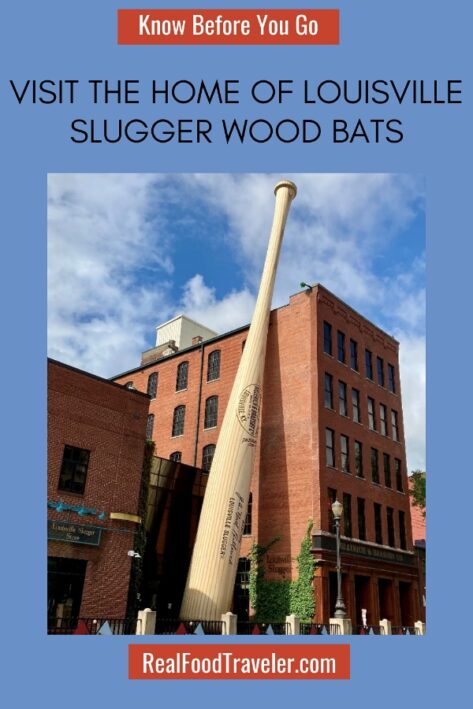
Who can miss the Louisville Slugger Museum and factory store in downtown Louisville, Ky? Save this article about the Louisville Slugger Museum to Pinterest to help plan your trip. Photo by Betsa Marsh. Graphic by RealFoodTraveler.
Hungry for more? Learn about Kentucky’s Green River Distilling Company.
Louisville Slugger Bats: Swinging for the fences in Louisville
Daffodils swivel their bonneted faces toward the sun. Jenny Wren angles a skinny stick into her nesting box. Lo, the signs of spring. The newness never gets old. But for millions, something’s missing from this tableau: the crack of the bat. For true fans, it’s just not spring until it’s baseball.
Labor disputes made this a rough slide into Baseball ’22, but there’s one place to always get into the swing of the game: the Louisville Slugger Museum in, yes, Louisville, Kentucky. Casual fans can breeze through the Louisville slugger factory, kibitzing over the shoulders of artisans who turn wooden stakes into glossy bats. Baseball fanatics, on the other hand, are welcome to linger and delve into the minutiae of the craftsmanship and the game.
Hang around a ballpark and fans can blitz you with stats: RBI, OBP, SLG, more than you can absorb. In the spirit of fun facts, figures and legends, here are some cool stats from the home of the Louisville Slugger, the official bat of Major League Baseball.

Bats on the roll at the Louisville Slugger factory. Betsa Marsh photo.
The original Louisville Slugger was a player, not a bat
Pete Browning was a star on the Louisville Eclipse team, winning the batting title for his rookie year of 1882 and the nickname “The Louisville Slugger.”
Bud Hillerick, toiling away in his father’s woodworking shop, was a keen amateur baseball player. After he saw The Louisville Slugger break a bat during a game, Hillerick offered to make the young phenom his first professional bat in 1884.
In the Slugger museum, you can check out the massive bat that Browning wielded in 1887 when he hit .402 for the season. Browning earned three other hitting titles, for a lifetime average of .341, before his death at age 44.
Babe Ruth bats forever with Louisville Slugger wood bats!
Every legend has to start somewhere. Young Boston Red Sox pitcher Babe Ruth was four years into his career when he signed a contract with Hillerick & Bradsby (H&B), the new name of the Louisville bat maker, in 1918. Unlike other players who put a time limit on their deals, often 10 years or to retirement, Ruth gave permission for the company to use his name and likeness forever. You can still order an H&B Babe Ruth bat today.
In a company ledger on display, visitors can track Ruth’s 1926 order for a Lou Gehrig model. Nearby is the G76 bat he used to hit 21 of his record-breaking 60 homers in 1927. When that bat broke, Ruth sent the pieces to H&B with a note, “I am doing pretty well with this—make me more.”
The Sultan of Swat was still going strong in 1931 when he wrote H&B, praising the bats for their “driving power” and “punch that brings home runs. All of my records have been made with Louisville Sluggers.”

Babe Ruth cut notches around the logo for every homerun he hit in his historic 1927 season. Betsa Marsh photo.
Hungry for more? Make time for the Kentucky Beer Cheese Trail.
Louisville Slugger Museum: Factory-floor inspection
Ted Williams, the Hall of Fame left fielder for the Boston Red Sox, loved to visit the H&B factory and see bats evolve from the first flake of sawdust to the last jot of paint.
“I was just like a kid in a toy factory,” he said of his Louisville trips, “because I thought, boy, this is the greatest place I have ever been.”
Williams greeted the workers and picked out the wood for all his bats, searching for lumber with tiny pin knots. He could be one exacting client. When he complained about the handles on an H&B order not being quite right, the craftsmen re-measured the grips and found they were off by 5/1000th of an inch.
Following in Williams’ cleats, modern players still stop by to sign the visitor board and watch the magic happen.
Hungry for more? See what to expect at the Dollhouse Museum also in Kentucky.
It takes a forest
In 138 years, H&B has made bats from ash, hickory, maple and birch wood. Northern white ash is by far the company favorite, with more than 90% of bats crafted from it since 1884.
On the Louisville Slugger factory tour, visitors wend through the production line, from bins of wood chosen for or by specific players to the final finish. There’s plenty of turning, sanding and branding along the way.

Young fans learn about baseball bat production at the Louisville Slugger factory. Betsa Marsh photo.
Louisville Slugger wooden bat company pride
As Babe Ruth told H&B in 1931, “All of my records have been made with Louisville Sluggers.” Modern players might not be texting in their testimonials, but more than 80 percent of the hitters in the Baseball Hall of Fame are under contract with H&B.
The museum honors the stars with their signatures and induction dates. And, ever loyal to their first customer, the original Louisville Slugger, curators point out that Pete Browning’s “lifetime average of .341 exceeds many players in the National Baseball Hall of Fame, but he has yet to be inducted.” As a heritage company, H&B is still waiting for its hero to receive the laurels Pete Browning earned with a Louisville Slugger bat more than a century ago.

Workers wrap new bats to protect them at the Louisville Slugger factory. Betsa Marsh photo.
To plan your visit to see the wood bats of the Louisville Slugger factory tour:
For more information about the Louisville Slugger factory tour, visit the slugger website. And to learn more about Louisville, Kentucky, visit this site.
-Story and photos by Betsa Marsh
Hungry for more? Plan a Kentucky Derby Party wherever you may be.









0 Comments