











To step into everyday activities and live like a local is a real joy when traveling. RFT’s vegan/vegetarian editor, Teresa Bergen, takes us olive-harvesting (and eating) in Jordan.
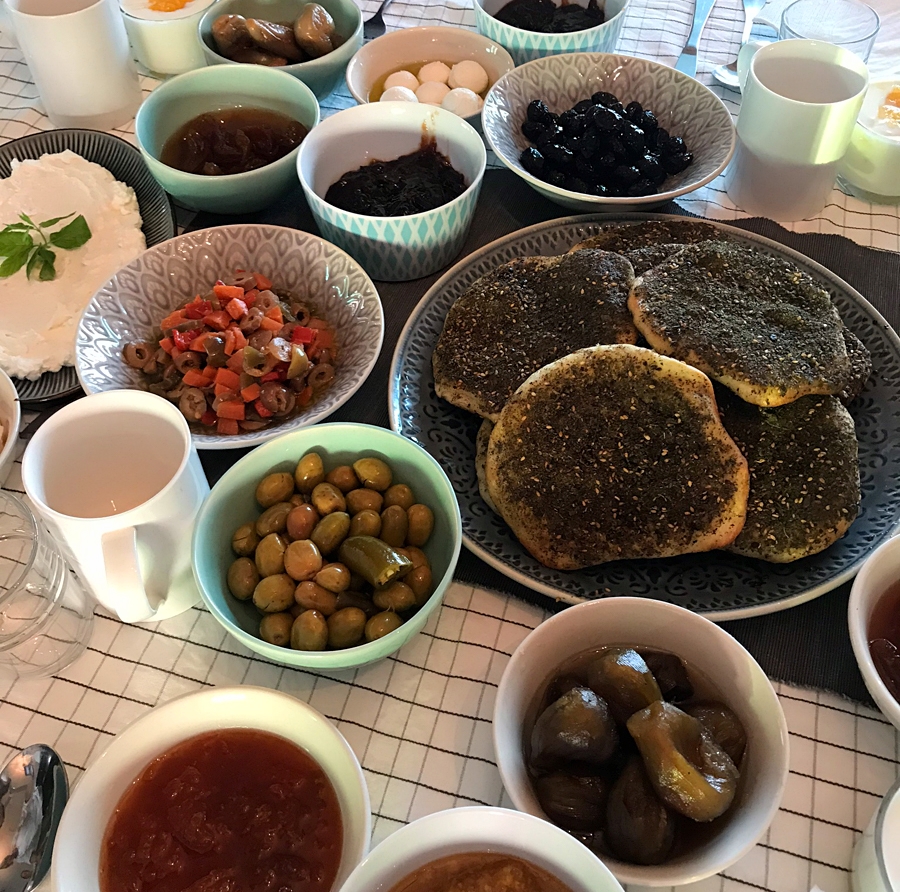
A beautiful breakfast spread in which olives make more than one appearance.

Many people come to see the archeological sites such as Gardara. But olive harvest is also a big draw.
When it’s harvest season in Umm Qais, in the autumn, locals eat a lot of olives and olive oil. And so do visitors, I realized at the end of a long, olive-laden day
Umm Qais is a village of 7,000 close to Jordan’s border with Syria. Traditionally, visitors only spend a couple of hours here visiting the ruins of the Roman city Gadara. But, thanks to the work of Muna Haddad and her sustainable tourism consulting firm Baraka Destinations, people are staying longer to experience agri-tourism and ecotourism.
“This is the fertile crescent,” she explained when I visited Beit al Baraka, her B&B in Umm Qais. When she started her project in Umm Qais in 2015, she met with the local community to discuss which cultural aspects they wanted to promote. Food seemed like a natural.
When I enjoy breakfast at Beit al Baraka, I see what she means. Everything at the enormous breakfast feast – except for strawberries and eggplant – is produced locally. The zataar, a traditional spice blend, is made with wild thyme and sesame grown in local women’s gardens. Staff makes massive pots of pomegranate molasses in the garden. Wheat is boiled, laid flat on rooftops to dry, and ground into flour. At Beit al Baraka, breakfast is served in a dining room filled with locally crafted woodwork and chandeliers from an abandoned church.
Haddad wants visitors to experience the village’s present, not just its ancient Roman past. “We’re trying to connect tourists to people, to the living history.”
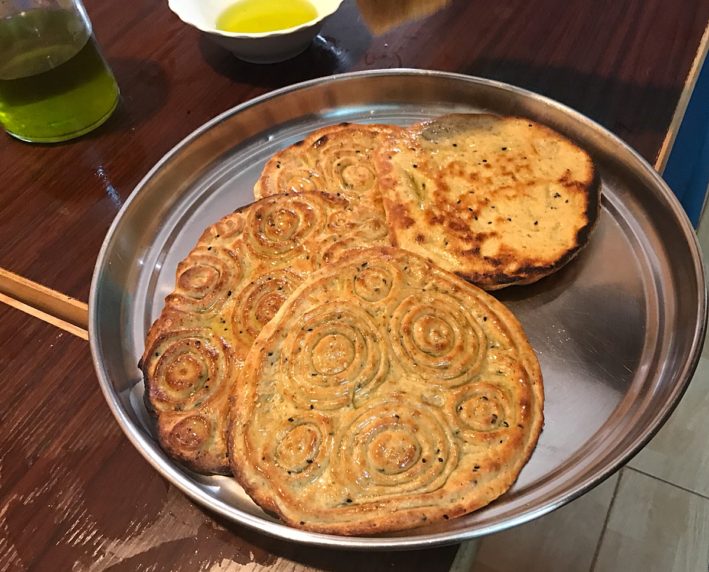
Just look at that beautiful flatbread made with olive oil!
Where Olives Come From
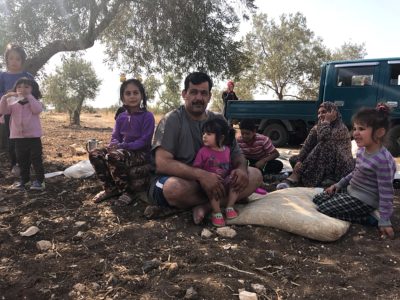
The Malkawi family rests for a bit after working hard harvesting olives.
I’ve probably consumed thousands of olives in my life, but I’d never picked one off a tree until I visited Umm Qais. On a sunny afternoon, we head to an orchard to experience the olive harvest. Two men work together harvesting a tree by hand, one up a ladder and the other working from the ground. A few trees away, a large family, including half a dozen children, break for lunch.
The ripe olives come off easily. It’s fun for five minutes, but probably induces back aches after a couple of hours. We sort olives on a plaid blanket, pulling out leaves and stems.
Next we follow the olive production cycle by visiting a factory that processes olives into olive oil. Machines sort and crush the olives, removing pits and spitting them outside to be converted into jift, a fuel made of pits. The workers were obviously busy, but Arab hospitality overcame labor. Soon after our arrival, a worker produced strong Turkish coffee and poured us tiny cups.
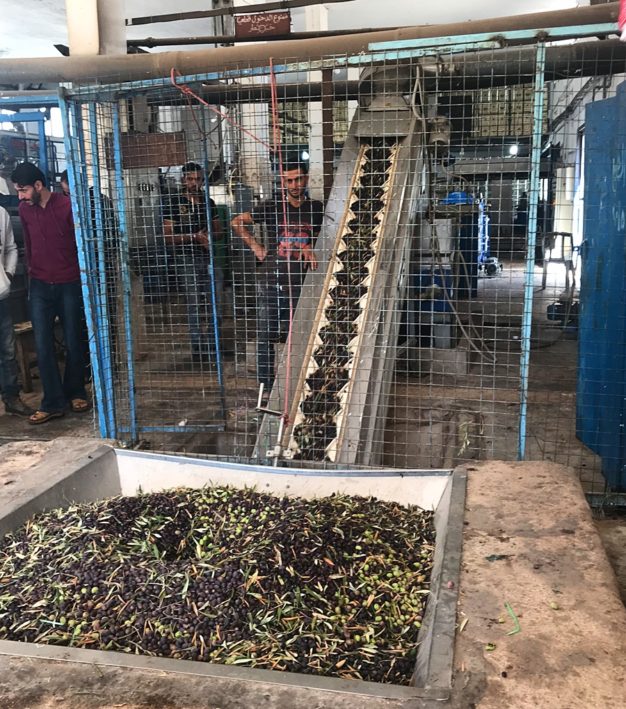
An olive oil factory in Jordan.
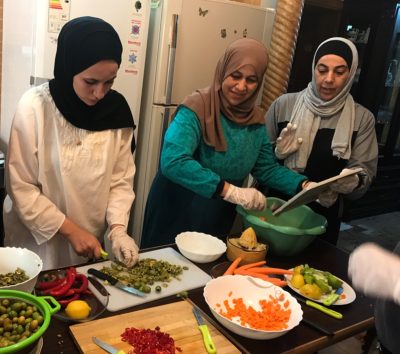
The teachers at the cooking school in Jordan give a rare look at life inside a Jordanian home.
Cooking Class
Olives that aren’t pulverized into oil get made into delicious food. My group of five went to Galsoum’s Kitchen, a tiny cooking school in a family home. Galsoum herself taught us to make olive salad and special fennel-flavored harvest-time bread, which uses unbelievable quantities of olive oil. Since most women in Jordan take a behind-the-scenes role, and many are completely covered except for their eyes, I was thrilled to spend time with Galsoum, her sister and two daughters. For a casual traveler like me, it was a rare look inside a Jordanian home. Galsoum was welcoming and friendly, but shy about her English. The cooking school can accommodate from two to 20 people, and has had more than 200 students since opening in April, 2017.
According to Haddad, the cooking school is the biggest financial investment to date in Umm Qais cultural tourism. The $10,000 startup cost came partially from a USAID grant and part from a Baraka Destinations investment. The goal is for Galsoum to pay the loan back in four to five years and have a sustainable business. Haddad runs feasibility studies for each cultural tourism business in Umm Qais. “Philanthropy has to be a proper business,” she says. “People should come here and be willing to spend money on this.”
Later, my group eats dinner on the low cushions and table at Galsoum’s house. While most of the folks eat chicken, I enjoy fattoush salad and a special mujaddara Galsoum, a healthy concoction of lentils, bulgar wheat and caramelized onions. Learning about Western diners’ preferences and allergies, including vegetarian, vegan and gluten-free, was yet another lesson for the cooking school owner. They’ll make a delicious feast, even with restrictions.
– Story and photos by Teresa Bergen, RFT Vegan/Vegetarian Editor
If You Go
Umm Quais is worth a visit, even if you miss olive season. Other cultural activities include beekeeping, hiking, biking and basket weaving. Visit the Baraka Destinations website and Visit Jordan for more information.
See olive picking in action:
Also, read more about Jordan’s culture, in another article by Teresa, here.
Enjoy these Recipes
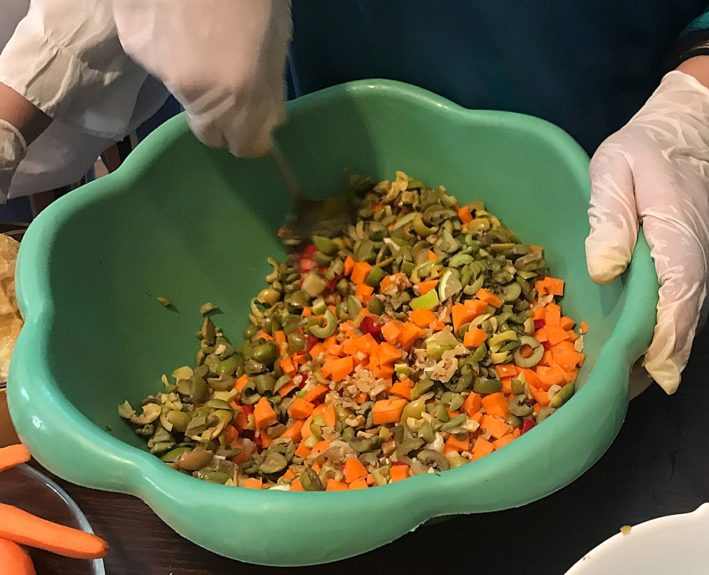
In a cooking class in Jordan, olives were a main ingredient in this olive salad.
Olive Salad
We made a simple chopped olive salad at Galsoum’s Kitchen. Nothing was measured, so feel free to adapt to your tastes.
1 cup chopped green olives
½ cup diced carrots
Chopped red chilies
Pinch of salt
Olive oil
Mix olives, carrots, chilies and salt in a bowl. Transfer to a glass jar. Fill with olive oil. Set aside for a week. Open and eat.
I didn’t manage to get Galsoum’s mujadarra recipe (cooked lentils together with groats, generally rice, and garnished with sautéed onions). But writer/recipe developer Faith E. Gorksy kindly shared her recipe with me, below. Find out more about Faith by reading her blog, An Edible Mosaic https://www.anediblemosaic.com/ or checking out her cookbooks https://www.anediblemosaic.com/books/
Lentil and Bulgur Pilaf with Caramelized Onion (Mujaddara Burghul)
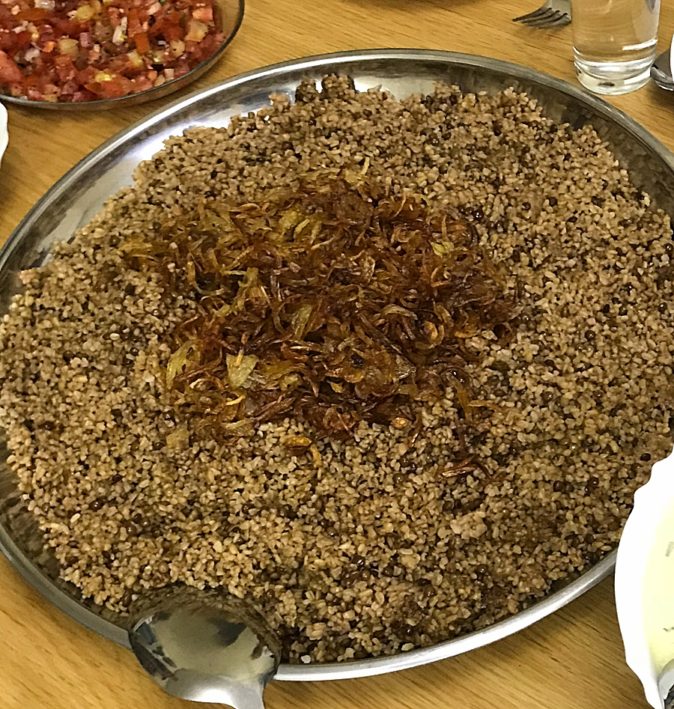
A lentil, bulgur wheat pilaf with sauteed onions.
This hearty pilaf is commonly eaten as a vegetarian meal, with little else besides a bowl of plain yogurt and maybe some sliced tomato, cucumber and/or onion to accompany it. It’s eaten in many Middle Eastern countries and my husband remembers children singing a song about it in middle school while growing up in Syria. For an easy variation on this dish, use white or brown rice instead of bulgur wheat.
Serves 4 to 6
Preparation time: 10 minutes
Cooking time: 50 minutes, plus 10 minutes to let the bulgur sit after cooking
1 1/3 cups (275 g) dried brown lentils (or 2 cans brown lentils, rinsed and drained)
6 cups (1.5 liters) water
2 tablespoons olive oil
2 tablespoons butter
2 large onions, quartered and thinly sliced
1 bay leaf
2 pods cardamom, cracked open
2 cloves
2 teaspoons ground cumin
½ teaspoon ground cinnamon
1 ½ teaspoons salt
¼ teaspoon freshly ground black pepper
1 cup (185 g) coarse-ground bulgur wheat
1 ½ cups (300 ml) boiling water
Plain yogurt (optional, for serving)
1.Sort through the lentils to remove any small stones or pieces of dirt, then rinse with cold water in a colander. Bring the rinsed lentils and the water to a boil in a lidded medium saucepan. Cover the saucepan, turn the heat down to a simmer, and cook until the lentils are tender, but not mushy, about 20 to 30 minutes, stirring occasionally and adding more water as necessary so that they’re always immerse. Strain.
2. While the lentils cook, heat the oil and the butter in a large skilled over moderately high heat; add the onion and sauté until completely softened but not yet browned, about 10 minutes, stirring occasionally. Transfer half the onion to a small bowl and set aside. Continue cooking the remaining onion until deep caramel in color, about 5 to 10 minutes, stirring occasionally and adding a splash of water as necessary if the onion starts to get too dark. Set aside.
3. Put half a kettle of water on to boil. Transfer the sautéed onion (no the caramelized onion) to a medium saucepan. Add the bay leave, cardamom, clove, cumin, cinnamon, salt and pepper and cook 1 minute. Add the bulgur and cook 1 minute more, stirring constantly. Add the boiling water, turn the heat up to high, and bring to a rolling boil.
4. Give the bulgur a stir, then cover the saucepan, turn the heat down to very low, and cook until tender, about 10 minutes (do not open the lid during this time). Turn the heat off and let the bulgur sit 10 minutes, then fluff with a fork and gently stir in the lentils. Taste and add additional salt, pepper and olive oil if desired.
5. Transfer to a serving dish and top with the caramelized onion. Serve with plain yogurt to spoon on top, if desired.







0 Comments