





As Edward Placidi made his way around the culinary scene of South Korea, he found many discoveries, many of them boldly seasoned. In his latest article with Real Food Traveler, Edward takes us on a tour.
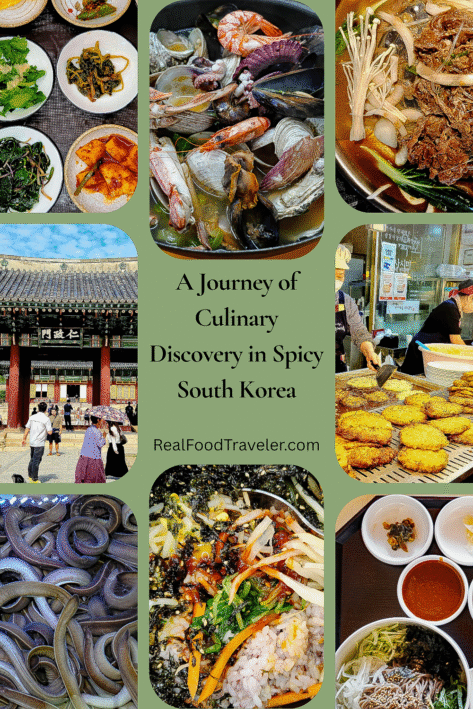
Save this article about South Korea’s cuisine to Pinterest to help you plan your own discoveries. Photos by Edward Placidi. Graphic by Courtney Drake-McDonough.
A Journey of Culinary Discovery in Spicy South Korea
The South Koreans love their food. And the social scene that accompanies it.
In Seoul, they are out in force every night, by the uncountable thousands, the hungry streaming through the streets shoulder-to-shoulder, filling the too-many-to-count street tables, restaurants and carts that overwhelm the avenues and lanes of Insadong, Myeongang and other districts. It’s an electric, exciting nightly culinary extravaganza. While all ages are out and about, it’s Gen Zers and Millennials who seem to be mostly crashing the thronging street party.
The streets of Seoul’s Myeongang area is an exciting nightly culinary extravaganza.
South Korea is a sizzling hot destination, with tourist arrivals soaring exponentially, fueled by growing interest in the culture notably popular K-Pop and K-Drama ‒ as well as the unique Korean kitchen. I joined the tourism surge recently with a culinary goal: travel around the peninsula trying as many foods and learning as much as I could about the cuisine. It was a delicious and rewarding experience.
South Korea is an orderly society with clean streets, where people follow the rules and cue up politely. It carries over into dining: there are rules, guidelines and practices that inform how you eat and drink, how you order, the way you mix ingredients, how drinks are poured.
I got an early lesson in culinary protocol at the Korean Grill Restaurant in Seoul’s bustling Insadong district.
Using Google Translate, the accommodating young server futilely attempted to understand what I wanted to order. Then the elderly, kindly owner shuffled over and initiated a conversation in broken English. He froze, puzzling over what to do, then had a long back-and-forth exchange with the server. A mini crisis seemed to be brewing, but I didn’t understand why.

Seoul’s Insadong district throngs with street tables, restaurants and food carts.
Koreans rejoice in eating communally, a manifestation of traditional cultural roots that emphasize sharing experiences and building connections with family and friends. The bulgogi meal, a popular cook-at-the-table Korean favorite, is only for two or more people. It can’t be for only one guest! Then, surprisingly, the owner turned to me and said he’ll ask the chef if he will prepare the bulgogi for only one person. Of course he did ‒ and it was a mouth-watering treat.
The table grill was lit and small plates immediately began arriving – almost anything ordered in South Korea comes with a selection of side dishes, each in an individual plate ‒ including kimchi, marinated eggplant and peppers, a green salad and rice. The round metal platter was placed on the grill, filled with a rich broth with Korean paengi mushrooms, onions, bokchoy, glass noodles and thinly sliced strips of beef (that the owner said were marinated for two days in a mixture of soy sauce, honey, sesame oil, rice vinegar, garlic and ginger). The server came by several times to turn the meat, and in less than 10 minutes it was pronounced ready. The lunch was so enjoyable: great depth of flavor, the meat tender, savory and slightly sweet, with the crunchy, mildly spicy side dishes an excellent complimentary balance.
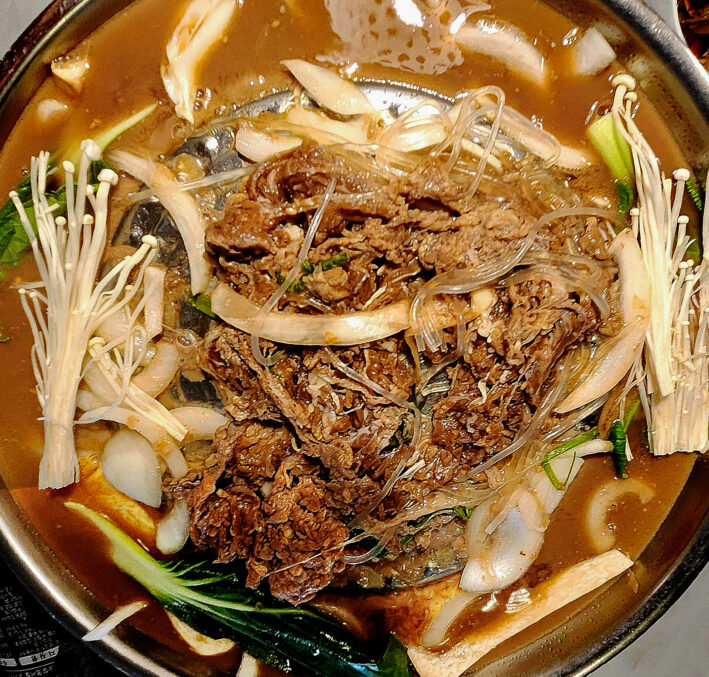
A savory pot of bulgogi at Korean Grill Restaurant in Seoul.jpg
The Korean Grill Restaurant was an exception: though there are few English speakers, ordering was easy in Korea because there’s normally a QR code at the table to scan and order, with the menu usually available in English. Sometimes there was a monitor at the table to order. Within literally a minute or two, the side dishes and your drinks are arriving, and usually 5-10 minutes later mains are served. Also standard is a drawer on one end of the table where you’ll find chopsticks, spoons, a bottle opener and napkins. You usually pay on your way out with a quick tap of your credit card; there’s no tipping. The system is fast, organized and efficient.
I spent an evening at one of Seoul’s food hubs, Gwangjang Market, with an affable and energetic young food guide named Tan, sampling some popular and traditional dishes while adding to my understanding of Korean culinary culture. Gwangjang is one of the capital’s most popular evening food spots with long rows of kiosks, lit up with hundreds of bright lights. Myriad foods are being cooked up, a whirlwind of hungry people streaming through deciding what frying and boiling eats to have, nearly every seat at every kiosk filled.
The Koreans like ‘kimbap’ so much the name means ‘drug’ – as in they are addicted to it. It’s simply seaweed rolled with various ingredients such as rice, vegetables and beef. Tan scored us kimbap at Gwangjang stuffed with sesame oil-seasoned rice and pickled radishes and carrots with a Korean mustard and wasabi dipping sauce. The acute flavors were quickly overwhelmed by the dipping sauce, which exploded with heat in my mouth, surged into my sinuses, then dissipated fast as if it never happened.
The mung bean pancakes were crispy, golden brown delights that were fun to eat. A batter made with ground mungbean, kimchi, soy sauce, garlic, scallions and sesame oil was fried on a grill in a generous amount of vegetable oil, delivering a crunchy exterior and a soft burst of flavor inside. The pork version was savory as well, but with tiny pieces of bone to spit out.
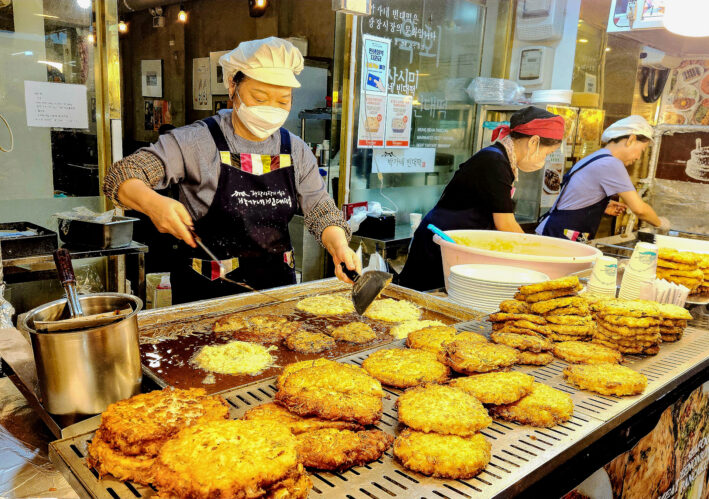
Grilling mung bean pancakes at Gwangjang Market in Seoul.
If you’ve ever watched a K-Drama you would know about soju. The clear, distilled spirit is a national drink fermented from rice, wheat or barley. It’s also fermented in drinking rules, including: never pour your own (that disrupts the communal drinking spirit); use two hands when pouring for others and when receiving a glass of soju; look away when drinking to show respect.
Soju is mostly drunk neat, either sipped during a meal or downed like a shot. Tan was among a number of Koreans who prefer it with beer. Mix three parts beer with four parts soju, or 6 to7 parts for a less strong concoction (though sometimes compared to vodka, soju actually is only about 6-7% alcohol). The mix then must be “activated”: Tan slammed a spoon to the bottom of the glass and it instantly fizzed wildly, forming a frothy top. Then it must be consumed quickly, which is simple to do: It’s so smooth, faintly sweet, refreshing and easy to drink you can down a lot in a short time before you realize you’ve maybe had too many.
Rice wine, makgeolli, is another favorite libation and a trendy drink today. I was eating dinner in a restaurant when a kind couple dining nearby suddenly asked (in English) if I wanted to try makgeolli. They shook the bottle (a must to get the full flavor because ingredients settle), got a waiter to bring one of the small shallow bowls it’s served in and poured for me with two hands. It was milky and cloudy with an unusual flavor profile: a little sweet, fizzy, creamy and tangy.
The makgeolli was an excellent counterbalance to my savory dinner ‒ grilled marinated pork with ssamjang sauce (fermented soy bean paste, red chili paste, toasted sesame seed oil, garlic, green onions and sugar).
Yukhoe, or Korean raw beef, is a crowd pleaser on the peninsula. The little eatery in Gwangjang Market prepared a well-paired juxtaposition of tastes: thinly sliced, blood-red lean meat, mixed with egg yolk, sesame oil, soy sauce, garlic, honey and sesame seeds, then topped with sweet, julienned Korean pear. Two distinct flavors and textures – savory and sweet, smooth and crisp ‒ harmonized ideally in my mouth.
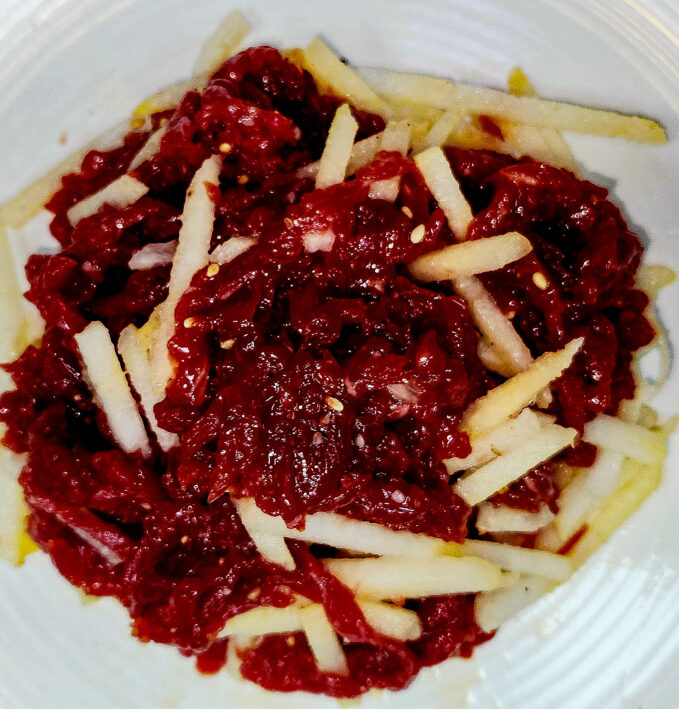
Korean Raw Beef is paired with crisp, sweet Korean pear.
Imagine live octopus arriving wiggling and squirming on your plate. Yes, they are live, kept in tanks, and are cut into pieces just before serving. Using chopsticks you drop the wigglers in your mouth and chew well. Sannakji is very popular and considered a delicacy, but from a personal perspective I found it unappetizing for two reasons: it was rubbery and mostly tasteless (except for the sesame oil, salt and pepper seasoning), and not a humane process. “Live octopus is not a delicious dish, we eat them because it’s something unusual and unique,” explained Tan.
Jagalchi fish market in Busan, the second most populous city, is the nation’s largest and most famous. The quantity of shellfish, especially, is staggering, many in oxygenated tanks so they can be sold live. The market also doubles as a huge food court; in addition to selling mackerel and clams, many stalls offer up a range of seafood dishes, served at simple bench tables. Capitalizing on the location, quality and freshness, prices are generally higher than at restaurants (which are relatively inexpensive in South Korea). I slurped down a simple but tasty seafood soup: a generous mix of steamed clams, mussels, crab, shrimp and more in a rich, salty fish broth.
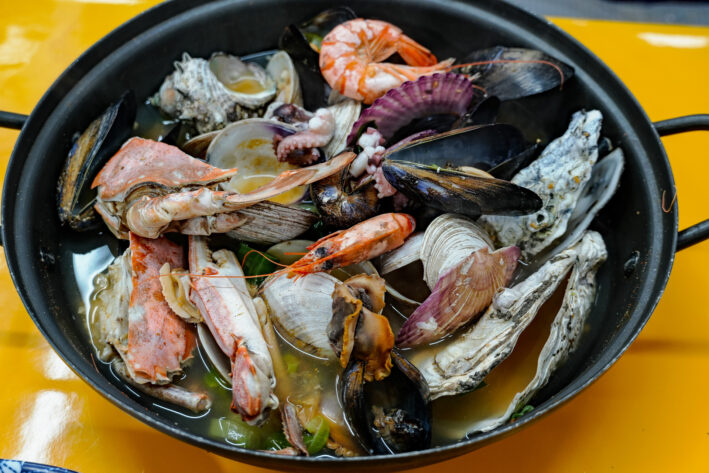
A Shellfish Soup at Busan’s fish market, which doubles as a huge food court.
A beloved national dish, bibimbap, varies in preparation by region but generally combines rice or noodles with beef, vegetables and gochujang (spicy fermented chili paste) with a fried egg atop. Sosohamburg restaurant ‒ in historic Gyeongju, in the atmospheric Hwangnidan Street area where the traditional wood-and-tile-roof architecture has been recreated in a modern iteration adjacent the complex of ancient tombs that is a huge tourist draw ‒ served me their version that was a fresh mini feast for less than a fast food meal at home.
Hungry for more? Read about the Haenyo (Seawomen) Divers of Busan.
A bowl with buckwheat noodles, shaved onion and cucumber, greens, seaweed, topped with sesame seeds and gochujang, came with beef tartare tossed with egg yolk plus sides of miso soup, a potato croquette, thinly shaved cabbage in a creamy mayonnaise and pickled ginger. I mixed the beef into the bowl and had great fun enjoying an array of tangy flavors in every bite.
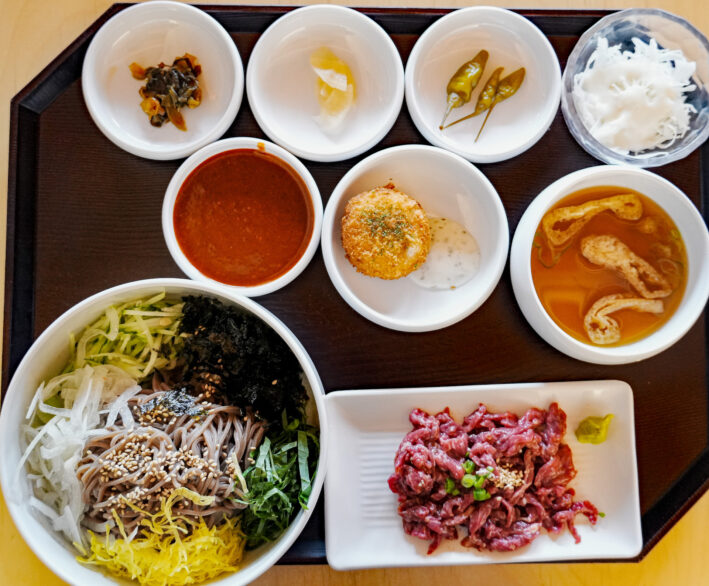
Beloved national dish bibimbap at Sosohamburg Restaurant in historic Gyeongju.
Koreans love their gochujang as well as other chili concoctions like ssamjang, so their cuisine is often labeled ‘spicy.’ However, when compared to fiery Indian curries or the chili-heavy dishes of Mexico, I found the heat level quite mild.
At a country eatery outside Gyeongju, where I was visiting ancient temples in the local hills, I discovered another version of bibimbap that came with an incredible 12 side dishes (the most of any restaurant I experienced, and accompanying a dish that cost only about $10). The Hot Stone Bibimbap, served in a heavy, sizzling pot emitting clouds of steam, was to die for: crispy, caramelized rice on the bottom under lettuces, seaweed, sprouts, carrots, a piquant soybean paste sauce and a fried egg crown.
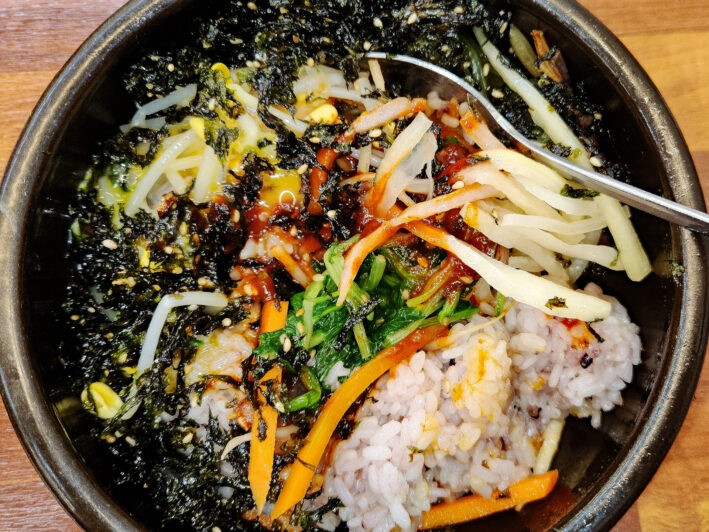
Beloved national dish bibimbap at Sosohamburg Restaurant in historic Gyeongju.
When the server brought the pot, she grabbed a spoon, busted the egg (before I could photograph the dish!) and showed me how to scrape up the rice and mix it with the other ingredients. Some 30 seconds later, the proprietress came over, determined I had flunked the mixing test, and worked on it herself – then proclaimed it ready to eat. The ingredients were simple but the deep flavor and texture of the caramelized rice was a taste-bud pleaser.
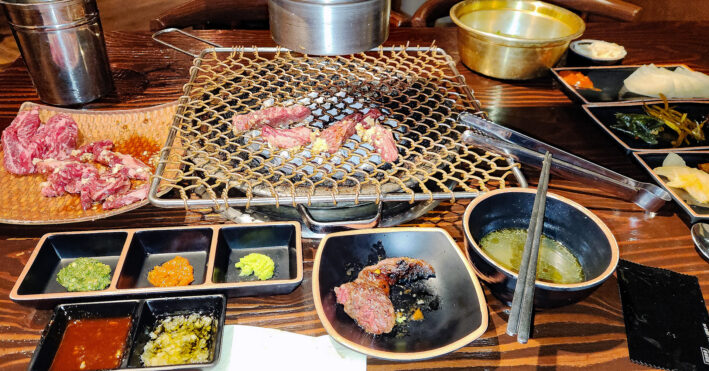
The Korean penchant for communal eating blossoms at a Korean barbecue. Together, the diners cook their meat at the table just a few bites at a time, so there’s plenty of time to share sides, favorite libations and conversation. At Restaurant Daehwa Sanjang in Gyeongju, the metal bowl of ready-to-cook charcoal arrived first, then an array of sides from kimchi and seasoned mustard greens to creamy mashed potatoes, followed by three kinds of marinated premium beef, cut into small, thin strips, and five dipping sauces from wasabi to chili cilantro. Sizzling seared premium beef with bold-flavored accompaniments, slowly cooking a few strips while nibbling, lingering to drink and talk – it was a memorable evening.
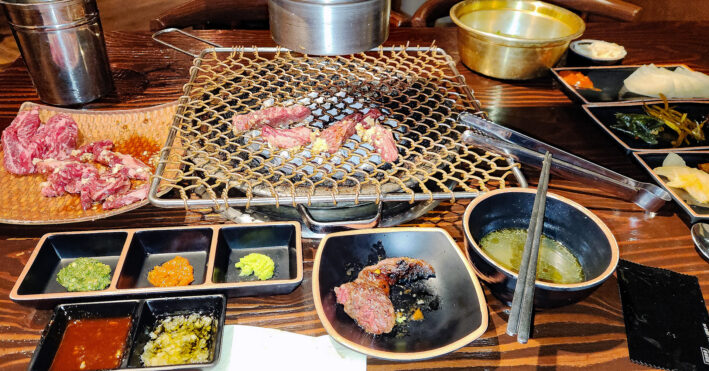
A Korean Barbecue at Daehwa Sanjang Restaurant in Gyeongju.
With numerous dishes on menus, I was trying something different every day – from Busan’s traditional gijang soup made with a local seaweed renowned for its nutritional power (given to women who have just given birth as a restorative), to Andong city’s traditional specialty of grilled salted mackerel (if you like mackerel, it’s a fresh, salty treat), to a comfort food called jajangmeon with chewy, thick wheat noodles with seafood and/or meats covered in a caramely black bean sauce.
The South Koreans are not only passionate about their traditional foods but also the coffee culture they’ve adopted. There was a coffee shop seemingly on every block. There was always an Ediya Coffee nearby – the country’s largest coffee franchise has thousands of locations. People sipping a cup of java while nibbling on a Western-style pastry was a common sight.
The sweet that captured my culinary heart, however, was not found in coffee shops. Deep fried, heavy and deliciously sinful, the yakba is a Korean-style donut combining flour, sesame oil, cinnamon and honey. Scooped from the fryer too-mouth-burning hot to eat, it’s rolled in sugar. I let it cool two minutes before biting into the sweet, crunchy exterior and digging into the warm, fluffy interior. It was a perfect flavor and texture transition from the crusty outside to the heavenly inside.
Sometimes called a medicine cake because, I was told, the yakba ‘improves your mood and happiness,’ it did add moments of joy to my culinary journey in South Korea.
– Story and photos by Edward Placidi
Use Real Food Traveler’s Stay 22 affiliate link to help plan your journey to South Korea.
Hungry for more? Read Edward’s article about Central Asian cuisine.







0 Comments