











While visits to National Parks peak during warmer weather months, there is a definite beauty to be enjoyed that comes from the architecture of bare branches, expanses of land, and frozen waters. Carole Jacobs, Real Food Traveler’s Health & Fitness Editor shares her recommendations for the best national parks in winter in this, the first of two articles, that cover the United States.

Save this list of the best national parks to enjoy in winter to Pinterest to help you plan a trip. Graphic by Real Food Traveler.
Hungry for more? Read Carole’s list of 8 Great Places to See Northern Lights.
The Best National Parks in Winter (West and Central U.S.)
Whether you want to ramble through snow-blanketed splendor or savor the silence of desert solitaire, winter is a magic time in America’s national parks. Parks with frosty climes in winter offer crystalline beauty minus the madding crowds that eclipse their scenery in high season, while parks with steamy summer weather chill off in winter so you can enjoy outdoor adventures minus the glaring heat, sun, and sweat. Below are four national parks in the West and Central U.S. you won’t want to miss this winter.
Haleakalā National Park, Maui, Hawaii
Centered around a dormant, 10,023-foot volcano towering over Maui, this 30,000-acre park encompassing a breathtaking range of landscapes and skyscapes– from Mars-like red deserts and rock gardens near the summit to tumbling waterfalls and rushing streams in the park’s coastal Kīpahulu section, near Hāna, plus more endangered species than any other national park. The park is also steeped in Hawaiian lore: Haleakalā means “house of the sun,” and legend has it that the demigod Maui lassoed the sun from its journey across the sky as he stood on the volcano’s summit to slow its descent and make the day last longer. Winter is the best of both world in Haleakala, offering pleasant temps and fewer crowds.
Winter weather watch: Daytime highs in the upper 70s, with overnight lows in the mid-60s.
Base camp: The only lodging in the park is campgrounds and primitive cabins. If you prefer not to rough it, head 18 miles down to Makawao, a former Paniolo (Hawaiian cowboy) town-turned renowned art community nestled on the western slopes of the volcano. Settle in at the historic Banyan Bed & Breakfast, a 1927 plantation with lodging in the main house or in cottages. Set on two landscaped acres with gardens and a saltwater pool, the B&B is just a short walk from Makawao.
Option 1:(Self-guided) Sunrise at the summit: The night before, pack breakfast and lunch to enjoy in the park. Rise in the predawn hours for the drive to the Haleakalā Visitor Center at the summit, site of one of the most dramatic sunrises on earth (about 7am in January and February). As the sun peeks over the horizon, swirls of color and light dance across the vast sea of clouds, a sight author Mark Twain described as “the most sublime spectacle I have ever witnessed.” (Reservations required for vehicles.)
Breakfast on high: Enjoy a picnic breakfast at Leleiwi Overlook, overlooking views into the crater, out the Kaupō Gap, and down the Koʻolau Gap to the coastline along Maui’s north shore.
Hike down inside a volcano: From the summit, drive about a half mile down to Sliding Sands Trail. The steep trail descends 2,400 feet in four miles to the otherworldly crater floor past an ever-changing display of light and colors.
Option 2: (Guided) Sunrise at the summit and bike ride from the park to the beach: Several touring outfits offer 8-to-10-hour tours that combine sunrise at the summit with a guided 23-to-26-mile all-downhill bike ride from the park boundary at 6,500 feet through bucolic ranchlands and pastures, braking for lunch in the Paniolo (Cowboy) town of Makawao. Tours end either in Haiku (elevation 500 feet), a lush sugar mill town where you can fuel up on an Hawaiian-style “plate lunch” at Kings BBQ or indulge in Ahi Poke at Haiku Marketplace; or in Pa’ia, a quirky oceanside surf town that’s home to Mama’s Fish House. The converted beach house, nestled in a coconut grove on a secluded white sand beach, dishes up world-class macadamia nut crab cakes, calamari, and a front row seat to windsurfers.
Afternoon in Upcountry Maui: Back at the B&B, freshen up for an afternoon of exploring Upcountry Maui, a laid-back organic farming area hugging the western volcanic slopes, where small farms harvest everything from strawberries, sweet Kula onions, lavender, coffee and flowers to cattle and goats.
- Grab a pick-me-up coffee at Grandma’s Coffee House, founded in 1918, and still serving locally ground coffee, fresh baked goods and to-order breakfasts like Grandma used to make.
- Buy farm-fresh organic produce at Kupa’a Farms, a 6-acre organic famous for its organic produce and award-winning coffee.
- Brake for Al’ii Kula Lavender Farm. Roll down the windows as you approach this 13-acre farm to inhale the heavenly scent and sight of 45 varieties of lavender growing on the volcano’s slopes at 4,000 feet.
- Meet the critters and taste the cheese at Surfing Goat Dairy: Home to more than 100 happy goats, this 42-acre farm churns out 30 fresh and aged goat cheeses (18 have won national awards), goat cheese truffles, and goat milk soap.
- Stop and smell the blossoms at Kula Botanical Gardens, alive with orchids, bromeliads, bird-of-paradise and carnations.
Dinner on the town: Savor local farm-to-table Hawaiian cuisine with an Asian twist at the historic Hali’imaile General Store, a former one-stopbutcher shop, fish market, post office, and clothing and household goods store nestled in pineapple fields in Makawao. Don’t miss the Macadamia Nut Crusted Mahi Mahi with Molokai whipped sweet potatoes, tropical fruit salsa, and mango-lilikoi butter sauce.
Sunset at the summit: Overslept sunrise? Sunset at the volcano (about 6am in winter) is equally dramatic as flaming clouds surrender to a starry sky. It’s also far less crowded, and you won’t need a reservation.

Haleakala National Park. Photo courtesy Unsplash.
Yellowstone National Park, Idaho, Montana and Wyoming
For total immersion in winter, head to Yellowstone, a life-size snow globe. Winter intensifies the park’s bizarrely beautiful landscapes as its celebrated steamy wonders – scalding geysers, steam vents, and hot springs—meet winter’s single-digit temps, sending steam billowing 1,000 feet into the frosty landscape and turning the landscape into a glittering fantasia. The park’s silence is broken only by the hiss of steam from geysers, the tinkling of partially frozen rivers, and the occasional whine of a distant snowmobile. Most park roads are buried under drifts of snow all winter, so the only way in and out is via snow coach (or for the truly hardy, snowmobile), which only enhances the park’s snowclad enchantment. Yellowstone gets just 3 million visitors all winter, versus 4 million in July alone, so you’ll have that world-famous geyser or frozen cascade all to yourself.
Winter weather watch: Daytime highs in the mid-20s, with overnight lows -3 and below.
Base camp: Hop a snow coach to Old Faithful Snow Lodge in the park’s frozen interior, a modern but rustic award-winning lodge whose heavy timber construction, exterior log columns and cedar shingle roof showcase its rugged “parkitecture.” The lodge has cozy rooms, a full-service restaurant and bar, the Geyser Grill, a cozy lobby with fireplaces, and the Bear Den Ski Shop where cross-country ski and snowshoe rentals, lessons, and tours are available. A boardwalk system out the front door leads to cross-country ski trails, snowshoeing, the visitor’s center, and a front-row seat Old Faithful, whose erupting waters become suspended ice crystals in winter.
Breakfast: The lodge’s western-themed Obsidian Dining Room serves whole-hog all-you-can-eat breakfast buffets as well as healthy ops like homemade seven-grain pancakes and granola with yogurt.
Make tracks: Ski or snowshoe out the front door of the lobby to the foot of Old Faithful.
Take a narrated snow coach tour: Or see the frozen interior of the park from the comfort of a heated snow coach on an all-day (7- to 9-hour) snow coach tour. Spy on steam-frosted bison, wolves, bison, fox. and eagles as they hunt for food; picnic next to frozen waterfalls or in a steamy backcountry thermal basin; hear stories of Yellowstone’s past and present; and learn about winter ecology and how wildlife adapts for survival. Return to the lodge as sunset paints the sky and snow pink, orange, and purple.
Dinner at the Inn: Back at the Obsidian Dining Room, get a taste of Yellowstone with the bison short ribs, wild boar with cranberries, or roasted pheasant, and save room for the cheesecake with huckleberry sauce.
Moonlight spin: Borrow free ice skates from the front desk for a starry spin around the lodge’s ice-skating rink, located just outside the lobby. Then come in and warm up by the fireplace with a steamy cup of coffee or hot chocolate.

Old Faithful Snow Lodge. Photo courtesy Flickr.
Hungry for more? Picnic Ideas for 7 U.S. Hikes.
More National Parks in Winter for the West and Central Parts of the United States:
Zion National Park, Utah
A typical winter day brings just 3,000 visitors to Zion’s 15-mile-long canyon, compared to 17,000 in summer. When dusted with snow, the park’s sandstone kaleidoscope of red, orange and pink cliffs, canyons, and crags, takes on an otherworldly quality, and even hot spots like Canyon Overlook are free of mobs.
Winter weather watch: Daytime highs in the 50s and 60s, with overnight lows well below freezing.
Base camp: Huddled beneath soaring red rock monoliths in a bend of the road by the Virgin River, Springdale, population 500, may be pint-sized, but its tiny main drag offers all the essentials for a winter vacay: cozy lodges, eclectic restaurants, cafes, bakeries and coffee houses, camp stores, touring outfits and gift shops, galleries, Native American boutiques, and concerts and festivals held in two theaters.
Stay: Cliffrose Springdale, an historic luxury lodge and spa with a restaurant, heated pool and hot tubs, overlooks the Virgin River and stunning red rock cliffs.
Rise for dawn’s early light (about 7:30am in Feb): Shadows on the park’s soaring cliffs, buttresses and rock faces fall away like curtains as sunrise lights up the multicolored sandstone.
Breakfast: Fuel up for the morning on hefty breakfast burritos and Springdale’s best brews at quaint Deep Creek Coffee Company.
Take a winter hike: Best choices, weather permitting, include Riverside Walk, a 2-mile paved hike along the Virgin River; the 1.2-mile loop to Lower Emerald Pools, where icy turquoise waters are captured in glistening ice; and the mile-long Canyon Overlook Trail, where sandstone steps climb above the Great Arch to one of Zion’s signature vistas.
Warm up with Tex Mex: Chow down on pork chili verde tamales at Oscar’s Café.
Afternoon scenic spin: The Zion Mt. Carmel Highway Scenic Drive rollercoasters past swirling layered strata of rusty red, orange, cream, yellow and brown towers, hoodoos, and hilltops, and ducks into the historic 1920’s Zion–Mt. Carmel Tunnel, where windows carved in the rock offer flashes of stunning red rock scenery as you drive along.
Night on the town: The Bit & Spur Restaurant & Saloon, a lively cantina and watering hole, dishes up contemporary Mexican & Southwestern fare with craft beers.
Stargaze: An International Dark-Sky Park, Zion keeps the drama going after dark, when the orange glow fades from the canyon walls and surrenders to a canopy of stars. Catch the show on the paved 3.5-mile Pa’rus Trail along the Virgin River.
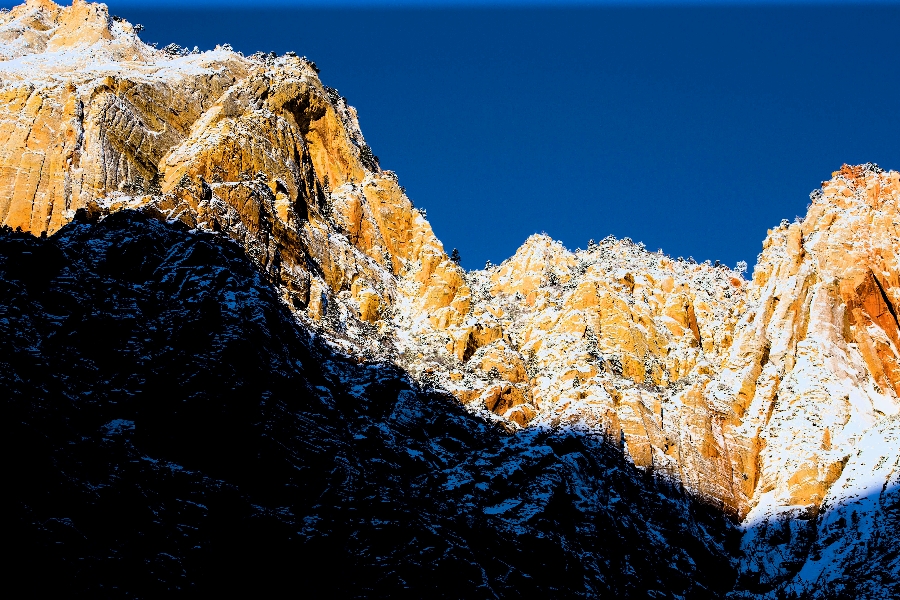
Sunlight on Zion Peaks in winter. Photo courtesy Unsplash.
Hungry for more? Idyllic Shoulder Season Resorts in the West.
Big Bend National Park, Texas
This far-flung park in West Texas boasts night skies as black as coal, rivers that carve chasms into limestone, and a lone mountain range surrounded by weather-savaged sands. A natural wonder (especially in the mostly flat Lone Star State), the ruggedly beautiful park is named after a huge bend in the churning Rio Grande River that separates West Texas from Mexico.
Winter weather watch: Daytime highs in the 60s-70s, with overnight lows in the 30s.
Base camp: You wouldn’t expect to find a classy hotel with a luxury spa, gourmet restaurants, swank bar, and trendy coffee bar in the rough-riding town of Marathon (population 386), located 40 miles north of Big Bend. But that’s Texas for you. The historic Gage Hotel offers 45 plush (TV-less) rooms spread over a restored mission-style hotel, pueblo-style lodge and the 1880 Captain Shepard House, plus a fitness center, heated swimming pool, and a 27-acre landscaped native garden. Marathon was a cattle-trading hub in 1927 when Houston oilman J. P. Bryan bought and restored the hotel – followed by most of the town. Today, his empire includes 26 meticulously restored historic buildings around Marathon.
Breakfast: V6 Coffee Bar, a casual cafe east of the hotel entrance serves locally roasted brews, smoothies, and breakfast entrees ranging from stick-to-your-ribs (Biscuits and Jalapeno Gravy) to trendy (Avocado Toast).
Walk it off: Big Bend has more trails (150-plus miles worth) than you can shake a stick at. A few can’t miss hikes include:
- Hot Springs Historic Walk meanders 2 miles along a dirt road to an historic homestead and hot springs
- Grapevine Hills Trail follows a sandy wash 2 miles through massive granite boulders to a picturesque “window” of boulders.
- Rio Grande Village Nature Trail climbs a half mile to a high desert promontory overlooking panoramic views of the Rio Grande: Downriver are several Mexican villages, upriver are sand dunes and the distant Chisos Mountains, and just across the river is the tiny farming village of farming village of Ojo Caliente (“hot spring”), where fields are irrigated by warm springs.
Do lunch in a living ghost town: About 26 miles from the park is Terlingua, a turn-of-the-century boom-to-bust silver mining town that was home to 2,000 residents before going belly-up in 1942. Today, the population is just 84, but the town swells in size each November as “chili heads” from the world over descend for the town’s historic Championship Chili Cookoff. For heaping portions of smoky goodness, head to DB’s Rustic Iron BBQ, the town’s undisputed diamond in the rough.
Scenic drive to scenic ramble: Ross Maxwell Scenic Drive leads to fantastic views of the Chihuahuan Desert landscape and on to the banks of the Rio Grande, with scenic overlooks and historic exhibits along the way. Short walks to Sam Nail Ranch, a 1916 adobe homestead nestled in a tangled orchard; Homer Wilson Ranch, an early-20th-century line camp where the dusty remains of a corral with a central snubbing post, a dipping vat for sheep and goats, and a ranch house with a shady porch peek from the brush; and the Castolon Historic District, the ruins of an early-20th century farming and trading community and U.S. Army outpost. At the end of the drive is Santa Elena Canyon, a narrow oasis nestled in 1,500-foot cliffs on the banks of the Rio Grande.
Sunset ops (about 6:50pm): In Big Sky County like Big Bend, catching the sunset is a big priority, and the park has several ways to savor it:
- Sunset hot springs soak: Soak your weary bones in the park’s historic hot springs as the sunset turns Elena Canyon a hundred shades of amber.
- Sunset stroll: The setting sun through the rock window along the .3-mile Window View Trail is classic Big Bend.
- Sunset by horse: Saddle up for a 2-hour ride into Big Bend’s painted desert to see the setting sun ignite the red and lavender badlands.
Texas-style happy hour: Back in Marathon, head to the White Buffalo Bar, a legendary watering hole with an extensive tequila bar named one of the best in Texas by Texas Monthly. Try the White Buffalo Margarita, named the best margarita in the Lone Star State by Saveur magazine.
Dinner: The Gage’s 12 Gauge Restaurant dishes up authentically Texan gourmet grub—confit duck flautas topped with roasted chipotle salsa, and salsa verde; “Iron Mountain” chicken fried steak smothered in pepper cream gravy and mashed potatoes, and vegetables and herbs grown in the Gage’s backyard Garden. For BBQ and Beer, the true Texas Two-Step, try Brick Vault Restaurant & Brewery.
Star gazing: See Marathon’s jaw-droppingly beautiful night sky at the Marathon Sky Park located a half mile from town, where a vast canvas of stars twinkle and blink in a pitch-black sky with one of the lowest light pollution levels on earth.

Santa Elena Canyon in Big Bend. Photo courtesy Unsplash.
-Story by Carole Jacobs, Real Food Traveler Health & Fitness Editor
Hungry for more? Read Carole’s Part 2 article, covering the Midwest and East.









0 Comments