






Far off the touristy path, writer Yvonne Horn gets a taste for the people, the vibe, the food, and the firewater on Amorgos, the easternmost island of the Cyclades island group in Greece. Find out where she found she could eat like a local.

A brilliant white and blue church in Amorgos.
Where to enjoy Greek food like the locals do in Amorgos
While my traveling companions head off on a trail leading to yet another blue-domed, white-washed chapel overlooking the sea, I’m staying behind for a very good reason – meatballs. Not just any old meatballs. The ones I await – while sitting on a blue-painted chair at a little blue table for one in the village of Tholaria’s town square – are said to be Amorgos’ best, some say in the entire Aegean.
On Amorgos every village has a kafeneio – part grocery store, part café, part men’s social center. Not too long ago, women were not welcome, except, perhaps, to come in for coffee after Sunday church. That remains so today in the smallest of villages where naught but men gather to play cards and down raki, island firewater, with small plates of food, meze, sent out from a button-sized kitchen tucked into the back.
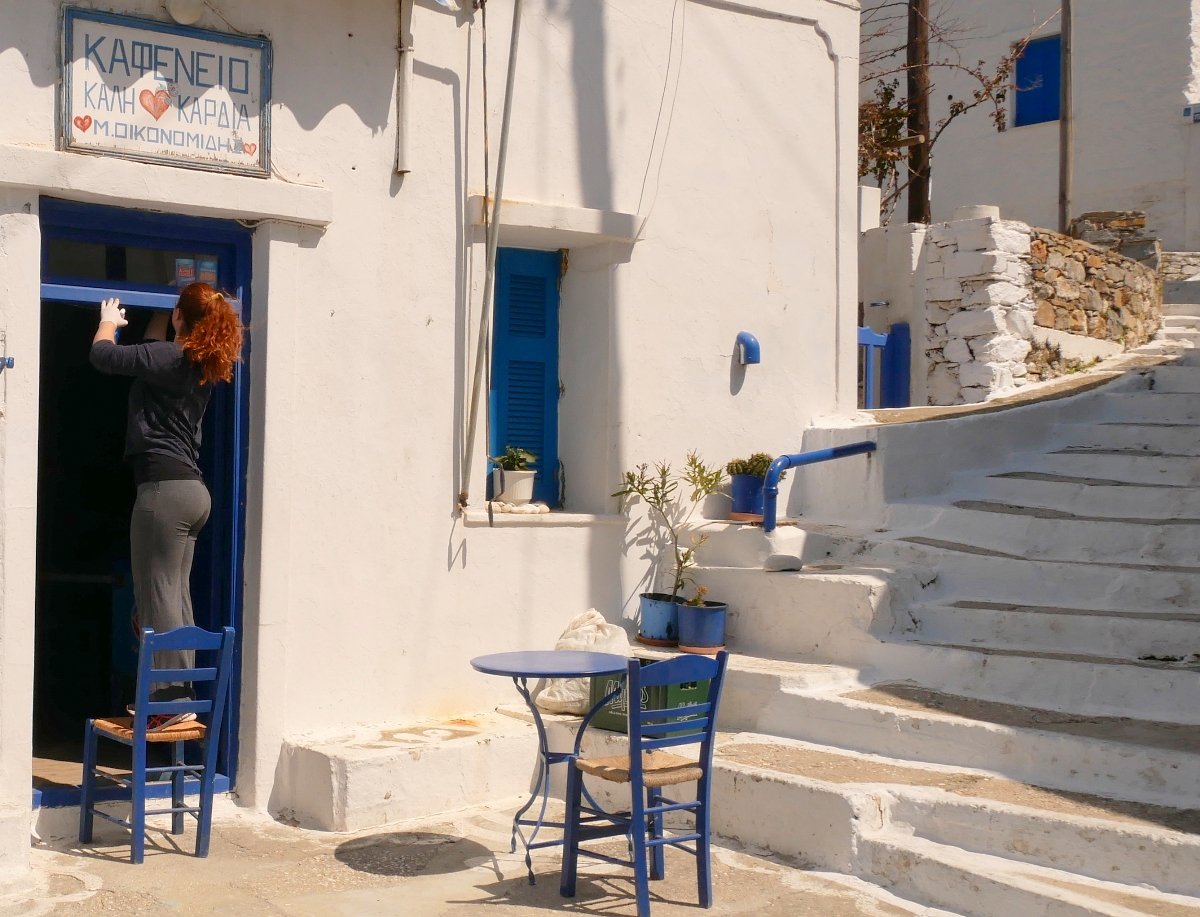
Plito Economides perches on a chair to shine up the window over Kali Kardias’ doorway.
Kali Kardia has held forth on the square for over 100 years, evolving today from men-only to a near full-scale restaurant – as have most others on the island – with plates of food emerging somehow from its still teeny kitchen. Three generations of the Economides family provide the cooking and serving. “My grandfather, my mother, and me,” Plito, the daughter, tells me, adding that all ingredients come from Amorgos. An uncle grows vegetables and provides lamb. As we talk, the uncle strides in with a sack of potatoes thrown over his back.
I’d had a glimpse of “for men only” on a Sunday afternoon in the speck-sized village of Vroutsi when three of us, women walkers all, spotted a kafeneio and thought it a likely place to ask for directions to the path we planned to follow. The half dozen men chatting around a table fell silent at our entrance. While we didn’t find which way to go, the aroma of whatever was being stirred up on the little stove in the back made me want to abandon the walk and sit down – if only.
Waiting for Amorgo’s best to emerge from Kali Kardia’s kitchen, I contemplate the non-parade of people passing by – a dour, black-clad priest walks through on his way to imposing Agii Arangyti, the church that shares the square, and that was about it. On this springtime day, Amorgos, easternmost of the Cyclades, seems a world away from its loved-to-death neighbors, Mykonos and Santorini. The main reason is that it’s not easy or fast to get to – six hours from Athens on the Blue Star ferry. And so far, no cruise ships make their way to Amorgos.
My meatballs arrive, baked, not simmered in sauce as I’d expected. Juicy, not a bit dry, gently redolent of fennel and mint. An ample serving of tzatziki is provided, the yogurt mixed with diced cucumber and laced with garlic and lemon that seems no Greek-island meal can begin without. With the toothpick provided, I dip each meatball in. My rating, delicious.

Not the meatballs you’re used to, but delicious just the same, in Amorgos.
In Chora, the island’s tucked-into-the-mountains capital city, (population 490, with Amorgos’ total population less than 2,000), I find kafeneio Paras next to the pharmacy. Three men are playing cards as I walk in. In one corner of the memorabilia-cluttered main room, a woman, who I take to be the family grandmother, is separating broccoli into florets. I ask what the kitchen is cooking that day and decide on courgette croquettes, which arrive crispy on the outside and meltingly tender within, and a plate of sliced baby beets that come with their greens sautéed in olive oil and arranged alongside. With a squeeze of lemon, I sop up the beet juices with the bread that always just comes unless one says “no bread” at the outset. And why would one, when a basket liberally filled is but .40 euros?

A plate of croquettes.
At Paras, I decide to give a shot of raki a try as an aperitif, neat as the locals down it, not psimenti raki flavored with cinnamon and sugar as offered to visitors. As warned, firewater is an apt description.
On the waterfront of Katalopa harbor, where a map of the island greets visitors with the heading “Welcome to Amorgos. Nobody will find you here,” Prekas has been the meeting place for fishermen since the 1920s. Today, the granddaughter of the original owner who now manages the place, keeps it just as it used to be – patterned floor, interior wall color unchanged, retsina jugs arranged on a shelf – along with a collection of vintage radios and TVs. Photos of the old port at the time when Prekas first opened its door hang on the walls. Crunchy whitefish and grilled octopus are musts to order.
At Prekas, as at any of the island’s kafeneios, you’ll be hard pressed to pay as much as the euro equivalent of ten dollars for a meal, no matter how many shots of raki you manage to toss down.
— Story and photos by Yvonne Horn

A landmark series of five windmills march across the hills behind Chora, Amorgo’s inland capital city. .
Do you want to eat like a local in Amorgos, Greece?
Learn more about Amorgos and get the schedule for the ferries, visit this website.
Hungry for more? When you need a fix of Greek food at home, try this recipe for Dolmades. Also, read some of Yvonne’s other articles on RealFoodTraveler.com She has shown us where to eat in Prague, and where to seek out the best pasty in Cornwall.
PIN it so you don’t forget it, on Pinterest!








0 Comments