





Explore the historic charm and experiences of Cáceres, Spain in another vividly written article by Betsa Marsh for RealFoodTraveler.com readers.

Save this article about Caceres, Spain handy by pinning it on Pinterest. Photos by Betsa Marsh. Graphic by RealFoodTraveler.com.
Cross-cultural secrets unfold in historic Cáceres, Spain
Rising above medieval Arab ramparts, the spires and cupolas of Cáceres bask in the Spanish sun. So untouched are the ancient stones of Old Town that the Renaissance jewel box became Spain’s first listed heritage city in 1949 and a UNESCO World Heritage Site in 1986.
Streets may boldly cut through the walled quarter and doors may open wide to travelers, but still dozens of surprises lie hidden within this historic core. Much of the fun of Cáceres is discovering her secrets, top to bottom.
A millennium-old Arab cistern, for instance, lurks within a municipal museum. Buildings rise atop Roman and Jewish ruins. And every tower but one stands mysteriously truncated, their crenellations lopped off since 1476.
Cáceres, 184 miles/297 km southwest of Madrid, is the capital of its namesake province, the northern part of the Extremadura region. To the south is Badajoz, the two provinces divided by the Toledo Mountains.
Cáceres’ Old Town is a time-skipper’s dream, with hearty vestiges from Roman to Arab to Jewish and Christian times within its Arab walls. Scratch the façade of many a Renaissance building and you’ll find another era, another culture, somewhere beneath.

Overlooking the rooftops of Cáceres. The city lost all but one of its defensive watchtowers in 1476, by decree of Queen Isabella and King Ferdinand. Betsa Marsh photo.
Cáceres hit its peak in the late 15th and 16th centuries. Today, 50 palaces from that era remain within its nine hectares/22 acres.
“There is nothing modern within the walled area,” guide Marco Mangut says as he wends through the labyrinthine streets. “This,” he said, with a sweep of his arm toward the ashlar facades, “is the result of poverty. Everything stopped in time. In the 20th century, this area that nobody was interested in was now a treasure.”
A recent reign of peace has been pivotal to Cáceres’ preservation: The city was spared the sweeping wars of the 19th and 20th centuries.
But the past was not always tranquil. Celts arrived here about 3,000 years ago, and some of their gravestones and solid gold bracelets hold the spotlight in the Museum of Cáceres. Romans fought to take this land about 78 BCE, naming it Norba Caesarina. The Arabs followed, calling their city Qarci. For centuries, Arabs and Christians wrestled for control until Alfonso IX of Leon conquered the town for the Kingdom of Castile in 1229.
The city of free trade thrived under Isabella and Ferdinand, monarchs who soon tired of infighting among Cáceres’ aristocrats and merchants. They ordered all the fortified watchtowers demolished in 1476, and only Diego de Ovando, an Isabella supporter, was allowed to keep his slender, battlemented tower atop the House of the Storks.
Ovando’s watchtower may stand alone on the skyline, but it always pays to look up in Cáceres. Giant stork nests crown nearly every shortened tower, just one of 70 bird varieties who come here to build their homes.
Near the House of the Storks, some of the city’s best time travel begins in the Museum of Cáceres. The site was an Arab fort, converted into a palace in 1600. After the cultural displays, be sure to climb all the way down into the basement. Beneath graceful arches lies an Arab cistern from the 11th or 12th century, rediscovered in 1914. This is the only one on view in Europe.
Travelers can peel back other layers of history at the Bujaco Tower, just off the Plaza Mayor. It’s part of the 12th-century Arab wall that’s now a history center, with a great view of the square below.

The Bujaco Tower, left, rises from the Plaza Mayor in Cáceres. It’s part of the 12th-century Arab walls surrounding Old Town. Betsa Marsh photo
Hungry for more? Learn about Spain’s love for saffron.
Guests who check into the Parador of Cáceres will discover it’s actually a union of four palaces from noble families: the Houses of the Marquises of Torreorgaz. Like so much of Cáceres, the quartet of homes was built atop Roman and Arab ruins. Today, the indoor yard is surrounded by Tuscan arches and columns, and a Roman funeral stele (monument) discovered during construction anchors the lobby wall.
Outside the Parador, just follow the bells to one of Cáceres’ oldest churches, San Mateo. Working atop a Moorish mosque, masons built the church from the 14th through the 17th centuries.
Even the Cáceres Board of Tourism and Handicrafts is housed in a cultural mosaic. The Carvajal family built their palace during the 15th and 16th centuries, attaching it to a much older Arab round tower. The building was burned and abandoned, then restored in the mid-1900s.
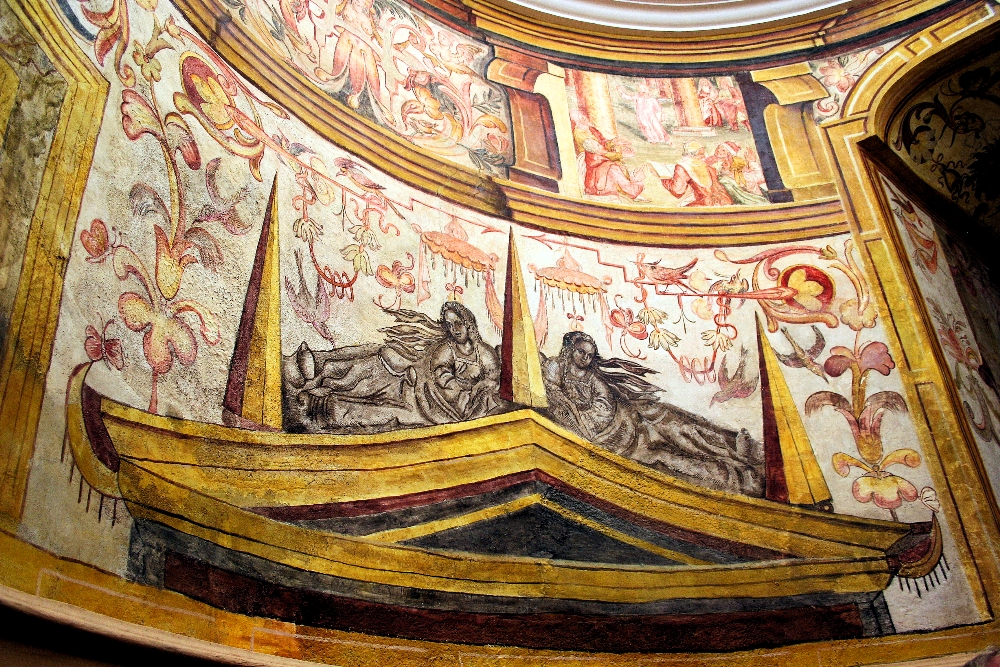
Peek inside the private chapel of the Carvajal palace, now the Cáceres Tourism and Handicrafts Office, for hand-painted images from the Renaissance. Betsa Marsh photo.
Don’t miss the palace’s Renaissance garden, with inviting benches to pause and admire a monumental 1,000-year-old fig tree. But the palace’s real secret wonder is tucked behind a curved door just off the tourism reception desk.
Cross the threshold and suddenly you’re a house guest of the Carvajal family, invited into their private chapel in the base of the 12th-century Arab round tower. An Italian painter created four scenes from the life of Christ, ringing the upper walls of this tiny, round room with vibrant imagery. The restored faces beam down beatifically.
Zooming between centuries like this is hungry work, and chefs across Cáceres stand ready to fortify diners from around the world. They work with a rich pantry of Extremaduran specialties, many of which have Protected Designation of Origin (PDO) status, including Iberian ham, honey, olive oil, cheeses, veal, wine, cherries and the distinctive smoked peppers that become Pimentón de la Vera, the spice in many a Spanish dish. This bounty helped crown Cáceres the Culinary Capital of Spain 2015.
The city’s heritage cookbooks overflow with recipes from the cuisines of the Romans, Arabs, Jews and Christians. Look for large, plump Roman gold mushrooms shaved into super-thin slices for carpaccio, topped with foie gras and olive oil.
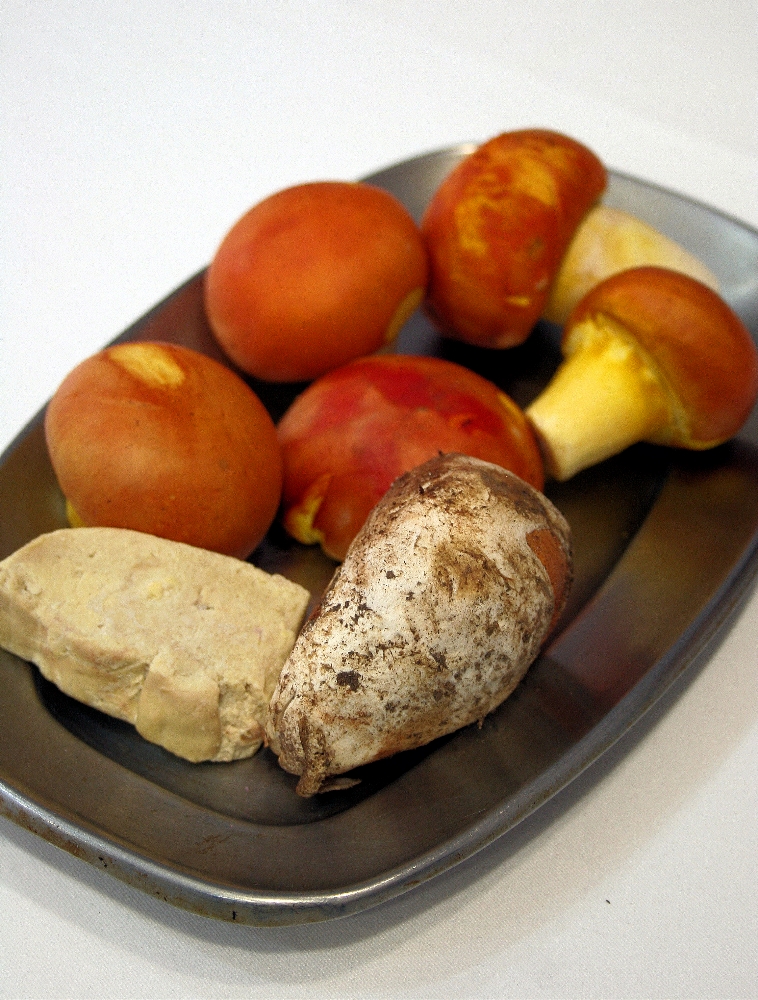
Roman gold mushrooms have been favorites in Cáceres for millennia. Betsa Marsh photo.
Next, adventurers might try local wild boar over an Extremaduran salad of roasted peppers and onions. Plus partridge with a chocolate meat sauce.
For dessert, thrifty home cooks and chefs alike are wizards at whipping up an Arab treat from deep in Cáceres’ history. During difficult times, people used what they had, creating little fried repapalos. For a taste of the past, today’s cooks soak crust-less bread in milk and cinnamon, then form the bread into balls for frying. The perfect topper? Another healthy dash of cinnamon and vanilla ice cream from a local churn.
Hungry for more? Explore Pintxos in Spain’s Basque country.
Leading the city’s gourmet surge, elegant Atrio offers a tranquil hideaway from the rush of central Cáceres. The Relais and Chateau inn, with three Michelin stars, is tucked behind a Renaissance stone façade off Plaza San Mateo.
Co-owners Jose Antonio Polo and Grand Chef Toño Perez have transformed the medieval mansion into an ultra-sleek retreat, showcasing their personal art collection. Passages, rooms and vistas are muted in grays and creams, and a sense of quiet descends to shut out the busy tourist center.
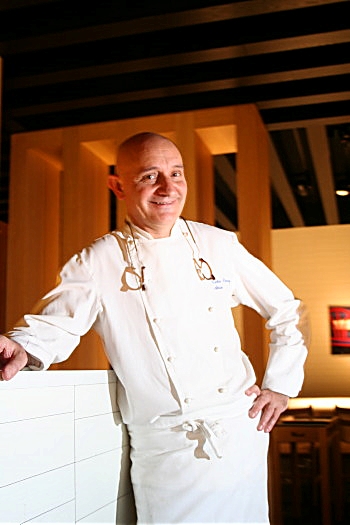
Toño Perez, Grand Chef of Michelin three-star Atrio. Betsa Marsh photo.
Atrio’s menu is an exercise in refinement, showcasing traditional Extremaduran ingredients such as Iberian pork and Torta del Casar sheep cheese. Dinner may begin with tuna belly with red lard and caviar, then the invention continues with a Thai spin, glazed lobster with pork sauce, green curry and lemongrass. And how to choose a dessert? Let’s nibble on two, Iberian chocolate with coffee and aged ham, and Atrio’s famous finale, “The cherry, which is not a cherry.” How delightful to be fooled by your food.
All of this is accompanied, of course, by wines from the cellar that has won the Wine Spectator Grand Award yet again in 2023. The collection sparkles with more than 20,000 bottles from global vineyards, including one of the most historic collections of Chateau Y’quem sauterne in the world.
At Atrio, as in so much of Cáceres, heritage and tradition matter. Cáceres’ people remain proud of their city of palaces, once too impoverished to remodel, now too perfect to touch.
When You Go:
More information on Cáceres, visit this website. And for more information on visiting Spain, click here.
You can also use our affiliate links to plan your trip with Expedia and Hotels.com. Going through these links will not change your search experience, nor pricing. It may, however, provide a small commission to RealFoodTraveler.com which we use to maintain the site.
-Story and photos by Betsa Marsh








0 Comments