





At RealFoodTraveler.com, we can always count on writer Edward Placidi to return from his far-reaching travels with delicious tales of the local cuisine. This article is no exception with Edward having visited the country of Moldova, sharing what we can expect from the Moldovan food and drink experience.
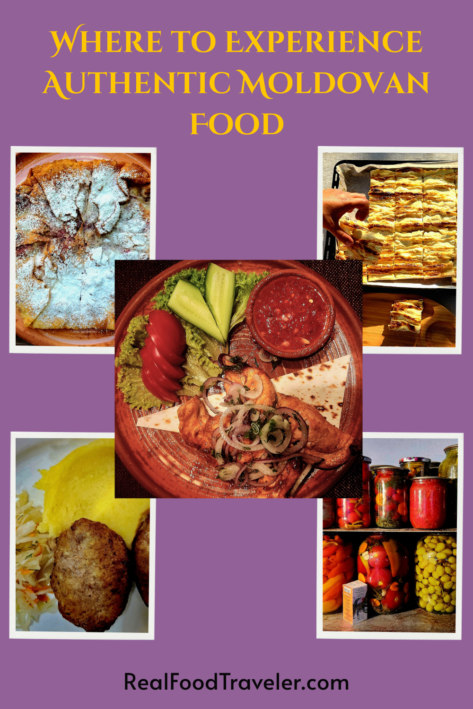
Save this article to Pinterest to help you plan your own journey into the traditional food of Moldova. Photos by Edward Placidi. Graphic by RealFoodTraveler.com.
Where to Experience Authentic Moldovan Food
Sizzling meats, showers of dill, tomato and cucumber salads, hearty stews and soups – Moldovan cuisine was so deeply familiar to me.
I’ve sampled it many times over the years – in other countries, across a wide swath of real estate spanning many regions and two continents.
From East Europe to the Caucasus to the Stans of Central Asia, the tables are set with surprisingly alike foods, menus and preparations. There are local variations and preferences of course, along with dishes that are unique to a country or region. But a culinary foundation and emphasis is shared across thousands of miles.
Unknown, landlocked, isolated in a remote corner of East Europe, tiny Moldova with less than three million people is the continent’s anomaly. It is Europe’s least visited country. Life is slower and more traditional here. And it remains largely undeveloped with a predominantly agricultural economy.
All of this has resulted in a culinary scene where time-honored foods, dishes and practices continue to reign supreme. The Moldovans can’t get enough of their stuffed, flaky plăcintă pies, continue to pickle vegetables and store them in cellars for winter eating, and make their own homemade wine.
Hungry for more? Read Ed’s article about discovering the food of Central Asia.
Discovering the Best Restaurants in Chisinau, Moldova
The capital, Chisinau, stands out from the rest of the nation. The dining picture is expanding there, mostly in Chisinau’s compact central area, with ethnic and fusion restaurants, coffee houses and wine bars, along with fast-food pizza and kebab joints. Traditional menus, however, remain the most popular, in Chisinau as well as across the country.
Some of the culinary standards that transcend geography are dill, shaskliki (or other spelling variations), beef broths and baked flatbreads.
Dill is not only a very popular herb in Moldova and in the countries to the east. It’s an obsession, a foundational ingredient. It is tossed onto almost anything, from soups and stews to salads. Moldova even has one of its iconic plăcintă pies that features dill.
Herring salad is a classic Moldovan dish, channeling similar versions elsewhere in East Europe. The herring salad I ordered at Vatra Restaurant in Chisinau, with new potatoes and red onion, was so heavily topped with dill that the herb vied to overwhelm the taste of the fish.
When I sat down to Veal Shashliki (essentially shish kebab) at Back in the USSR restaurant it felt like I was having dinner at the home of a Russian babushka. I was actually in Transnistria, which fought a civil war with Moldova in 1991 to remain Russia-aligned and ended up an autonomous Moldovan republic where the USSR seemingly lives on. But I could have been in Uzbekistan.
From Chisinau to Tashkent, sizzling meats are a huge favorite that are very simply grilled and always served with a mound of very-thin-sliced white onions, typically with a tomato, cucumber and dill salad, and usually a tomato-based dipping sauce. In Moldova, the sauce is called agica, and is usually slightly picante, sometimes a little hotter.
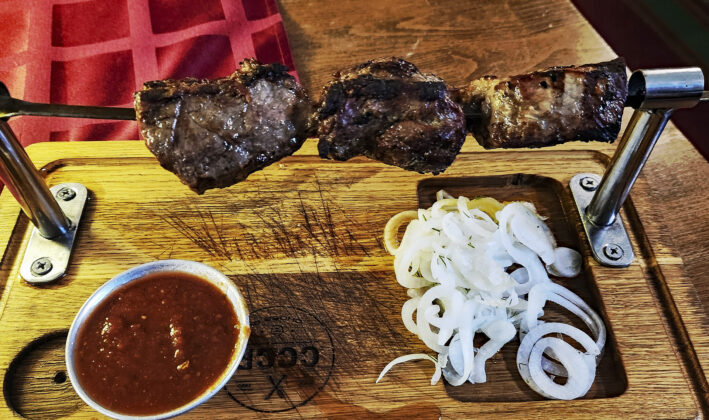
Shashliki is one of the traditional foods in Moldova. This version is served at Back in the USSR restaurant, with sliced onion and agica sauce.
Slurping up a traditional and hearty Zeamā soup at stylish Vatra Restaurant in Chisinau, I had a sense of culinary déjà vu. I’ve enjoyed the simple and familiar mix of ingredients, or a variation of ‒ beef broth, noodles, shredded carrots, onions, chicken or beef and of course lots of dill ‒ in many nations.
A local baked flatbread, often dotted with various seeds, generally comes with your meal in these parts of the world. But this is where Moldova breaks the mold. The flatbread here is a completely different animal.
La Plăcinte, a Moldovan restaurant chain with multiple locations in Chisinau, is beloved for its expansive menu of hearty Moldovan dishes. The chain particularly specializes in their namesake, the Moldovan plăcintă, an ubiquitous flatbread that is the country’s culinary icon. The plăcintă is rustic, usually round like a pizza and flaky like a phyllo pastry and stuffed with a wide variety of fillings such as mincemeats, potatoes and bacon, cheese or vegetables.
I sampled several varieties of this tasty, filling comfort food, at La Plăcinte and elsewhere, discovering that the true standout is the sweet version.
At Vila Etnica restaurant in Butuceni village, steps from the country’s most important religious pilgrimage site of Urheuil Vechi, the cherry-filled plăcintă, heavily dusted with powdered sugar, was a heavenly experience. A little crunchy, a little flaky, a little doughy, with a burst of cherry sweetness, it’s a candidate for my favorite food in Moldova.
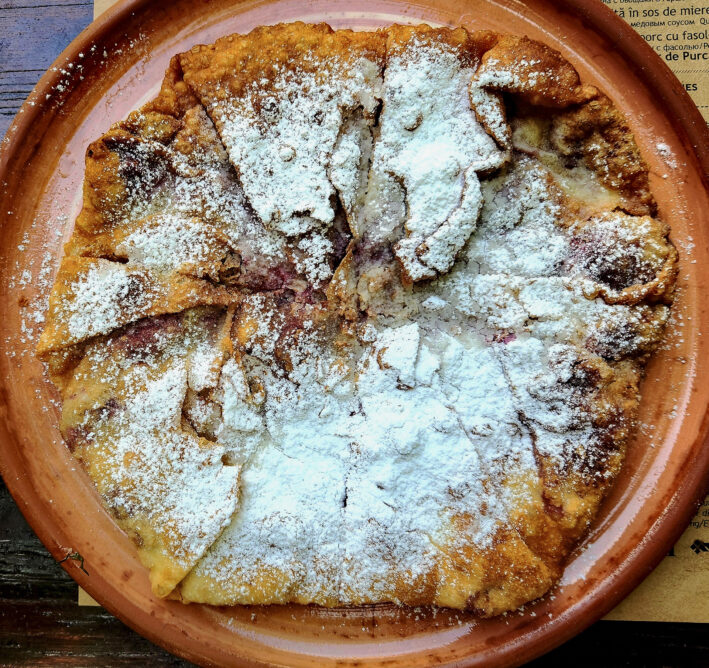
The mouth-watering cherry version of the traditional plăcintă pie is dusted with powdered sugar.
Hungry for more? Read Ed’s article about discovering the foods of Djibouti, Africa.
Discovering Wine in Moldova
Moldova’s most deep-rooted culinary tradition, going back millennia, is its wine industry. The country is an oenophile’s dream world – with 100+ wineries, unique varietals, high quality yet inexpensive wines to enjoy, and more vineyard area and density per capita than any other country.
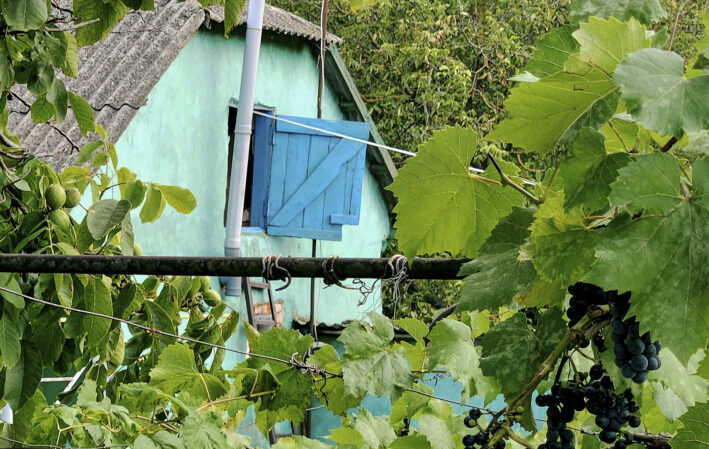
Moldova is an oenophile’s dream with 100 wineries, unique varietals and high-quality, yet inexpensive wines to enjoy.
Moldova’s largest winery (one of the largest anywhere) is Milestii Mici, which boasts the Guinness World Record for most bottles in storage; the award was recorded in 2005 for 1.5 million bottles, but the total has since grown to more than 2 million. The oldest bottles date to 1968; all are for sale, except of course the stashes of the serious wine collectors who keep their hoards there.
On a tour and wine tasting at Milestii Mici, I whirled through a maze of cold underground tunnels (about 40F) aboard an open-air electric cart, passing areas of huge wooden barrels and steel storage tanks, and walked amid numerous vaults filled with stacked bottles shrouded in dust. The scope of the winery is a stunner: some 120 miles of tunnels (though only a portion are currently in storage use) descending several hundred feet down. For a true wine lover, it’s like finding buried treasure.
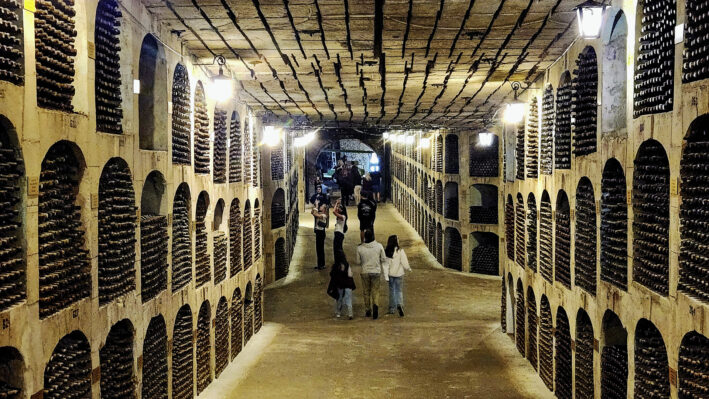
Milestii Michi winery holds the Guinness World Record for most stored bottles.
A host of wineries around the country ‒ from Moldova’s other giant winery, Cricova, to modest ones like the Winery at Comrat ‒ offer tours, tastings, restaurants and, for those who want to immerse deeper into the vineyard life, overnight accommodations.
Hungry for more? Read about the fermenting pots of Georgian wine.
Eating Traditional Food in Moldova, With the Locals
I felt I truly dived into Moldovan food when I visited Max and Vera in the small community of Ceadir-Lunga, in the autonomous province of Gagauzia where some farm houses are still topped by medieval-style thatched roofs. Max and Vera introduced me to the typical culinary life of a Moldovan. The couple works with guides to offer visitors a personal taste of this little-known land. They taught me how to make the kyvirma, the Gagauzian version of the plăcintă. It was simple to prepare.
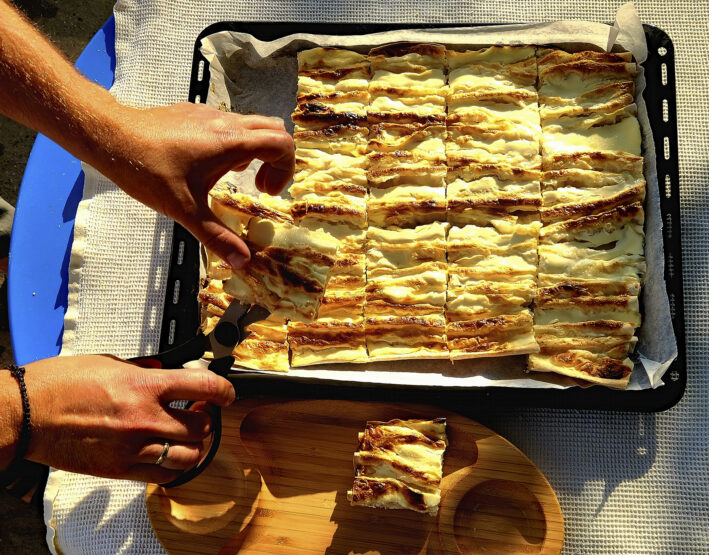
The Kyvirma is the Gaguazian region’s version of Moldova’s ubiquitous plăcintă pie.
At one time they made their own very thin, large, lavosh-like flatbread, but now in somewhat-more modern Moldova they buy it. I was instructed to spread out the flatbread and fold it over from one end to the half-way point, then sprinkle the single-layer half with a generous combination of cottage cheese and goat cheese. Then, pull the double bread layer over the cheese, squash it flat, and scrunch into an accordion-like series of folds. Next, in a small bowl I blended equal amounts of plain kefir and sour cream with two eggs, pouring the mixture first into the folds and then all over the top. Then we baked it at about 350F for 45 minutes.
It was a bit crunchy and flaky, with the consistency of the filling almost like a cheese custard. The very cheesy treat was not a true wow factor but very enjoyable.
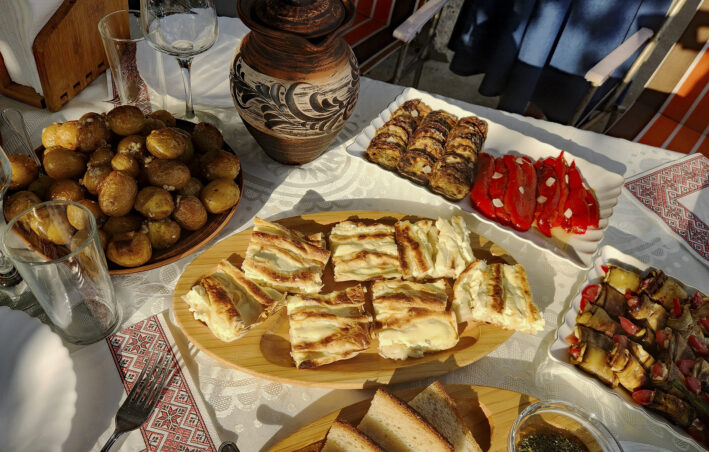
Max and Vera served me an array of common Moldovan foods at their home.
Along with the kyvirma, Max and Vera served an array of common Moldovan foods people eat at home such as grilled vegetables, potatoes with garlic, eggplant slices rolled with tomatoes, aged sheep’s, goat and cottage cheeses, a variety of fruits, and a traditional drink made from fruit compote. Typical of Moldova, everything was homemade and homegrown ‒ by them, neighbors or other locals. The topper was homemade wine ‒ “Everyone makes their own wine,” Max assured me ‒ that was a bit fizzy, a touch fruity, but a very drinkable rosé made from grapes growing in their garden.
Max and Vera took me to neighbors’ houses to see their verdant vegetable gardens and all-important cellars. Moldovans pickle everything, particularly the abundant summer tomatoes. Traditionally, their cellars were a lifeline to survival in the winter months, and they maintain the custom, filling them with numerous jars of pickled vegetables, homemade wine and more.
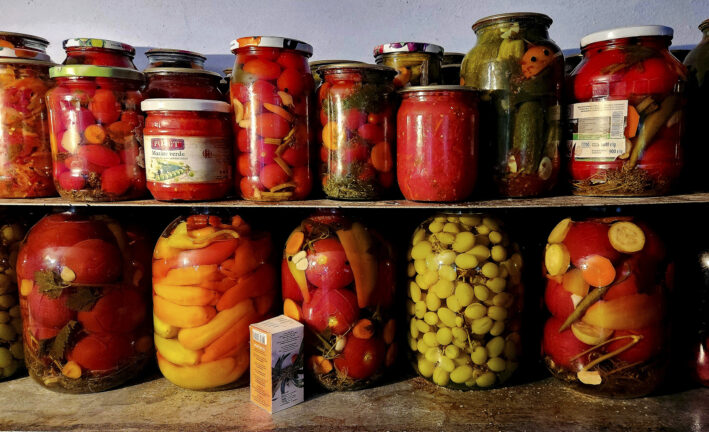
The cellar of a typical Moldovan home is filled with pickled vegetables for the winter.
MOLDOVA’S SPIRIT
Moldova is small enough that most of the most popular sights can be seen on day trips from the capital, while enjoying evenings in the city at the legacy restaurants where traditional cuisine reaches a zenith and is served with time-honored Old World music.
Classic acoustic quartets fill the evenings with lilting, rich folkloric sounds in the top traditional-cuisine restaurants of Chisinau. The ensembles combine historic instruments: a violin, an accordion, a nai (a pan flute deeply rooted in Moldovan folklore), and a cimbalom (a dulcimer played with mallets that is a cornerstone of Moldovan folk music). To appeal to a broader audience, the quartets often spice their repertoire of archetypal songs with some modern tunes.
The timeless music can be heard at such restaurants as lively Acasa la Mama (Mama’s House), with a large wooden deck and decorated with colorful Moldovan artisan weavings; classy Vatra Restaurant, where typical dishes are seasoned with a modern take; and La Taifas, chic and expensive (for Moldova that is, which is surprisingly inexpensive).
My last night in Moldova, I was finishing dinner at La Taifas, musing on all the foods I’d tried.
Among them pirjoale, ground-meat patties combining chicken with pork or beef, pan fried until crisp outside and tender in middle, served with pickled vegetables; Salmati Moldovenisti, the Moldovan stuffed cabbage rolls filled with minced pork, rice and vegetables reminiscent of delicate pot stickers; the side of sour cream that accompanied seemingly every dish; and the traditional compote drinks, made from boiling and reducing berries mixed with a little sugar.
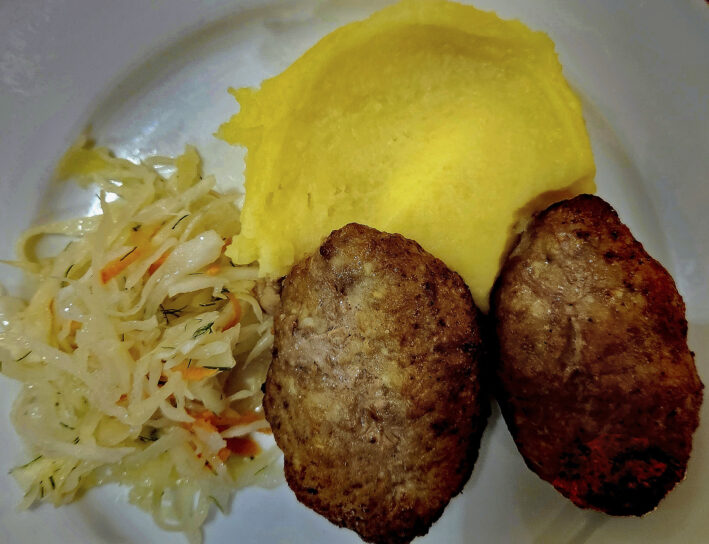
Pirjoale are ground meat patties combineing chicken with pork or beef, pan-fried and served with pickled vegetables.
My sojourn in Moldova was ending perfectly, sipping my favorite Moldovan wine ‒ a delectable Rara-Neagra, an indigenous grape that delivers full bodied, ruby colored, velvety wines with hints of pomegranate ‒ and digging into a luscious, alcohol-infused classic Moldovan dessert, Prune Uscate cu Nuci, the prunes soaked in brandy, stuffed with walnuts and combined with vanilla ice cream.
If You Go:
– The lack of English speakers can make ordering difficult. There is a lifeline, however: many Chisinau restaurants provide a QR code so the menu can be pulled up in English.
– The more popular restaurants in Chisinau, particularly the top traditional establishments, fill up fast for dinner, especially on weekends, so reservations are recommended.
– The Moldovans, proud of their wine-making culture going back thousands of years, celebrate with a huge annual wine festival in October. The National Wine Day of Moldova is a great time to visit, but be sure to make hotel reservations well in advance.
To learn more about visiting Moldova, check out their tourism website.
-Story and photos by Edward Placidi
Use our RealFoodTraveler.com affiliate links for your favorite booking tools to plan your visit to Moldova.
Please note: This site uses an affiliate tool provided by the third-party provider Stay22. If you use certain affiliate links to make a booking or take advantage of an offer, the site may receive an affiliate commission from this third-party provider. To determine whether you have used any of the affiliate solutions, the third-party provider will use cookies to attribute commission. These cookies will be removed as soon as they have served this purpose.






0 Comments