











When it comes to tasting the authentic cuisine of Italy, Puglia is a place travelers should put on their list. With a deep appreciation for what the land provides them, the people of Puglia make the most of the bounty in varied and delicious ways. Writer Ed Placidi tells us, and shows us, what we can expect to find, and where we should go to experience, the best of food in Puglia.

Save this article about authentic food of Puglia, Italy to Pinterest so you’ll know what to order when you go. Top right, Insalatone with Tuna; bottom right, Focaccia from Panificio Fiore; left, sunset over the Ionian with Aperol Spritzes, bruschetta and other snacks.
Hungry for more? Ed reveals the iconic ingredients of Sicily.
Authentic Food in Puglia: Deep Connection to the Land Fires Puglia’s Mouthwatering Cuisine
Puglia has assumed a semi-legendary travel status in recent years. Occupying the iconic heel of the Italian boot, the province has become a hot destination talked about in superlatives for its ancient towns with labyrinth historic centers, dramatic coastline, endless olive tree groves, hospitable locals, and, especially, its mouthwatering cuisine.
Some go so far as to say Apulia (as the Italians spell it) has the country’s best food. On a recent 10-day driving trip in Puglia, from town to port we indulged in a wide-ranging array of favorite dishes, beloved street foods and iconic ingredients, savoring a region that, undoubtedly, serves up some of Italy’s tastiest tidbits.
The people of Puglia have a soul-deep identification with the land. People frequently told me about the foods of their area, taking great pride in their local products. Indeed, Puglia is a breadbasket of Italy, producing more olive oil, wine and durum wheat than any other region. The meals you eat in Puglia are entirely locally caught, grown and sourced – from the fresh flavorful fruits and vegetables, famed artisanal cheeses and cured meats, and internationally acclaimed flour for bread, pasta and pastries, to the abundance of fresh seafood from the Ionian and Adriatic seas that wash Puglia’s more than 500 miles of coastline.
The women are out each morning, laboring at tables in narrow lanes in Bari’s old town, nimbly popping out – cutting from a thin roll of dough and forming each piece in seemingly a fraction of a second ‒ the favorite and iconic pasta of the region, the orecchiette, or little ears. Large trays of pale yellow, red (tomato) and green (spinach) orecchiette are drying on the tables.

The women in Bari’s old town can be seen each morning, forming iconic pasta, orecchiette, which means “little ears.”
When I ordered Orecchiette al Pomodoro for dinner at La Baresana, a popular Bari street eatery, they asked if I wanted cheese. It came absolutely smothered in grated cacioricotta, Puglia’s version of fresh ricotta. The orecchiette were thick and chewy, imbued with the earthy flavor of Puglian flour, juiciness of vine-ripened tomatoes, and luscious creaminess of melted cacioricotta. The full, intense, delicious pasta experience set the tone for the food journey to come.
In whitewashed Ostuni, the “White City” nestled on a high promontory, a popular street food for lunch was one of the most delicious meals of the trip, while enjoying green panoramas to the blue Adriatic. Friselle, or just frise, are double-baked rusk bread topped with meats, cheeses or seafood and condiments. Frise Rustico with marinated cherry tomatoes and artichokes, tuna and capers was a burst of umami heaven. The proprietor of Avenida 40 Café revealed the secret: “The bread is a hard and dry rusk, so to give it a soft and pleasing consistency we wet it with water and olive oil, or milk or beer, depending on what we put on the frise.”
Hungry for more? Click to start planning your own trip to Puglia.
Surrounded by seas, Puglia is swimming in fresh seafood, with grilling the favorite preparation. Puglians have a special love for grilled octopus – it’s on virtually every menu ‒ and for pastas with delicacies from the water. At the southernmost point of Italy’s heel, Santa Maria de Leuca, the Pasta Fresca with Frutti di Mare ‒ at romantic Albachiara Restaurant on a deck over the water where the Ionian and Adriatic meet ‒was a brief sojourn in scrumptious abundance.
Two types of fresh pastas, orecchiette and double-pointed spears called minchiareddhi, were bathed in a luscious fresh tomato-based sauce and topped with seemingly a net full of perfectly grilled calamari, mussels, clams, shrimp, langoustine and octopus. The Insalatone (Giant Salad), with tuna, corn, mozzarella, cherry tomatoes, arugula and radicchio, was just as lip-smacking. And paired with a refreshing local white frizzante wine, it was a culinary moment we relive every day.

Right, Fruitti di Mare seafood pasta; bottom left, Braciole at Taverna del Duca in Locorotondo; top left, Frise Rustico are all food in Puglia you’ll want to try.
Meats are less widespread, but they make some brilliant appearances: The Braciole at Taverna del Duca in charming Locorotondo – pounded veal flank steak rolled with olive oil, garlic, black pepper, pecorino romano and parsley, then sautéed in olive oil with onions and slow-roasted five hours with tomatoes ‒ melted in my mouth with an intense richness. Cured meats, however, are everywhere, notably on the popular charcuterie and cheese boards. As with all ingredients in Puglia, everything is locally produced and superb quality, from capocollo and mortadella to beloved local cheeses like sweet and delicate caciocavallo, creamy straciatella and, of course, Puglia’s most prized homegrown cheese: rich and buttery burrata. You choose what’s included on the board, with the price based on weight. Some restaurants serve nothing else.
The owner of one of these specialty restaurants, in the World Heritage Site of Alberobello known for its unique cone-topped houses, told me: “We have a long tradition of making our own foods locally, and restaurants like ours make it possible for people to try many of these artisanal creations.” Our board was a rich, savory feast ‒ more than we could eat ‒ of marinated cipolline onions and artichokes, olives, roasted fava beans, burrata, wine-cured cheese, pouches of mozzarella, caciocavallo fresco, capocollo, prosciutto cotto and salame piccante.

Popular meat and cheese boards feature locally-made, artisanal products.
Speaking of artisanal excellence, the bakers of Puglia are at the top of their game. Italy’s most famous bread – and the only bread in the world awarded PDO status (Protected Designation of Origin) ‒ is baked in Altamura, a Baroque hilltop town with the chic-shabby look of faded grandeur. But its bakeries’ wood-burning ovens and extraordinary double-milled durum wheat flour turn a simple dough (just flour, water, local salt, yeast) into a magical food. At Panificio del Duomo, a loaf hot from the fire was irresistible with a slightly charred crust and lightly chewy richness inside (we also couldn’t resist the many other treats made from the flour, from fresh strawberry macaroons to mini round sponge cakes).
Hungry for more? Read Ed’s account of the food of Sri Lanka.
Panificio Fiore in Bari is an institution that raises focaccia to an art form. A bakery since 1508, it found fame more recently when proprietor Antonio Fiore was crowned Italy’s “King of Focaccia.” Long lines form every morning for slices straight from the oven: the well-done crust is crunchy along the edges, the cherry tomatoes blistered, the caciocavallo and mozzarella bubbling and browned, olives and oregano strewn atop ‒ a divine riot of complementing flavors in your mouth.
No day of enjoying the food in Puglia is complete without a pasticiotto. For breakfast, a snack or anytime, Puglians have had a love affair with the small oval pastries usually topped with powdered sugar since the 1700s. Short-crust pastry dough, typically stuffed with custard or fruit preserve, is brushed with an egg wash and baked until golden brown. While everyone has their favorite filling, jam of amarena, a small local sour cherry, may take the cake.

Top right, bread from Altamura; bottom right, Ciceri Tria pasta with chickpeas, tomatoes, rosemary and croutons; left, Pasticiotto di Amarena (cherry tarts).
Gallipoli, a storied island fortress connected to the mainland by a causeway, is among Puglia’s most engaging, friendly and fun destinations. In the evening visitors and locals flood the medina-like maze of alleyways and lanes within the high bastions, strolling, shopping and enjoying the dozens of small restaurants. This is a place for aperitifs ‒ served with olives, bruschetta and Puglia’s ubiquitous taralli, bagel-like but tiny and salty crisp bread snacks ‒ at bars along the walls while enjoying glorious sunsets over the Ionian. And also to sample Ciceri Tria, a cherished traditional dish of the Salento, the southernmost portion of Puglia, and a classic example of Cucina Povera, the simple kitchen of Italy’s historically poorer south that uses only inexpensive, readily-available ingredients. The modest meals were so skillfully prepared with natural, high-quality foods that today the dishes are feted.
Hungry for more? Our Europe Editor tells you where to go and stay when in Puglia.
Extra-wide, flat, fresh noodles are cut into bite-size pieces and mixed in a stew of chick peas, tomatoes, rosemary, fried-dough croutons and, a la Cucina Povera, just little bits of fish. The waiter at Ristró Restaurant told us Ciceri Tria was a favorite growing up and still is, but he wasn’t sure non-Gallipolians would like it. Oh, was he wrong. The owner of B&B Corte Casole enthused, “It’s truly Gallipolian, homey and familiar, a dish we can’t do without.” Indeed, it was so delicious that it’s not difficult to see why some aficionados believe Puglia has the best food anywhere in the boot.
At the very least, Puglia has some unsurpassed pasta dishes and street food – making it an indisputable star in the culinary heaven that is Italy. I still dream about the ultra-savory flavors of Sphagatone Cacio e Pepe at Ragno d’Oro (Golden Spider) in Giavanozzo: triple-thick spaghetti with creamy caciocavallo, cracked pepper corns and cured pork cheek ‒ with a preamble of crusty Altamura bread savored with a trio of olive oils channeling a Clint Eastwood spaghetti Western: mild Buona (good), peppery Cattivo (bad), and sharp Brutto (ugly).
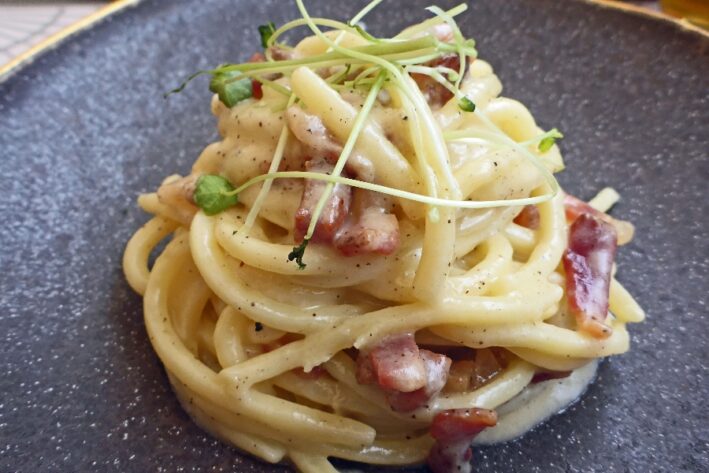
Ultra savory Sphagatone Cacio e Pepe at the Ragno d’Oro in Giovanozzo.
-Story and Photos by Edward Placidi. Graphics designed by RealFoodTraveler.com.
Learn even more about Puglia on the official website. And plan your trip there with this TripAdvisor affiliate link.
Please note: RealFoodTraveler.com is a member of AWIN, an affiliate marketing organization that pairs publishers with advertisers whose content matches the needs of the readers. Affiliate marketing programs are designed to provide a means for sites to earn a small amount of advertising fees by linking to their advertisers while providing convenience for the reader.





0 Comments