











It’s amazing what a little wandering can lead to. We welcome writer Gloria McDonough-Taub to RealFoodTraveler.com with this vivid account of a perfect day she spent in Guanajuato, Mexico, from simple bread purchases, to monumental statues overseeing all.

Guanajuato’s hillsides are full of houses that are an explosion of color.
The start of a perfect day in Guanajuato
Church bells ringing in the distance awaken me. As I lie in bed, I hear a few local dogs have joined in, providing a blustery bass for this opus to a Mexican morning.
I am in Guanajuato, a colonial city in the mountains of central Mexico. Often called the most beautiful city in Mexico, I’m here to see if it can live up to such a grandiose title.
The first thing anyone will notice when you get here are the colors. The houses that populate Guanajuato’s hillsides are an explosion of color – all shades and hues of cotton candy – fuchsia pink mingles with cherry red, saffron yellow, baby blue, sit alongside lime green – no boring “builder’s beige” resides here.
Cradled in the north-central highlands of Mexico, about 200 miles from Mexico City, and founded in 1559, Guanajuato was once one of the hemisphere’s richest silver mining towns. One of the mines, La Valenciana, accounted for two-thirds of the world’s silver production at the height of its production. It was the country’s second richest city only after Mexico City, for much of the colonial period. Perhaps one of the most opulent towns in New Spain in the 18th century, Guanajuato’s lush history is still alive and well – and on full display today.
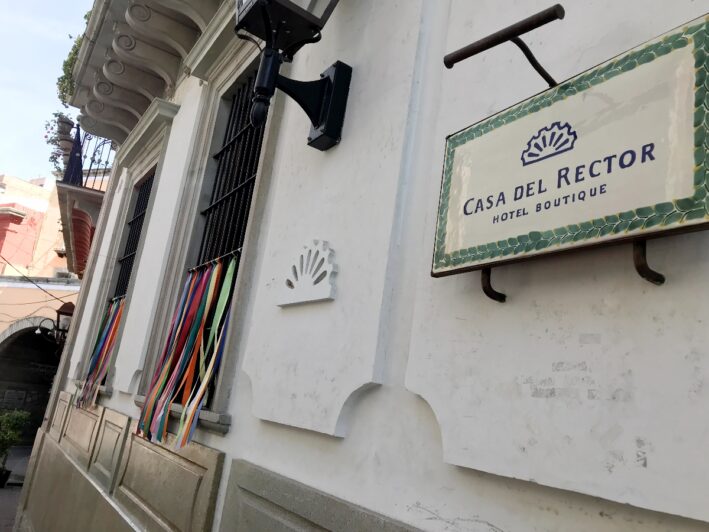
Once a home to Guanajuato’s wealthy families, Casa del Rector is now a boutique hotel and home to works by great contemporary Mexican artists.
I’m staying at Casa del Rector in the heart of old Guanajuato. It’s a stunning boutique hotel filled with art works by great contemporary Mexican artists. As much as I want to linger in the hallways and study the garden sculptures, I am drawn outside to the cobblestone streets by the smell of fresh bread.
I follow a man who is balancing a large basket of freshly baked goods on his head. His pace is quick as he leads me further up a hill, walking towards the rising sun and it offers some warmth on this chilly spring morning. Locals wear sweaters or fleeces to ward of the morning chill. Walking quickly past me are dozens of fathers each holding the hands of their small children, making their morning commute to school.

Armed with the day’s freshly baked bread, this delivery man makes his way through Guanajuato’s streets.
College kids armed with backpacks and T-bars rush by and scale the University of Guanajuato’s famous outdoor staircase – 113 steps that lead to the main building. Founded in 1732 by the Jesuits, it is one of the oldest universities in Latin America and is now home to some 20,000 students who bring their youthful vibrancy and a cultural sophistication to this city.
Winding through narrow alleys, I try to keep up with the bread man. His pace only slows as we enter a colorful square. Bordered by colorful homes painted in rich jewel tones, the delivery man finds his spot on the outer corner of the square. There he dumps his goods into bigger baskets where fathers, mothers, waiters, and commuters are waiting to buy the day’s fresh goods. I too grab a fresh conch de vanilla, pay 25 pesos, and set off to discover more.

Locals and tourists gather in a town square to buy the day’s freshly baked goods.
Guanajuato is a hilly town and I head upwards through the majestic colonial buildings. There are so many attractions vying for my attention – but what I notice right away are the warm welcomes I receive from the locals. Residents offer me a cheery, “Buenos Dias” and pause so as not to block me as I take my photographs, some even point out where to stand to get the best light.
Here in this historic university town, a professor can’t pass up a teaching opportunity. He stops and tells me to point my camera upward, showing me what I missed – a Madonna frieze high above the building’s enormous doorway. A tip of the hat and off he goes, knowing he’s furthered a stranger’s education of his beloved city.
The winding alleys take me past the palatial residences of the silver barons, and over a maze of stone tunnels through which the Guanajuato River once flowed. Now the tunnels are used by cars, taxis and trucks to bypass the narrow and dizzying alleyways.
I find myself facing a rock cliff and there at its bottom is a life-size statue of Don Quixote and Sancho Panza. The city has a Cervantes obsession, and is home each October to the International Cervantino Festival.

A statue of Don Quixote and his loyal sidekick Sancho Panza, sit at the bottom of a rock cliff at Plaza Allende.
Church bells again sound and I head downhill to see the Teatro Juárez, which was built starting in 1873. Next to it stands the even older Iglesia de San Diego church. Constructed in 1870 out of red sandstone, the church has a slight pink appearance.
Across the street is the Jardin de la Union, a popular gathering place. Indian laurel trees have been trimmed to create a dense canopy shading benches and those who sit in high chairs while shoe shiners dust off the dirt and polish their client’s shoes to a blinding shine. Surrounding the square are bars and restaurants offering outside seating for a prime location for people watching.

Neatly trimmed Indian laurel trees surround Guanajuato’s Jardin de la Union.
I make my way to the heart of the city, Plaza de la Paz (Plaza of Peace). The star of the square is the Collegiate Basilica of Our Lady of Guanajuato or el Basílica Colegiata de Nuestra Señora de Guanajuato built between 1671 and 1696. This was the city’s first parish church and can be easily recognized by its bright yellow and red colors. Inside is the statue, Our Lady of Guanajuato, an ancient sculpture made of wood of the Virgin and Child. “Nuestra Señora de Guanajuato” is the oldest sculpture of the Virgin coming to America. It was carved in Andalusia by an anonymous artist and its history dates back to the conquest of Spain by the Arabs, in the year 714, when they took Granada, Spain.
In front of the church is the plaque naming the center of Guanajuato a World Heritage Site.
Breakfast on a perfect day in Guanajuato
I decide to sit here to soak up the sun, scenery, history, and to have a full proper Mexican breakfast of freshly squeezed orange juice, coffee, and chilaquiles con salsa verde (rojo lovers be damned)!

Today’s breakfast is a feast of freshly squeezed orange juice, coffee, and chiliquese con salsa verde.
The city is still awakening as I savor my meal. Vintage-looking busses stop at the square to allow workers to hop on or off.
I listen to a guitar player belt out golden oldies hoping to earn some cash to help make ends meet, and I read up on the area’s history.
I spent most of my childhood growing up in Colorado where we always shared a great fondness and respect for friends whose names were Montoya or Rodriguez – even the name, “Colorado” is Spanish – yet I knew very little about Mexico until I retired in this country.
In addition to its mining past, Guanajuato was the site of the first battle of the Mexican War of Independence in the 18th century.
In another war, World War II, Guanajuato offered safety, hope and a new home to more than 2,000 Polish refugees including 1,400 Polish orphans, fleeing persecution from the Nazis.
So much history, so many flavors, so many calories – I gotta get up and move in Guanajuato
I head back to my hotel and pick up my husband so we can discover more. It’s only 10 am and I need to drop off my sweater. The sun here is strong and hot.
Just four houses down from our hotel is the Museo Casa Diego Rivera the house where Mexico’s famous mural artist, Diego Rivera, was born. You’ll need to go to Mexico City to see Rivera’s famous murals, but here in this house, you can see the where he spent his early childhood. The first floor is dedicated to furniture. The floors above contain a large collection of paintings, about 100 of which are Rivera’s early and little known works.
Next we make our way to Guanajuato’s most famous alley – the Callejón del Beso (Alley of the Kiss). Located on the slopes of the Cerro del Gallo hill, it is only 26 inches wide in places with balconies that nearly touch each other. Folklore has it that couples who kiss on the third step are guaranteed seven years of happiness together.
Pucker up!
Romance is in the air here. Couples walk hand in hand, stopping to look in on local stores and to gaze upon the purple blossoms of the jacaranda trees now in full bloom, adding to an already colorful and magical city.

Mother Nature adds to Guanajuato’s spectacular color when the purple blossoms of the Jacaranda trees are in full bloom.
We make our way to the Funicular and ride up to the top of San Miguel hill. There, high above the city is El Pipila, a 65-foot statue that pays tribute to a hero of the Mexican War of Independence.
At its base, a stunning panoramic view, overlooking Guanajuato City, its brightly painted buildings in every hue, and the surrounding lush mountains.

Greeting the town and visitors atop San Miguel hill is this statue of the local hero, El Pipila
It’s simply a fabulous view! Imagine if Positano and Segovia had a baby, it would be Guanajuato. The colors are something out of a Monet painting – soft, scrumptious, and dreamy.
With the sun beginning to wane, we head back to our hotel for a quick sunset swim and a mezcal cocktail before dinner.
Guanajuato is magical town – full of strangers who become instant new friends – a town where you want to get lost, where you want to find yourself off the grid, a town where 80s music drifts in and out, drowned out only by the hourly ringing of church bells. There are so many lanes and alleyways just waiting to be explored. It’s a treasured jewel of the country and yes, it is indeed, the most beautiful city in Mexico!
— Story and photos by Gloria McDonough-Taub.
Hungry for more? Another RFT writer went exploring in Villa de Bravo. Find out what he discovered in this article. Meet a famous chef in Playa del Carmen. Or, find out how to eat like a local in Guatemala.
Keep this destination at the top of your bucket list. PIN it!










0 Comments