





Every culture has its comfort foods. Writer Sharon Kurtz’s trip to Egypt introduced her to Koshari, the country’s national dish, which she made a point of trying, eating like a local, with the locals, along her journey.

Keep this article about this Egyptian comfort food handy by saving it to Pinterest.
Koshari: A Culinary Treasure in Egypt and the Ultimate Comfort Food
When it comes to Egypt, the first thing that usually comes to mind are the pyramids, the ancient temples, and the Nile River. It’s no surprise that these are the first things you think of with such a rich history. However, another aspect of Egyptian culture is also important to travelers: Egyptian cuisine – and that means Koshari – the National Dish of Egypt.
Koshari is an unlikely mix of ingredients served in every Egyptian restaurant, in every home, and on every street corner. It’s less about one ingredient than the right combination of textures and tastes. Delicious and savory, the idea sounds strange until you taste it. Then you’ll know why this dish is a favorite among Egyptians and visitors alike!
My Pandemic-timed introduction to Koshari
While armchair traveling on my computer in October, my planned trips dashed due to COVID; I was longing to assuage my wanderlust for faraway places. I discovered Egypt had recently reopened its borders to American visitors without a quarantine period, only requiring a Passport, Visa, and a negative COVID PCR test. I couldn’t resist the chance to explore the sights of Egypt without the pre-pandemic crowds. In a flash, I had booked my flight and was winging my way to Cairo to begin a 23-day tour of Egypt with Egyptoria, which arranged a private tour for me complete with an Egyptologist guide, vehicle, and driver.

My driver, Samy, on the left and and my Egyptologist guide, right, Zezo. They were the greatest guys – both family men – Samy spoke very little English, but he would include me when he face-timed his little kids, four under 8 years old! The relationships we form when we travel is one of my favorite parts – I’ll never forget these two!
My constant companions, the driver, and guide were both born and bred Egyptians from Cairo. I told them I wanted to eat as the locals eat – and they both exclaimed – at the same time, we must have “Koshari! “We ended up eating Koshari for lunch three times, twice at the same little Koshari Shop in Giza near my hotel.

Me and the crew from my favorite lunch stop near my hotel in Giza.
Koshari is comfort food
The roster of ingredients seems random, with a base of rice, lentils, and a scoop of plain ‘ol macaroni, and then topped with a spicy tomato sauce that uses a distinctive Middle Eastern spice blend. Next, chickpeas are scattered on top, ending with a substantial shower of crispy fried onions. Here’s a recipe for Koshari from Bon Appetit magazine to try.
Filling and delicious, Koshari is a mix of complex carbs and protein, with a flourish of added acidic notes customized with the addition of hot peppers in chili oil and fresh tomatoes served on the table. A garlicky, vinegary sauce ties it all together, three different cultural influences together in a single bowl.

Koshari is customizable with the various condiments you can add to it.
Hungry for more? Read about a camel-trekking journey in Egypt with Bedouin guides.
Food often defines the culture of a country
Although Koshari is Egypt’s national dish, it isn’t Egyptian in origin, as neither rice nor macaroni is indigenous to Egypt. The dish originated during the mid 19th century, combining Italian, Indian, and Middle Eastern culinary elements; three different countries contributed to this culinary puzzle.
Some say that Koshari evolved from mujaddara, a simple and comforting dish made with rice and lentils, famous throughout the Arab world. Others believe that Koshari originated in India and dates to the time of British Colonization. The name “Koshari” is actually from the Hindu “khichri,” which refers to the lentils and rice dish, that the British brought with them when they arrived in Egypt in the late 1800s. The small pasta is probably an Italian influence, perhaps from Italians working in restaurants who added the pasta and tomato sauce.
A significant amount of Egyptian cuisine is vegetarian due to both the historically high price of meat and the Coptic Christian community’s needs. Religious restrictions require mostly vegan diets for much of the year.
However Koshari came to be, it is a flavorful and satisfying dish, made of pantry staples, the ultimate comfort food. Inexpensive and filling, it didn’t take long before the Egyptian people enthusiastically embraced the dish.
Koshari recommendation with a military escort
The Fayoum Oasis is a basin in the desert area to the west of the Nile south of Cairo. It takes its name from the Coptic word, Phiom, meaning lake or sea. I made the trip to Fayoum to visit the nearby Maidum Pyramid, believed to be the first attempt by the Egyptians to build a pyramid.
Leaving Cairo in the early morning with my guide and driver, the traffic was heavy as we made our way toward Fayoum, as trips within Egypt often require traffic stops at military-type checkpoints. At the first checkpoint, I was surprised to learn that a vehicle with six Tourism and Antiquities Police officers would be my escort on our trip to Fayoum. Arriving in Fayoum nearing lunchtime, it was time for our Koshari fix. My guide approached the men in the escort to ask their recommendation, a few of whom were from Fayoum, and they were happy to escort us to the best Koshari shop in the City.
It was a slightly different preparation from the Koshari in Cairo, but just as delicious. Time for Friday prayers are when the stores typically close, however, the shop owner stayed open for us, welcoming the lunchtime American woman customer, and was happy to pose for photos to mark the occasion.
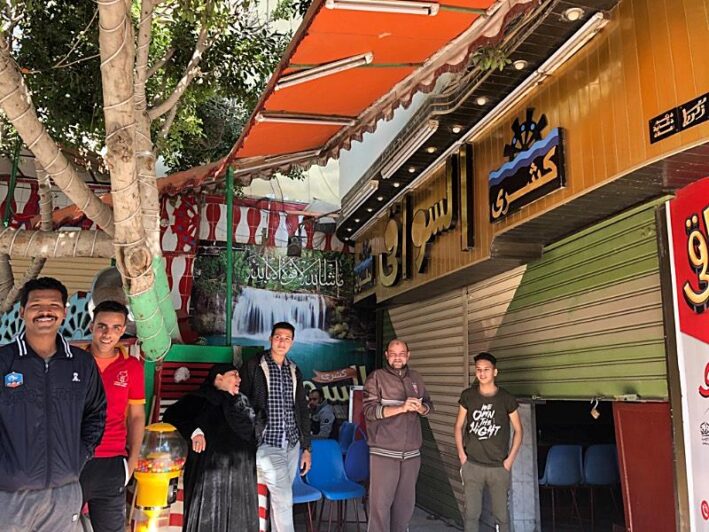
People outside a Koshari shop in Fayoum.
Food becomes a part of travel, even when you least expect it
I took this trip to Egypt without an immediately apparent food focus – more enamored of the history, pharaohs, and temples I would be seeing. But the trip ended up expanding my global palette and introduced me to flavors I would never have experienced otherwise.
Upon returning from my trips, I often attempt to recreate the recipes of the foods that I have discovered in my travels. Luckily, Koshari doesn’t require a hard-and-fast recipe, more an assembly of ingredients that create a mixture of contrasting textures and tastes. No element is more important than another. It incorporates many components, and getting a few pots going on the stove at the same time to cook the starches is most efficient and cuts down on prep time.
The sauce is the component that can make or break it. Start with a jarred marinara-style tomato sauce that you have on hand — ideally something with tomatoes, onion, and garlic, then season the sauce with Harissa. Harissa is a Middle Eastern spice mix that is not the traditional seasoning for Koshari. Still, I found that it contained most of the herbs in the dish, and easier to pour one blend into the sauce than to measure and dispense many different spices.
Traveling somewhere new opens your eyes and your taste buds to a whole new range of authentic flavors — foods that you would’ve otherwise been missing out on. If there is one food that all Egyptians cherish, it’s Koshari — a modern mystery in an ancient cuisine.
To learn more about travel in Egypt, visit this website. And learn more about the Egyptoria tour company on their website.
— Story and photos by Sharon Kurtz
Hungry for more? Make Mujadarra, a similar Middle Eastern lentils and rice dish.

Keep this article about eating like a local in Egypt handy on Pinterest.
Please note: RealFoodTraveler.com is a participant in the Amazon Services LLC Associates Program, an affiliate advertising program designed to provide a means for sites to earn a small amount of advertising fees by linking to Amazon.com while providing convenience for the reader.








0 Comments