











Travel and wine writer, Julie Pegg reminisces about a very special visit to the Umbria region of Italy with a quick, but satisfying stop in Orvieto. Be sure to click through to a delicious pasta recipes she shares from that visit, below.
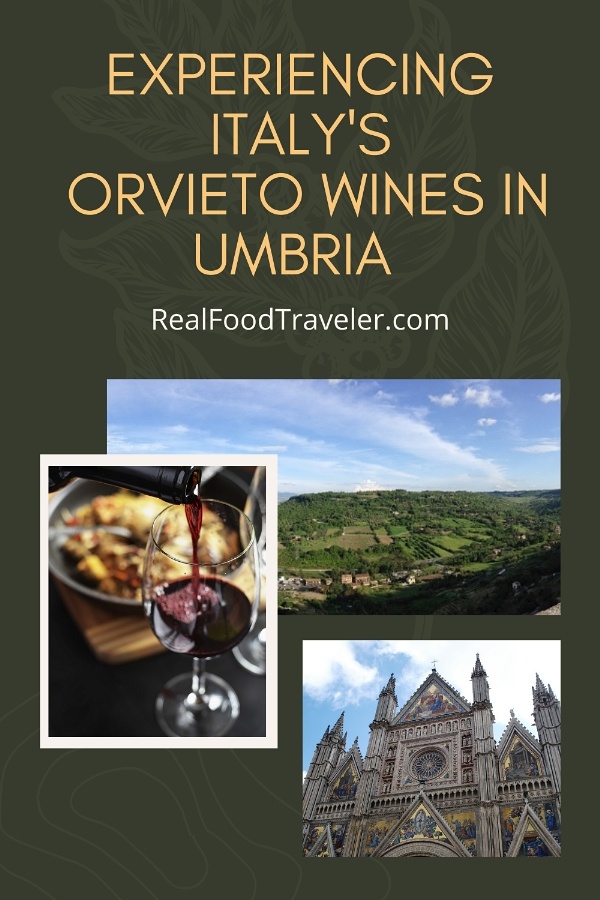
Save this article to Pinterest for the wine suggestions and planning your own trip to Orvieto in Umbria. Graphic by RealFoodTraveler.
What is this honey/Muscat-like wine I nose in my glass? Following on the palate is a good hint of flint. Why does this Orvieto little-resemble much of the bland stuff I’ve tried back home? I’ll find out the reason, but for now, I’m just happy sipping.
I’m on a whirlwind tour of Umbria as part of the International Wine Tourism Conference (#IWINETC) where I am one of the speakers. (My topic is Pacific Northwest Wine Tourism—but that is another story.) It’s a late January afternoon. The sun is already going to bed. I’m knackered, and wish I were, but this zippy wine perks me right up.
We are in Orvieto (the region’s white wine shares the name with the town). The breathtaking (yes it takes your breath away) Duomo commands the town square around which shops jammed with Majolica (pottery) line narrow cobble-stoned back streets. Beneath the town lies hidden caves and tunnels dug deep into the Umbrian rock–a labyrinth of Etruscan/Roman history.
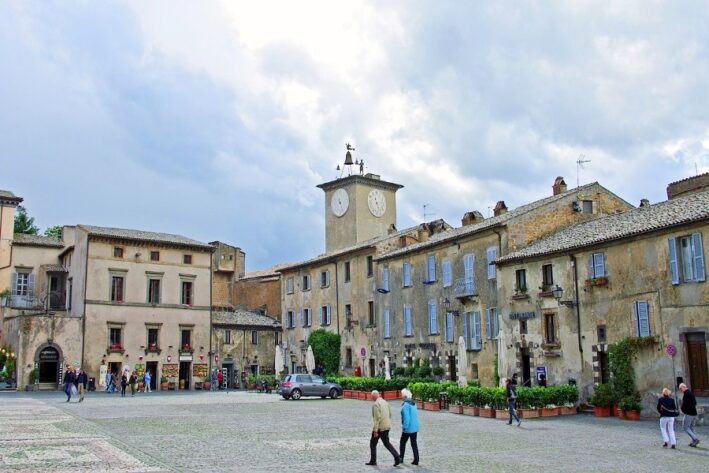
The Square in Orvieto in the Umbria region of Italy. Photo courtesy Pixabay.com.
Above ground, modern architecture captures ancient history town’s enoteca where, since wine is our credo, three local experts walk and talk us through three wines: Custido Orvieto, mentioned earlier, Calenco Sangiovese/Cabernet Sauvignon, whose fruit washes over the palate, and Cardito Muffata, a sauternes-like wine that’s sticky and lush with ripe apricot and almond flavours, yet not cloying in the least.
The wines are decidedly and delightfully different from far more renowned Vernaccia di San Gimginano, Chianti or Brunello di Montalcino from Tuscany, Umbria’s near northern neighbour.
As for white wine, there’s a lot more Orvieto to go round than there is Vernaccia di San Gimignano.
Umbria is also wedded to the Slow Food Movement (Citta Slow’s head office resides in Orvieto). While we learn about the wines, our hostess also waxes enthusiastically about charcuterie (superb pork “cold-cuts” Italian style), wild boar, cheeses, grains and fava beans, in particular, products for which the area is also noted.
La Pergola Trattoria, just off the town square, is a gem. It attracts mostly Italians – always a good sign. Homemade fat noodles become a vehicle for those fava beans which are pureed, sauced and dotted with guanciale (pig jowls). Wild boar too showed up earlier as pate and later in stew, and as sausage for a thinner noodle dish, paired with another Orvieto – Il Caio, which fares surprisingly well. Admittedly though, the sausage is better with Elicius, a blend of indigenous Montepulciano/Sagrantino grapes. Falesco (a Cabernet Sauv/Cab Franc blend) slowly evolves, perfect for two off-the-menu surprises which appear last minute; a rich casserole of the boar’s “fifth quarter” (aka the animal’s naughty bits) and a bright-tasting dish of tripe and tomato sauce.
A unique sweetie, Palazone, hints strongly at marmalade and nutmeg – the perfect top off to a fine first evening. Our lively group has firmly broken bread and silence. We’ve shared food, laughs and fun and wine as only the Italians can do it.
Exhausted I pass on the bar stop, and hobble back to the Hotel Piccolomini, heeding the call of smooth, silky sheets. The Umbrian town of Montelfalco lies ahead tomorrow and I look forward to it. But right now I can barely feel my head touch the pillow.
Hungry for more? Get the recipe for Noodles with Fava Bean Puree and Guanciale.
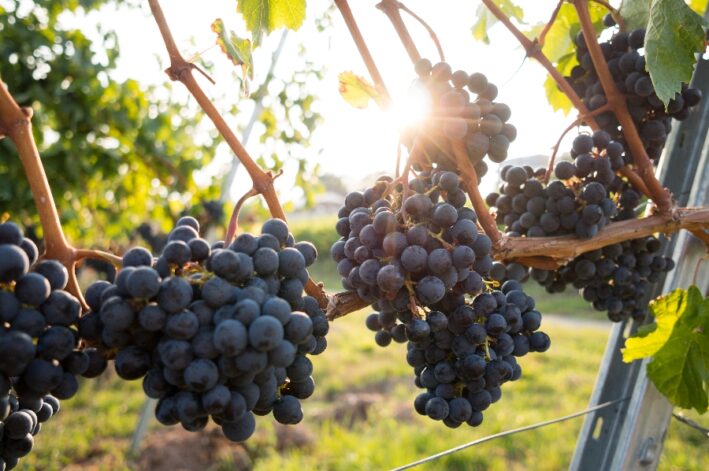
Photo courtesy Unsplash.com.
Experiencing Orvieto Wines in Umbria: The Green Heart of Italy
Barberani Wine Company, a family run winery, is our first stop on a chilly second day of our trip. The entire familia is on hand to greet us. We begin our visit with a round of firm handshakes, friendly nods and name exchanges. Jango, the winery pup, gives us each approving sniffs and a tail wag. We feel truly welcomed.
Bernardo Barberani tours us about the azienda. He tells us Umbria is known as “The Green Heart of Italy.” It is easy to see why. Even in late January, the sprawling hills are a soft grey-green. While Bernardo delights us with family history and wine philosophy, I continue to survey the scene about me and envision Summer’s Umbria—verdant vineyards that slope toward the Lago Di Corbara, leafy vines heavy with grapes that soften and turn color harvest approaches, and lush groves of ripe olives.
Barberani Wine Company is barely fifty years old (it says Viticoltori (winemakers) dal 1961), but the crumbly dirt that scuffs our boots is as old as the surrounding hills. Wine grapes have been planted this volcanic, chalky soil that dominates Orvieto Classico for centuries. The family practices sustainable farming and uses up-to-date winemaking techniques but still there is a great respect for tradition.
Bernardo Barberani is sales manager and brother Niccolo the winemaker. Originally nono Barberani grew native grape varieties (particularly white Trebbiano-Procanico) for wines to serve in his cafes in the town of Orvieto. Sangiovese can claim history in the region as well. Non-traditional grape varieties such as Cabernet Sauvignon, Merlot, Riesling and Chardonnay were introduced to the vineyards after the winery was built in 1961.
Back in the tasting room mamma and sorrella have readied local salumi and thick slices of crusty bread for us. Of course there is wine to try. (Our clocks strike eleven but we know it’s 5 o’clock somewhere). First up is Barberani Grechetto. Fresh and crisp the pure varietal delivers apple, pear and mineral notes. Prize winning Castagnolo Orvieto Classico Superiore (superiore is not an indication of quality but indicates a degree or so more alcohol than is typical for that wine) is a blend of traditional and new grape varieties. (Grecchetto, Procanico, Malvasia, Drupeggio, Verdello to which are added Riesling and Chardonnay). The blend works wonderfully. Both wines are uncomplicated, yet each balances the region’s zippy minerality with fresh fruit–delicious for our late-morning nosh, and I’ll wager, spot on for a meal of grilled seafood. We enjoy two reds too, Foresco 2009, a grippy young blend of Cabernet Sauvignon and Sangiovese, and a sturdy Barberani, Polvento Villa Monticelli 2006, that tastes of dried fruits and crushed herbs. (Roasted meats anyone?)
What clinches our visit, though, is a “muffa nobile” Orvieto Classico Superiore Calcaia Vini Dolce (2006). (Muffa nobile or “noble rot” is a kindly fungus that shrivels and concentrates the sugar in wine grapes). Originally Orvieto was only sweet. During the Middle Ages one of the popes (a Gregory I believe) decreed sweet wine a sin so the wine was made abboccato, that is, with some residual sugar. Orvieto abboccato remained popular until relatively recently. Though it is still made the trend is to ferment to complete dryness these days. But bless those Barberani miscreants for turning back the clock. Lush and lovely (and totally legal), with flavours of ripe apricot, almond and nougat, Calcaia demands nothing but a simple biscotti for accompaniment. Our troop gladly contributes to the family coffers as we lay down euros for a bottle or two of this elixir. We toss a lot of waving and arrivederci over our shoulder as we scramble back to the bus.
To learn more about visiting Orvieto in Italy, visit the tourism website.





0 Comments